- 1 The Short Answer: Total Startup Cost
- 2 Full Startup Cost Breakdown
- 3 Training & Certification Costs
- 4 Licensing & Exam Fees
- 5 Insurance: Your Biggest Required Cost
- 6 Equipment Costs Line by Line
- 7 Software, Website & Tech
- 8 Marketing & Branding Costs
- 9 One-Time vs. Recurring Costs
- 10 Hidden Costs New Inspectors Miss
- 11 How Fast You Recover Your Investment
- 12 Where to Save (and Never Cut)
- 13 Frequently Asked Questions
Quick Answer
It costs roughly $4,500 to $17,000 to start a home inspection business in 2026. A lean, budget-minded launch — online training, a basic equipment kit, required E&O and general liability insurance, an LLC, a DIY website, and inspection software — runs about $4,500–$7,500. A professional launch with premium gear, branded marketing, and in-person training runs $10,000–$17,000+. The two costs you should never cut are insurance and proper certification.
"How much does it cost to start a home inspection business?" is the first real question every aspiring inspector asks — and the honest answer is, less than almost any other business with this kind of income ceiling. There is no storefront to rent, no inventory to stock, and no payroll until you decide to hire. After 11+ years and 2,750+ inspections, the pattern I see is simple: inspectors who budget realistically and protect themselves from day one ramp faster than those who over-spend on gear they don't need yet.
This guide breaks every startup cost down line by line — what it actually costs, where the budget and professional tiers diverge, which expenses are one-time versus recurring, and where new inspectors quietly overspend. If you want the broader roadmap first, start with our complete guide to starting a home inspection business, then come back here for the numbers.
The Short Answer: Total Startup Cost
Across thousands of new inspectors, startup spend clusters into two realistic tiers. The "budget" path gets you legally operational and credible without waste. The "professional" path front-loads premium equipment and marketing that you could otherwise add later as cash flow allows. Neither is wrong — the right choice depends on your savings, your market, and how fast you want to look established.
| Startup Tier | Total Cost | Best For | Time to Launch |
|---|---|---|---|
| Lean / Budget | $4,500 – $7,500 | Career changers funding it themselves | 30 – 60 days |
| Standard | $7,500 – $11,000 | Most first-time inspectors | 45 – 75 days |
| Professional | $11,000 – $17,000+ | Inspectors entering competitive metro markets | 60 – 30 days |
Full Startup Cost Breakdown
Here is the complete picture in one table — every category a new home inspector needs to budget for, with budget and professional figures side by side. Each line is explained in detail in the sections that follow.
| Cost Category | Budget Option | Professional Option | Type |
|---|---|---|---|
| Training course | $500 – $800 | $1,200 – $2,500 | One-time |
| Association membership (InterNACHI / ASHI) | $300 – $500/yr | $500 – $800/yr | Recurring |
| State license & exam fees | $100 – $500 | $100 – $500 | One-time* |
| E&O insurance (annual) | $1,200 – $1,800 | $2,500 – $3,500 | Recurring |
| General liability insurance (annual) | $500 – $1,000 | $1,000 – $1,800 | Recurring |
| Inspection equipment kit | $1,500 – $2,500 | $3,000 – $5,000 | One-time |
| Business formation (LLC + EIN) | $50 – $200 | $200 – $800 | One-time |
| Website | $200 – $500/yr | $1,500 – $4,000 | Mixed |
| Inspection software | $79/mo (free trial) | $79 – $200/mo | Recurring |
| Marketing (first 3 months) | $500 – $1,000 | $1,500 – $3,000 | Recurring |
| Estimated total to launch | $4,500 – $7,500 | $11,000 – $17,000+ |
*License fees apply only in states that require licensing. See our guide to states with no inspection license requirement.
Training & Certification Costs
Before you spend a dollar on equipment, you need education and a recognized certification. This is what builds the credibility real estate agents look for before they refer you, and in many states it is a legal prerequisite to licensing.
InterNACHI vs. ASHI
The two dominant certification bodies are InterNACHI (International Association of Certified Home Inspectors) and ASHI (American Society of Home Inspectors). InterNACHI's training is self-paced, fully online, and bundled into membership — popular with new solo inspectors because you control the timeline. ASHI carries strong name recognition in some markets and with certain agents. Either is a defensible choice; pick the one your local established inspectors and agents recognize.
- Self-paced online training: $500 – $800. The most common path for budget-conscious starters.
- In-person / hybrid training programs: $1,200 – $2,500. More structured, often includes hands-on field components.
- Annual association membership: $300 – $800/year. Required to hold designations like InterNACHI's Certified Professional Inspector (CPI) and to access continuing education, agreement templates, and marketing resources.
Certification is the cost you should never short-change. Our full home inspector certification guide walks through each path, the exams involved, and how to choose between the bodies.
Licensing & Exam Fees
Licensing cost depends entirely on your state, and it ranges from $0 to roughly $500 in fees plus the cost of any required supervised inspections or exam attempts.
| License Category | Typical States | What It Involves | Cost Impact |
|---|---|---|---|
| No state license | CO, ID, KS, MI, MN, MO, OH, PA, UT (others) | Certification recommended; local rules may apply | Lowest — fastest launch |
| Exam + training | Most US states | 160–200 hrs training + NHIE or state exam | $100 – $500 in fees |
| Experience required | TX, FL, NY, NC (others) | Supervised inspections + exam | Higher — longer ramp |
The fees themselves are small relative to your other costs; the real "cost" of a licensed state is time. Application processing can add 4–12 weeks before you can legally inspect. If you live near a no-license state line, that timeline difference is worth understanding before you commit.
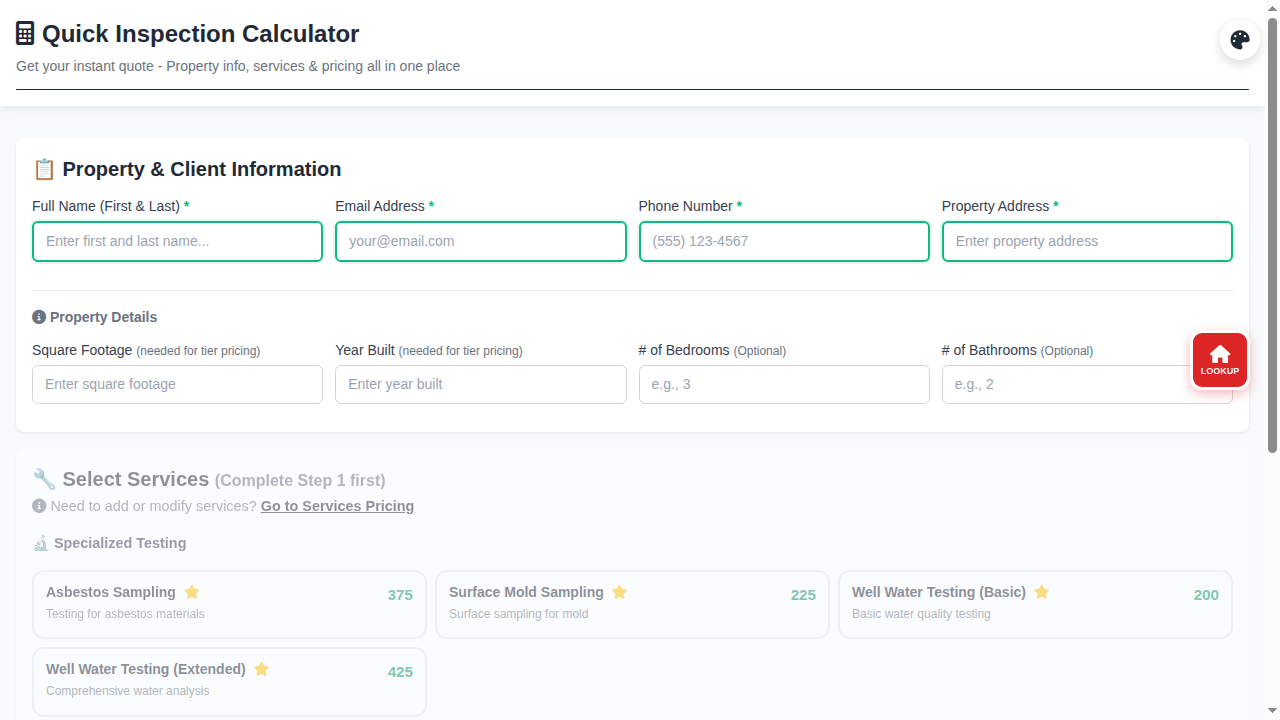
Instant Online Quotes & 24/7 Booking
The fastest way to recover your startup costs is to make booking effortless. Embed InspectorData's quote calculator on your new website and let agents and buyers get a price and book online — no phone tag. Included at $79/mo, with a 30-day free trial that covers your entire launch.
See the Quote CalculatorInsurance: Your Biggest Required Cost
Insurance is almost always the single largest required line item in your first year, and it is genuinely non-negotiable. Every paid inspection you perform without E&O (errors & omissions) coverage is a day you are personally liable for anything you miss. Many agents and brokerages will not refer or even allow an uninsured inspector on their transactions.
| Insurance Type | What It Covers | Annual Cost (New Inspector) |
|---|---|---|
| E&O (Errors & Omissions) | Claims that you missed or misreported a defect | $1,200 – $3,500 |
| General Liability | Property damage or injury during an inspection | $500 – $1,800 |
| Combined E&O + GL packages | Both, often bundled at a discount | $1,800 – $4,500 |
Cost drivers include your state (litigation-heavy markets cost more), your deductible, your coverage limits, and whether you offer higher-risk ancillary services. Common carriers for new inspectors include OREP, InspectorPro, and Verisk/ISO. Get quotes from at least three before you commit, and never let coverage lapse. Reducing claim exposure is also a skill — see our guide to reducing liability in your inspection business.
Equipment Costs Line by Line
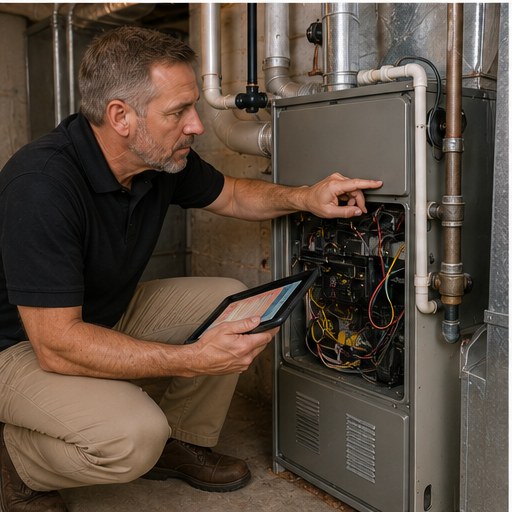
You do not need every gadget on day one. A focused kit covers the fundamentals; premium tools and add-on-service gear can come later once your schedule justifies them.
| Equipment | Budget | Professional | Required? |
|---|---|---|---|
| Electrical / outlet tester (GFCI) | $20 – $40 | $40 – $80 | Yes |
| Moisture meter | $60 – $120 | $200 – $400 | Yes |
| Ladder (telescoping + extension) | $150 – $300 | $300 – $600 | Yes |
| Flashlight / headlamp | $40 – $80 | $100 – $200 | Yes |
| Inspection mirror & probe | $15 – $40 | $40 – $100 | Yes |
| Combustible gas leak detector | $50 – $100 | $200 – $400 | Recommended |
| Carbon monoxide / combustion analyzer | $40 – $80 | $150 – $400 | Recommended |
| Thermal imaging camera | $0 (add later) | $400 – $2,500 | Optional (high ROI) |
| Smartphone / tablet for photos & reports | Existing device | $400 – $800 | Yes |
| Drone (for roofs) | $0 (add later) | $500 – $1,500 | Optional |
| PPE (gloves, respirator, knee pads, coveralls) | $60 – $150 | $150 – $300 | Yes |
| Total equipment | $1,500 – $2,500 | $3,000 – $5,000+ |
The thermal camera deserves special mention: it is optional to start, but it is one of the highest-ROI upgrades available because it unlocks a paid thermal imaging add-on service. Add-ons are where margins live — our guide to high-profit add-on services shows how a $500 camera can pay for itself inside 10–20 inspections.
Software, Website & Tech
Your tech stack is what makes a one-person operation look and run like an established company. The good news: it is also where modern all-in-one platforms have collapsed what used to be five separate subscriptions into one.
Inspection software
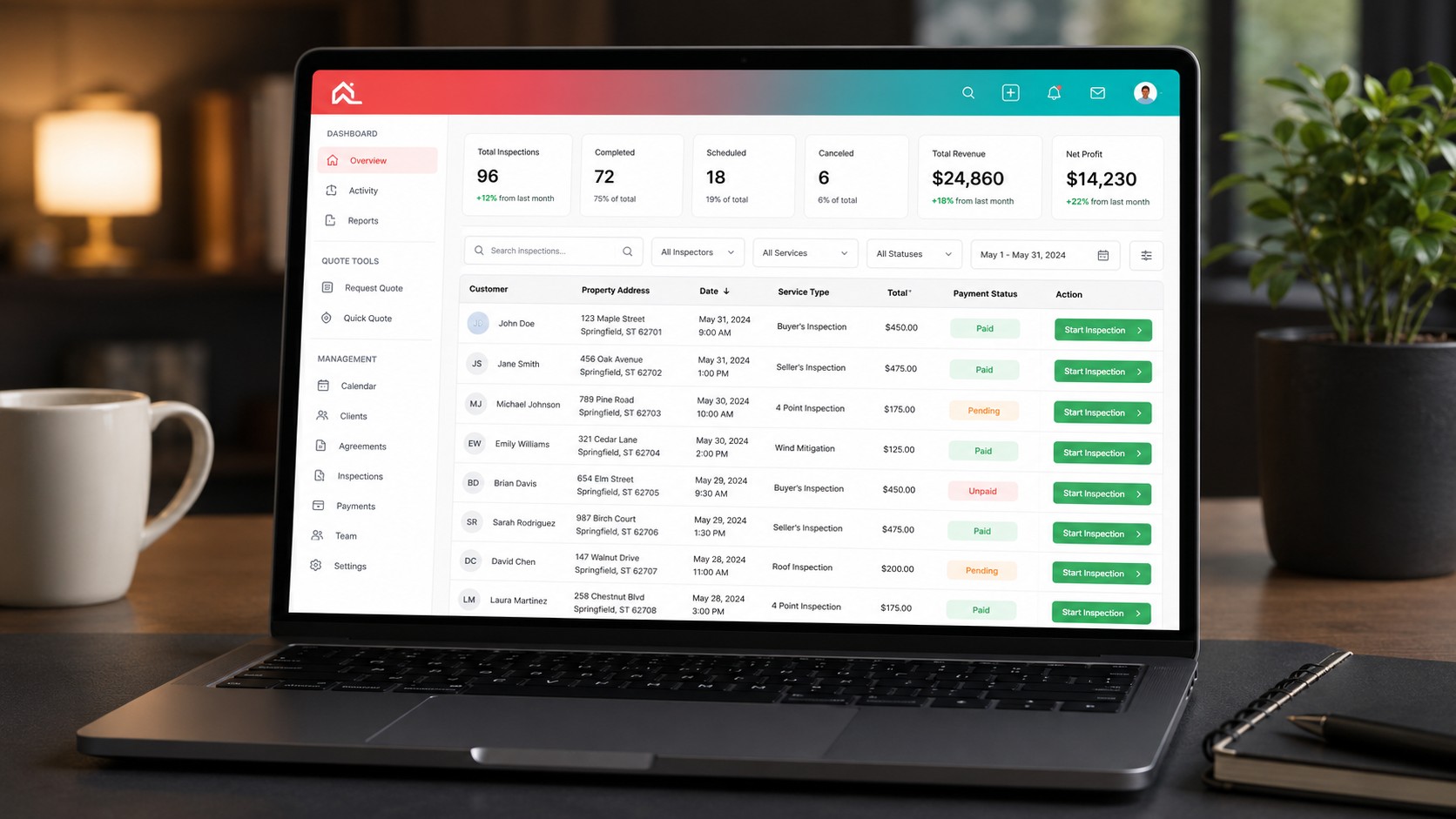
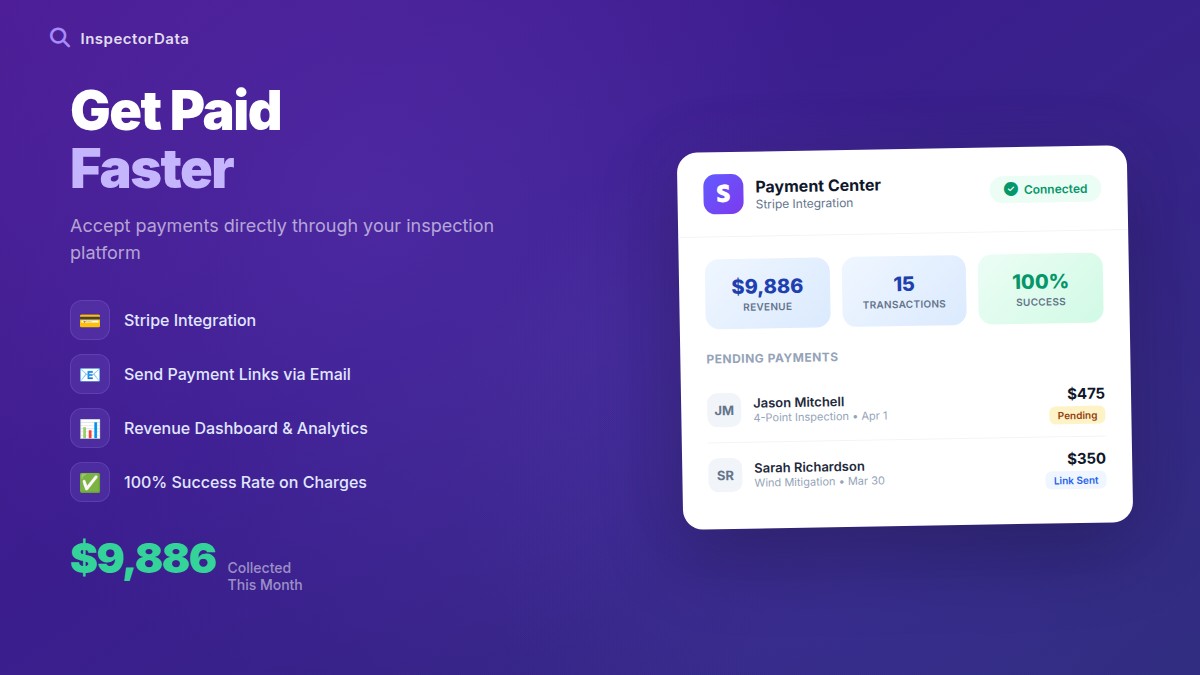
Inspection software typically runs $50–$200/month. The trap new inspectors fall into is stacking tools — separate apps for reports, scheduling, a CRM, agreements, and payments — and paying for each. An all-in-one platform avoids that. InspectorData is $79/month introductory and bundles AI-assisted reports, online scheduling, a client CRM, e-sign agreements, instant quoting, and integrated payments (3.35%) in one place. There is a 30-day free trial, which conveniently covers your entire launch window — you can be fully operational before you pay anything. Compare options in our best home inspection software guide.
Website
A DIY website on a template builder costs $200–$500/year; a professionally designed and copywritten site runs $1,500–$4,000 up front. Either way, the single most important feature is the ability for agents and buyers to get a price and book online. A site that forces people to call loses bookings to competitors who don't.
Marketing & Branding Costs
Marketing is where the budget and professional tiers diverge the most, but the highest-ROI channel for a new inspector is nearly free: agent relationships. A single agent who trusts you can send 20–40 inspections a year.
| Marketing Item | Budget | Professional |
|---|---|---|
| Google Business Profile | Free | Free |
| Logo & brand identity | $0 – $100 | $300 – $1,000 |
| Business cards & print collateral | $50 – $150 | $200 – $500 |
| Vehicle magnets / wrap | $30 – $100 | $1,000 – $3,000 |
| Initial paid ads (3 months) | $300 – $600 | $1,000 – $2,500 |
| Lead platform fees (Angi, etc.) | $100 – $300 | $300 – $800 |
Spend your first marketing dollars on the basics that compound: a complete Google Business Profile, professional cards, and time spent introducing yourself to buyer's agents. Our home inspector marketing guide and our deep dive on becoming the go-to inspector for realtors cover exactly how to turn that early effort into a steady referral stream.
One-Time vs. Recurring Costs
This is the distinction that separates a realistic budget from a surprise. Some startup costs are paid once; others repeat monthly or annually and must be covered by your inspection revenue.
| One-Time Costs | Recurring Costs |
|---|---|
| Training / certification course | E&O + general liability insurance (annual) |
| Inspection equipment kit | Association membership (annual) |
| LLC formation & EIN | Inspection software (monthly) |
| Initial license / exam fees | Website hosting / domain (annual) |
| Logo & initial branding | Continuing education credits (annual) |
| Business cards (first batch) | Ongoing marketing & ad spend |
A useful rule: assume roughly $300–$600/month in baseline recurring overhead once you are operational (insurance amortized monthly, software, membership, hosting). Your first dozen inspections cover that and your equipment; everything after is profit-building.
Hidden Costs New Inspectors Miss
The line items above are the obvious ones. These are the costs first-timers routinely forget to budget for — none are huge, but together they explain why a "$5,000 startup" sometimes feels like $7,000.
- Vehicle and fuel: You drive to every job. Mileage, maintenance, and fuel are real costs — track them; they're also tax-deductible.
- Continuing education: Most states and associations require CE credits annually to keep your license and certification current.
- Equipment replacement & calibration: Moisture meters drift, ladders wear, batteries die. Budget for replacements.
- Accounting & taxes: Bookkeeping software or an accountant, plus quarterly estimated self-employment taxes.
- Sample / practice inspections: Your first few inspections are often discounted or free to build experience and testimonials — a real opportunity cost.
- Software stacking: Paying separately for scheduling, a CRM, agreements, and payments adds up fast — one reason an all-in-one platform saves more than its sticker price.
How Fast You Recover Your Investment
Because overhead is low, a home inspection business reaches profitability faster than most. Here's a realistic payback view for a lean launch, assuming a modest local inspection fee.
| Milestone | Inspections to Reach It | Typical Timeframe |
|---|---|---|
| Cover your equipment kit | 5 – 8 | First few weeks |
| Recover full lean startup cost | 15 – 25 | Months 1 – 3 |
| Cover startup + 1 year insurance | 25 – 40 | Months 2 – 5 |
| Steady part-time-to-full-time income | Ongoing | Months 6 – 12 |
The single biggest variable is marketing consistency. For real numbers on what you can earn once you ramp, see our home inspector salary & income guide and the state-by-state breakdown in our income by state guide. For the month-by-month view of year one, our first-year inspector guide maps the whole ramp.
Where to Save (and Never Cut)
Smart frugality at startup means cutting what you can add later and protecting what you can't afford to skip.
Safe to start lean on
- Use your existing smartphone for photos instead of buying a tablet.
- Choose self-paced online training over in-person.
- Build a simple template website now; upgrade after your first 50 inspections.
- Add the thermal camera and drone once your schedule justifies the add-on revenue.
- Use a free trial to run your software through launch before paying.
Never cut these
- Insurance. E&O and general liability come before your first paid inspection, full stop.
- Certification. It's your credibility and, in many states, a legal requirement.
- A real moisture meter and electrical tester. Core tools you'll use on every job.
- Professional reporting. The report is your product — a clean, fast, photo-rich report is what earns referrals.
Run Your Whole New Business on One Platform
Start your home inspection business on InspectorData — AI-assisted reports, online scheduling, a client CRM, e-sign agreements, instant quoting, and integrated payments, all in one place. $79/month introductory with a 30-day free trial. The trial covers your entire launch window, so you can be fully operational before you pay a cent. Payments process at just 3.35%.
Start Your 30-Day Free TrialFrequently Asked Questions
How much does it cost to start a home inspection business?
A realistic startup budget in 2026 is $4,500 to $17,000, depending on how lean you start. A budget launch — online training, a basic equipment kit, required E&O and general liability insurance, an LLC, a DIY website, and inspection software — lands around $4,500–$7,500. A professional launch with premium tools, branded marketing, and in-person training runs $10,000–$17,000 or more. Remember that insurance and software are recurring, not one-time, costs.
What is the single biggest startup cost for a home inspector?
E&O insurance is usually the largest required first-year cost, typically $1,200–$3,500 annually for a new solo inspector, sometimes more in high-litigation states. It is non-negotiable: never perform a paid inspection without it. Inspection equipment is the second largest line item, ranging from roughly $1,500 for a budget kit to $5,000 for a professional setup with a thermal camera and premium moisture meter.
Can you start a home inspection business on a tight budget?
Yes. Many inspectors launch for under $7,500 by choosing self-paced online training, buying a budget equipment kit, using their existing smartphone for photos, building their own website, and starting their software on a free trial. The two costs you should never cut are insurance and proper certification — those protect you legally and build the credibility agents require before they refer you.
How long until a home inspection business is profitable?
Most new inspectors recover their startup costs within the first 15 to 40 inspections and reach a steady income within 6 to 12 months. Because overhead is low — no storefront, no inventory, no payroll when solo — a home inspection business reaches profitability faster than most service businesses. Consistent agent marketing is the single biggest factor in how quickly you ramp.
Do I need to buy a thermal imaging camera to start?
No, a thermal camera is not required to start, but it is one of the highest-ROI upgrades you can make. A quality thermal imager costs $400 to $2,500 and lets you offer thermal imaging as a paid add-on service, often recouping its cost within 10 to 20 inspections. Many inspectors start without one and add it once their schedule fills.
How much does home inspection software cost?
Inspection software typically runs $50 to $200 per month depending on features and team size. InspectorData is $79 per month introductory with a 30-day free trial, and it includes AI-assisted reports, scheduling, a client CRM, agreements, instant online quoting, and integrated payments at 3.35% — so a new inspector can launch and run on one platform without stacking separate tools.
Ready to Launch Your Inspection Business?
InspectorData gives you AI-powered reports, online scheduling, instant quoting, a client CRM, agreements, and integrated payments — everything you need to run a professional inspection business from day one. $79/month introductory with a 30-day free trial.
Start Your Free Trial