- 1 The Income Potential of Home Inspection
- 2 Average Salary by Experience Level
- 3 Salary by State & Region
- 4 Employee vs. Self-Employed Income
- 5 How Inspectors Increase Their Income
- 6 Revenue Math: Inspections to Income
- 7 The Role of Technology in Increasing Revenue
- 8 Highest-Earning Inspector Profiles
- 9 Frequently Asked Questions
Home inspectors earn between $50,000 and $150,000 or more per year, with the national average home inspector salary landing around $62,000 to $75,000 in 2026. But that average tells only part of the story. Self-employed inspectors who build efficient operations, offer add-on services, and leverage technology regularly clear six figures. This guide breaks down exactly what home inspectors make, what drives the differences, and how to position yourself at the top of the earning range.
Quick Answer
Home inspectors earn $50,000-$80,000/year on average. Top earners make $100,000-$200,000+ by doing 4-6 inspections per week, adding ancillary services (radon, sewer scope, mold), and building a strong referral network with real estate agents. (Whether you say home inspector or house inspector, it's the same profession — and the same pay.)
The Income Potential of Home Inspection
Home inspection is one of the most accessible paths to a strong middle-class income -- and for many, a path well beyond it. Unlike careers that require four-year degrees and six-figure student debt, most states allow you to become a licensed home inspector with a training program that takes weeks to months, not years. The barrier to entry is low, but the ceiling is surprisingly high.

The U.S. Bureau of Labor Statistics classifies home inspectors under construction and building inspectors, reporting a median annual salary of approximately $67,700 as of their most recent data. However, that number blends government building inspectors (who tend to earn less) with private home inspectors (who can earn significantly more, especially when self-employed). Independent home inspector income is driven by volume, pricing, and service mix -- all of which are within your control.
The real estate market continues to create strong demand. In 2025, approximately 5.5 million existing homes were sold in the United States, and each one represents a potential inspection. New construction inspections, pre-listing inspections, and investor due-diligence inspections add millions more opportunities. The home inspection industry generates an estimated $5 billion in annual revenue, and that number continues to climb as consumer awareness of the value of inspections grows.
Average Home Inspector Salary by Experience Level
Experience is the single biggest factor in home inspector income. As you gain field hours, certifications, and reputation, both your pricing power and your booking rate increase. Here is how compensation typically breaks down across career stages:
| Experience Level | Typical Years | Annual Income Range | Average |
|---|---|---|---|
| Entry-Level | 0 - 2 years | $35,000 - $55,000 | $45,000 |
| Mid-Level | 2 - 5 years | $55,000 - $85,000 | $68,000 |
| Senior / Established | 5 - 10 years | $75,000 - $120,000 | $92,000 |
| Master Inspector / Business Owner | 10+ years | $100,000 - $200,000+ | $130,000 |
Entry-level (0-2 years): New inspectors typically earn between $35,000 and $55,000 in their first two years. This period involves building your client base, developing relationships with real estate agents, and honing your inspection skills. Many new inspectors work for an established inspection company during this phase, earning a salary or per-inspection commission while they learn the trade. The home inspector salary at this stage reflects the learning curve, not the career ceiling.
Mid-level (2-5 years): Once you have a few hundred inspections under your belt and a growing referral network, income jumps significantly. Mid-level inspectors typically charge $50-100 more per inspection than entry-level inspectors and book more consistently. Most inspectors at this stage have transitioned to self-employment or are earning higher commissions at their company.
Senior / Established (5-10 years): Inspectors with 1,000+ inspections and strong reputations command premium pricing. They have full schedules, repeat referral sources, and typically offer multiple add-on services. At this stage, inspector pay is driven as much by business acumen as by technical skill.
Master Inspector / Business Owner (10+ years): Certified Master Inspectors and multi-inspector business owners represent the top tier. These professionals often charge $500-700+ per inspection, maintain waitlists, and may employ additional inspectors to handle overflow. Home inspector income at this level regularly exceeds $150,000, with some operators clearing $200,000 or more.
Home Inspector Salary by State & Region
Where you work has a major impact on how much you earn as a home inspector. States with higher costs of living, stronger real estate markets, and stricter licensing requirements tend to support higher inspection fees and higher incomes.
| State | Average Home Inspector Salary | Typical Fee Per Inspection |
|---|---|---|
| California | $82,000 - $110,000 | $450 - $700 |
| New York | $78,000 - $105,000 | $450 - $650 |
| Texas | $65,000 - $95,000 | Varies by state |
| Florida | $62,000 - $90,000 | $350 - $500 |
| Colorado | $70,000 - $100,000 | $400 - $600 |
| Washington | $75,000 - $105,000 | $425 - $650 |
| Illinois | $60,000 - $88,000 | $350 - $525 |
| Georgia | $58,000 - $85,000 | $325 - $500 |
| North Carolina | $55,000 - $82,000 | $325 - $475 |
| Ohio | $52,000 - $78,000 | $300 - $450 |
The pattern is clear: states with expensive real estate markets support higher inspector fees and higher incomes. California and New York lead because homes cost more, buyers are willing to pay more for inspections, and the cost of doing business (insurance, licensing, vehicle expenses) is higher. However, it is important to remember that higher gross income in California does not always translate to higher take-home pay when you factor in state taxes, fuel costs, and the price of living there.
Some of the best net income opportunities are in states like Texas, Colorado, and Florida, where inspection fees are strong but the cost of living and tax burden are lower. A home inspector earning $90,000 in Texas with no state income tax may keep more than one earning $105,000 in California.
Employee vs. Self-Employed Income Comparison
One of the most important decisions in a home inspection career is whether to work for someone else or build your own business. The income difference is substantial.
| Factor | Employee Inspector | Self-Employed Inspector |
|---|---|---|
| Typical Income | $40,000 - $70,000 | $60,000 - $150,000+ |
| Pay Structure | Salary or per-inspection commission (30-50%) | Keep 100% of inspection fees |
| Benefits | May include health insurance, paid time off | Must self-fund benefits |
| Overhead | Minimal -- company covers software, insurance, marketing | $8,000 - $18,000/year in operating costs |
| Schedule Control | Limited -- company assigns inspections | Full control over schedule and workload |
| Income Ceiling | Capped by commission structure | Unlimited -- scale with add-ons, employees, efficiency |
Most inspectors who earn above $80,000 are self-employed. The math is straightforward: if a company charges $450 for an inspection and pays you a 40% commission, you earn $180 per inspection. If you charge $450 on your own and your per-inspection operating cost is $40-60 (software, insurance, fuel, supplies), you keep $390-410. That is more than double the per-inspection earnings.
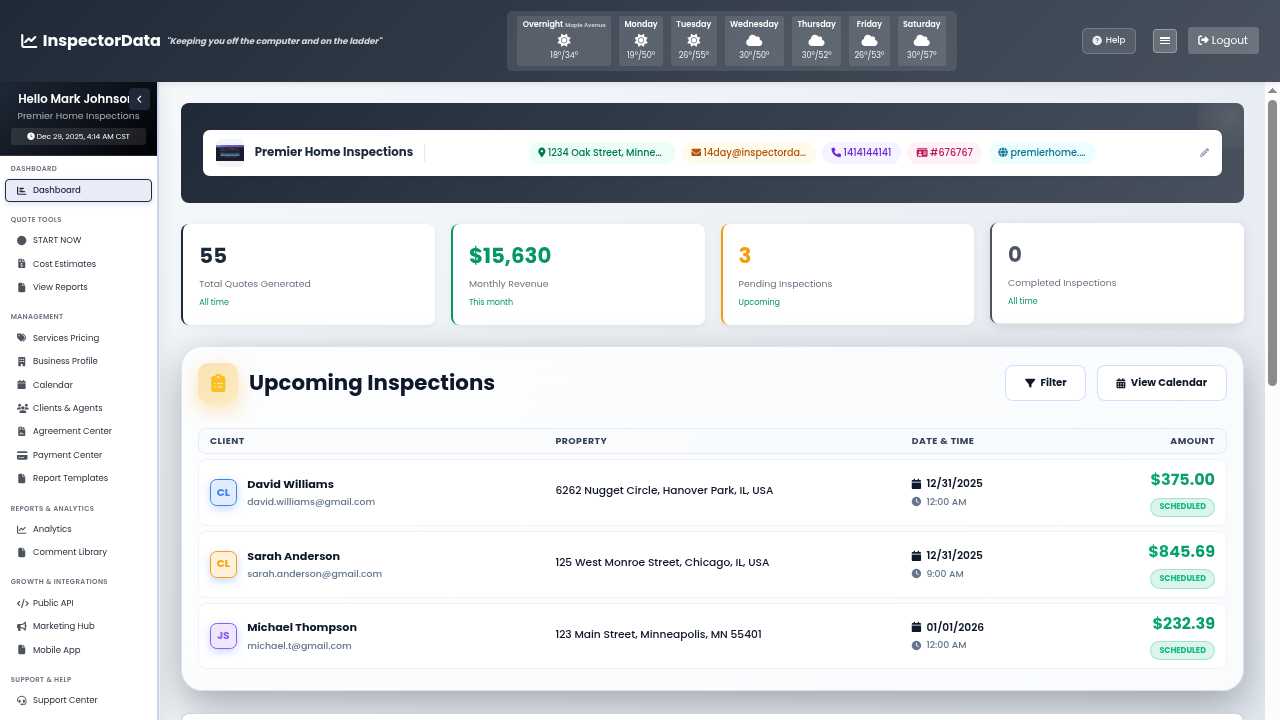
The tradeoff is that self-employment requires you to handle marketing, scheduling, accounting, customer service, and business development on top of performing inspections. However, modern inspection software has dramatically reduced the administrative burden, making solo operation more viable than ever.
Run Your Inspection Business from One Platform
InspectorData handles scheduling, quoting, reports, agreements, and payments -- so you can focus on inspections instead of paperwork. Self-employment made simple.
Start Your Free TrialHow Inspectors Increase Their Income
The gap between a $55,000 inspector and a $130,000 inspector usually comes down to a handful of strategic decisions, not harder physical work. Here are the most effective ways to grow your home inspector income:
1. Add-On Services
Add-on services are the single fastest way to increase your revenue per inspection. When a client is already paying $400-500 for a standard inspection, adding $125-350 in ancillary services is an easy upsell -- and often something the client's agent will recommend.
- Radon testing ($125-200) -- Minimal additional time on-site; equipment does the work over 48 hours
- Sewer scope inspection ($150-350) -- High perceived value; camera equipment pays for itself in weeks
- Termite / WDI inspection ($75-150) -- Often required by lenders, making it a near-automatic add-on
- Mold testing ($150-400) -- Lab costs are $30-50 per sample; the rest is profit
- Thermal imaging ($100-250) -- Differentiator that justifies higher overall pricing
- Wind mitigation / 4-point (Florida) ($75-150 each) -- Quick to perform with significant revenue per minute
An inspector who averages just $150 in add-on services per inspection across 300 inspections per year adds $45,000 in revenue. That alone can be the difference between an average salary and a six-figure income.
2. Raise Your Prices Strategically
Many inspectors undercharge because they fear losing bookings. But in a profession where the average inspection fee is $400-450, you only need to be the best inspector in your area -- not the cheapest. A $50 price increase across 300 inspections equals $15,000 more per year, and most inspectors report minimal booking loss when they raise rates gradually.
3. Build Agent Referral Relationships
Real estate agents are the primary referral source for home inspectors. An inspector with strong relationships with 15-20 active agents in their market will have a consistently full schedule. Focus on agents who value thorough inspections over fast ones -- these agents send higher-quality referrals and stick with you long-term.
4. Expand Your Service Area Strategically
Driving an extra 20 minutes to serve an adjacent market can open up significant new booking volume. The key is to route your schedule geographically so you are not driving an hour between inspections. Efficient scheduling can add 50-100+ inspections per year without additional marketing spend.
Revenue Math: How Many Inspections = What Income
Understanding the arithmetic of inspection business revenue helps you set realistic income targets. Here is how the numbers work at different volumes and price points:
| Inspections/Year | Avg Fee $375 | Avg Fee $450 | Avg Fee $550 |
|---|---|---|---|
| 200 (4/week) | $75,000 | $90,000 | $110,000 |
| 250 (5/week) | $93,750 | $112,500 | $137,500 |
| 300 (6/week) | $112,500 | $135,000 | $165,000 |
| 350 (7/week) | $131,250 | $157,500 | $192,500 |
| 400 (8/week) | $150,000 | $180,000 | $220,000 |
These are gross revenue figures. After subtracting operating costs (typically $12,000-20,000/year for a solo inspector covering software, insurance, vehicle, marketing, and supplies), your net income is 80-90% of gross revenue. That is an exceptionally healthy margin compared to most small businesses.
The sweet spot for most solo inspectors is 250-350 inspections per year. At five to seven inspections per week with an average fee of $450 plus add-on services, gross revenue of $130,000-$180,000 is realistic and sustainable without burnout.
The Role of Technology in Increasing Revenue
The biggest constraint on home inspector income is not demand -- it is time. There are only so many hours in a day, and the inspection itself is the fastest part of the job. For many inspectors, writing the report takes as long as performing the inspection. If you spend 3 hours on-site and 2-3 hours writing the report, you can realistically do one inspection per day. Cut report time in half and you can do two.
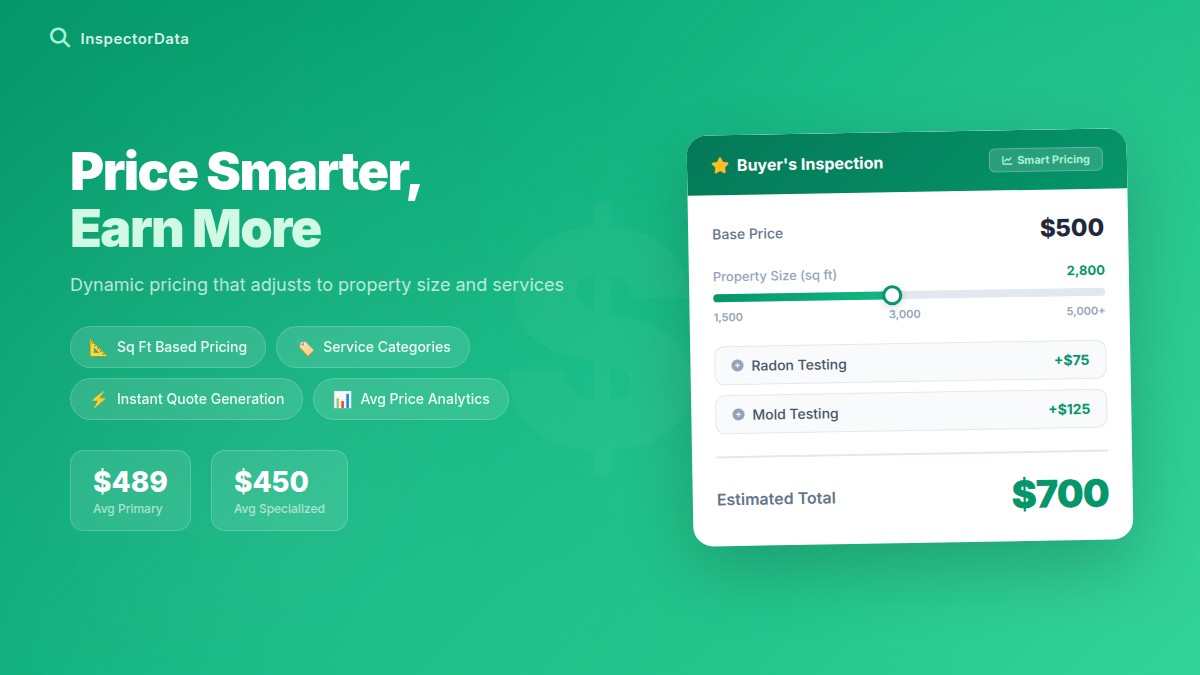
This is where modern AI-powered home inspection software creates a direct impact on home inspector salary. The math is simple: faster reports mean more inspections, and more inspections mean more revenue.
How Technology Accelerates Income
- AI-powered report writing -- Systems that auto-generate professional narratives from photo observations and checkbox selections can reduce report writing time from 2-3 hours to 30-45 minutes
- Comment libraries -- Pre-written, professional comments for thousands of common findings eliminate the need to write the same descriptions repeatedly. An 8,000+ comment library means you almost never write from scratch.
- Mobile-first on-site reporting -- Capturing data and photos on your phone during the inspection means the report is 70-80% complete before you leave the property
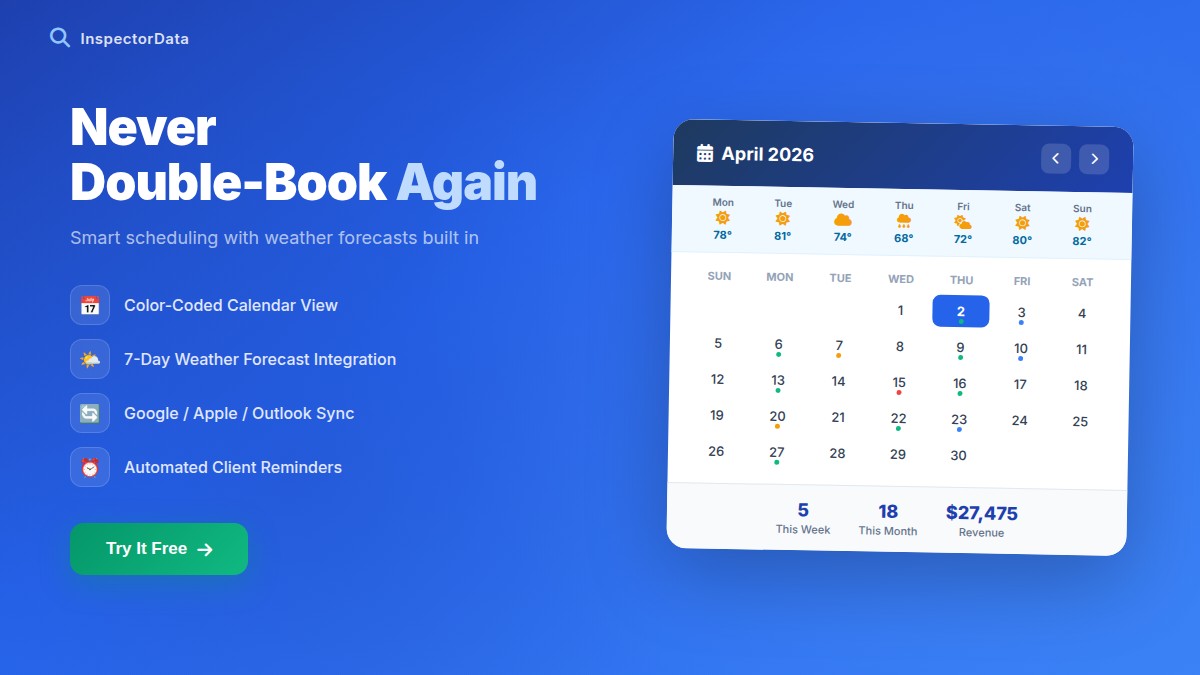
- Online scheduling and quoting -- Clients book and pay without phone calls, freeing up your evenings and weekends from administrative work
- Automated agreements and payments -- Digital pre-inspection agreements and integrated payment processing eliminate paperwork entirely
An inspector using modern software who completes reports in 45 minutes instead of 2.5 hours saves roughly 8-10 hours per week. That is two additional inspections at $450 each -- an extra $46,800 per year in revenue, simply by working more efficiently with the same number of hours.
Highest-Earning Inspector Profiles
What does a six-figure home inspection career actually look like in practice? Here are three composite profiles based on real-world patterns from successful inspectors across the country:
The Efficient Solo Operator -- $115,000/year
- Location: Suburban Atlanta, Georgia
- Experience: 6 years, InterNACHI CPI certified
- Volume: 280 inspections/year (5-6 per week)
- Average fee: $410 per inspection
- Add-on revenue: $125 average per inspection (radon, termite)
- Gross revenue: $149,800
- Operating costs: $16,000/year
- Net income: Approximately $115,000 (after self-employment taxes)
- Key strategy: Uses AI-powered reporting software to complete reports same day, maintains relationships with 18 referring agents, and bundles radon or termite testing on 75% of inspections
The Multi-Service Expert -- $155,000/year
- Location: Denver metro, Colorado
- Experience: 11 years, Certified Master Inspector
- Volume: 310 inspections/year (6 per week)
- Average fee: $500 per inspection
- Add-on revenue: $210 average per inspection (sewer scope, radon, mold, thermal imaging)
- Gross revenue: $220,100
- Operating costs: $22,000/year (higher due to sewer scope equipment maintenance)
- Net income: Approximately $155,000 (after self-employment taxes)
- Key strategy: Invested $8,000 in sewer scope equipment that pays for itself monthly, charges premium rates backed by CMI certification and thousands of five-star reviews, and offers thermal imaging on every inspection
The Team Builder -- $200,000+/year
- Location: Dallas-Fort Worth, Texas
- Experience: 14 years, CMI, business owner
- Volume: 700+ inspections/year across team of 3 inspectors
- Average fee: $475 per inspection
- Gross revenue: $380,000+
- Operating costs: $85,000/year (employee compensation, insurance, office, vehicles)
- Owner net income: $200,000+
- Key strategy: Hired and trained two additional inspectors, uses inspection management software to handle scheduling, dispatch, and report review across the team. Owner performs 250 inspections personally and manages the business.
Cut Report Time by 70% with AI-Powered Reports
InspectorData's AI report writer and 8,000+ comment library let you complete professional reports on-site. More inspections per week means more income per year.
See the Report WriterFrequently Asked Questions
How much do home inspectors make per hour?
Effective hourly rates vary widely. An inspector charging $450 for a 3-hour on-site inspection plus 1 hour of report writing earns approximately $112 per hour of work -- not counting drive time. When you factor in travel and administrative time, the effective rate drops to approximately $60-90 per hour for most inspectors. Self-employed inspectors who have optimized their report process earn the highest effective hourly rates because they spend less time per inspection on non-billable work.
How much do home inspectors make per inspection?
Inspection fees vary widely by state, property size, and services offered. We do not provide pricing for individual contractors — prices should be obtained from your local inspector. With add-on services, inspectors can significantly increase their per-inspection revenue. Net earnings vary based on whether you are self-employed or working on commission.
How much do house inspectors make?
House inspectors and home inspectors are the same profession, so the pay is identical: $50,000-$80,000 per year on average in 2026, with self-employed house inspectors earning $100,000-$150,000+ once established. "House inspector" is simply the more common phrasing in some regions -- licensing, training, and income potential are exactly the same.
Is home inspection a good career in 2026?
Yes. The combination of accessible training requirements, strong demand tied to real estate transactions, flexible scheduling, and the ability to earn $70,000-$150,000+ makes home inspection one of the most attractive trades-adjacent careers available. The profession is also largely recession-resistant -- even in slower real estate markets, homes still sell and still need inspections. Demand for home inspectors is projected to grow 5-7% through 2030, outpacing many other occupations.
What is the highest salary a home inspector can earn?
There is no fixed ceiling. Solo inspectors regularly earn $120,000-$180,000. Multi-inspector business owners can earn $200,000-$400,000+ depending on team size and market. The home inspector salary ceiling is limited only by how effectively you scale your operation through add-on services, efficient systems, and (optionally) hiring additional inspectors.
How long does it take to start earning a full-time income as a home inspector?
Most new inspectors reach a full-time income (3-4 inspections per week) within 6-12 months of starting. The ramp-up period depends heavily on marketing effort, agent networking, and the strength of your local real estate market. Inspectors who start part-time while building their client base often transition to full-time within the first year.
Do home inspectors need a license?
Licensing requirements vary by state. As of 2026, most states require some form of licensing or certification, which typically involves completing an approved training program (40-200 hours depending on the state), passing a state or national exam, and maintaining continuing education credits. Some states, such as Colorado, have no state licensing requirement but professional certifications (like InterNACHI CPI) are still strongly recommended for credibility and referrals. See the full breakdown in our home inspector license requirements by state guide, or if you're starting out, how to become a home inspector.
Ready to Maximize Your Inspection Income?
InspectorData gives you AI-powered reports, 8,000+ comments, online scheduling, instant quoting, and everything else you need to earn more per inspection and do more inspections per week. $79/month with a 30-day free trial.
Start Your Free Trial