Most new home inspectors quit within 18 months. Not because they were bad at inspections — but because they didn't understand the business. Year one is harder than anyone tells you, but it's also more financially promising than most careers you could start with the same time investment. This guide gives you the honest picture: what income looks like month by month, where clients actually come from, and the specific mistakes that end new inspection careers before they begin.
What Your First 90 Days Actually Look Like
Be honest with yourself: the first 30 days are about building infrastructure and getting your first handful of clients. Most new inspectors do 0-5 inspections per month in this period. That's normal. It's not failure — it's foundation.
What to focus on:
- Get your E&O and general liability insurance in place immediately. No insurance = no inspections. Most policies cost $1,500-$3,000/year total.
- Set up your Google Business Profile on day one. Start collecting reviews from friends and early clients.
- Contact every real estate agent you know personally — even distantly. Tell them you've started and ask for their first referral.
- Join InterNACHI. The directory, training resources, and credibility signal are worth the membership fee many times over.
- Get your field inspection app sorted. Nothing kills referrals faster than slow, unprofessional reports.
Expected income in first 30 days: $0 to $4,000. This is a real number. Don't panic if it's slow — the inspectors who quit in this window almost always do so prematurely. The pipeline is building even when the phone isn't ringing.
Months 3-6: Building Momentum
This is where most new inspectors find their rhythm — or quit. The key difference between those who make it and those who don't is one thing: consistency of activity, not number of inspections.
Inspectors who consistently visit agent offices, follow up with past clients, and deliver professional reports every time build momentum that accelerates in the back half of year one. Those who wait for the phone to ring don't.
What 5-15 inspections per month looks like financially:
- 5 inspections × $400 avg = $2,000/month
- 10 inspections × $425 avg = $4,250/month
- 15 inspections × $425 avg = $6,375/month
The jump from 5 to 15 inspections/month is entirely about referral relationships, not skill. Two or three loyal agents sending you regular business makes all the difference.
12-Month Income Projection for a New Inspector
| Month Range | Expected Inspections/Mo | Avg Monthly Revenue | Cumulative Revenue |
|---|---|---|---|
| Months 1-2 | 1-4 | $400 - $1,600 | $800 - $3,200 |
| Months 3-4 | 4-8 | $1,600 - $3,400 | $4,000 - $10,000 |
| Months 5-6 | 8-14 | $3,400 - $5,950 | $11,000 - $22,000 |
| Months 7-9 | 12-20 | $5,100 - $8,500 | $26,000 - $47,500 |
| Months 10-12 | 15-25 | $6,375 - $10,625 | $45,000 - $79,000 |
Year one total revenue for a new inspector who works the business consistently: $35,000 to $75,000. Year two, with the referral network in place, typically ranges from $60,000 to $100,000+. Read our full home inspector salary guide for detailed income breakdowns by experience level, and our home inspector income by state data to see how earnings shift depending on where you work. Not licensed yet? Start with how to become a home inspector, and see why the field is growing in our home inspector jobs & demand outlook.
The #1 Thing That Determines Your Success: Agent Relationships
This cannot be overstated. The inspectors who build strong agent relationships in year one have full calendars in year two. Those who don't are still scratching for business in year three.
How to build agent relationships that last:
- Show up in person. Visit offices. Agents are busy — they need to see your face, not just your email. Coffee for the office goes a long way.
- Ask what they wish their inspector did better. Then do that thing. Most agents have specific pain points (slow reports, unavailability, overcommunication of minor issues).
- Deliver reports faster than anyone else. Same-day or next-day reports are the single biggest differentiator for agent referrals. Learn how to write reports 3x faster.
- Never kill a deal unnecessarily. Identify real issues clearly. Don't amplify minor issues. Agents trust inspectors who are honest without being alarmist.
- Follow up every 30 days. A brief email with a useful tip or market stat keeps you top of mind without being annoying.
Pricing in Year One
The biggest year-one pricing mistake is undercharging. New inspectors drop prices to "win" business — but lower prices attract the worst clients, damage your perceived value, and make it almost impossible to raise prices later.
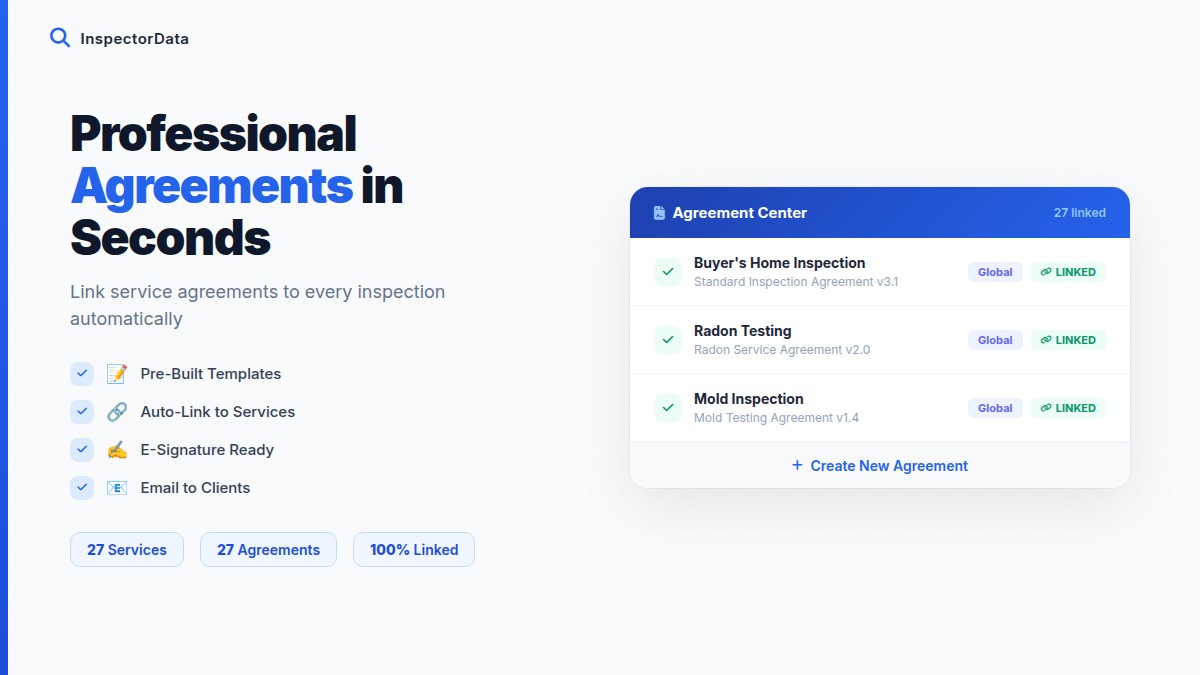
Start at market rate. Research what established inspectors in your area charge and price at 90-100% of that rate. You're not offering a discount service — you're offering professional inspections. If you're certified and professional, charge like it.
Inspection fees vary widely by state, property size, and scope of services. We do not provide pricing for individual contractors — contact your local inspector for current rates in your area.
Equipment You Actually Need in Year One
| Item | Cost Range | Priority |
|---|---|---|
| Inspection flashlight (2,000+ lumens) | $50 - $150 | Essential |
| Electrical outlet tester / GFCI tester | $15 - $50 | Essential |
| Moisture meter | $60 - $200 | Essential |
| Telescoping ladder | $150 - $400 | Essential |
| Carbon monoxide / gas detector | $50 - $150 | Essential |
| Thermal/infrared camera | $500 - $2,500 | High ROI — add to quotes as premium add-on |
| Report software subscription | $50 - $100/month | Essential — non-negotiable |
Total year-one startup cost: $1,500 to $5,000. Less if you're in a no-license state and skip exam prep. More if you invest in a thermal camera immediately (recommended — it pays for itself quickly).
Add-On Services: Your Income Multiplier
Don't wait until year three to add services. Radon testing can be added in month two with minimal investment. Here's what add-ons do to your income:
- Radon testing: Add $125-$200 per inspection. At 3 tests/week, that's $19,500-$31,200 in additional annual revenue. Certification is inexpensive and often available online.
- Mold/air quality testing: Add $150-$350 per test. Clients in humid climates buy this readily.
- Sewer scope: Equipment costs $2,000-$5,000 but pays off within a few months of consistent upselling.
See the complete income math in our add-on services guide.
Common First-Year Mistakes That End Careers
- Underpricing: Attracts bad clients, impossible to raise later.
- Slow reports: Kills referrals faster than anything else. Same-day delivery should be your standard by month 3.
- Not asking for Google reviews: After every inspection, send a review request. 50 Google reviews changes your business completely.
- No E&O insurance: One claim without coverage ends your business and potentially your finances.
- Perfectionism that slows reports: Done is better than perfect. A 95%-complete report delivered the same day beats a 100%-perfect report delivered two days later.
- Waiting for referrals instead of asking: Nobody sends you business without being asked. Ask every satisfied client and agent for a referral.
What Year Two Looks Like
Year two is where the work from year one pays off. Inspectors with a solid first year typically see:
- 15-25 inspections per month with less marketing effort
- $6,000 to $12,000 monthly revenue
- Established agent relationships sending consistent work
- The ability to raise prices 10-15% without losing volume
- Add-on services adding $1,500-$3,000/month in incremental revenue
Year two is also typically when inspectors start thinking about hiring — because they're turning away work. That's the best problem to have. For the complete growth roadmap, see our guide on how to grow your home inspection business.
FAQ: First Year as a Home Inspector
How long until I get my first client?
Most new inspectors book their first inspection within 2-4 weeks of getting certified. It often comes from a personal connection or a real estate agent contact. Don't wait for it to come to you — reach out to every agent you know.
Should I work for an inspection company before going solo?
Working for an established company for 6-12 months gives you field experience without the pressure of building a client base. Many successful solo inspectors started this way. The tradeoff is lower income per inspection — but you're learning on someone else's dime.
How much does E&O insurance cost for a new inspector?
E&O (errors and omissions) insurance typically costs $1,200-$2,000/year for new inspectors. General liability adds another $300-$600. Budget $1,500-$2,500 total for insurance in year one.
How many inspections can I do per day?
Most inspectors can complete 2-3 inspections per day comfortably. Some efficient inspectors with good report systems can do 3-4. Going beyond that typically sacrifices quality or personal sanity.
Can I really make $100K in year one?
Possible but uncommon. Year one income of $35,000-$70,000 is more realistic. $100K+ typically comes in year two or three once referral networks are established. Inspectors in high-demand markets with no license requirement and strong real estate activity can hit six figures faster.
Start Your Inspection Career With the Right Tools
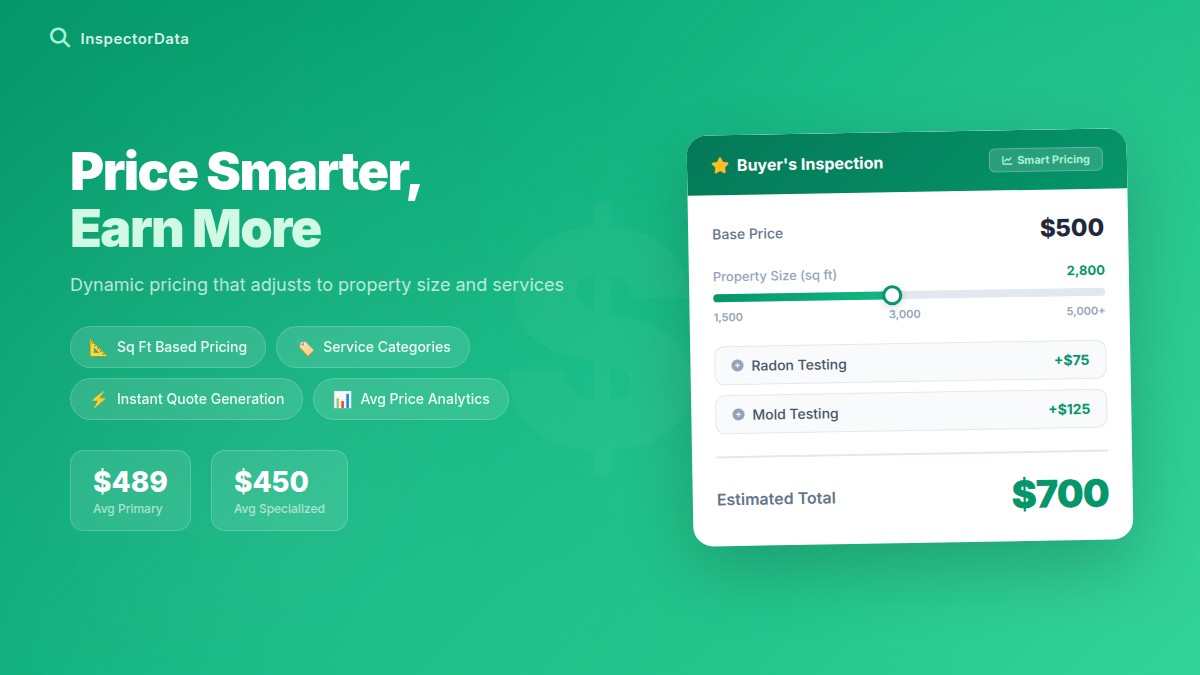
InspectorData was built for exactly this moment — your very first inspection. Professional AI-powered reports, instant online quotes, automated booking, and payment collection. Everything a new inspector needs to look established from day one. Try it free for 30 days.
Try InspectorData Free for 30 Days