

Disclaimer: This article is for educational purposes only and does not constitute legal advice. Consult a qualified attorney for guidance specific to your business and jurisdiction.
One lawsuit can destroy years of work and significant personal wealth. Inspection liability is real — and largely preventable with the right systems. This guide covers what experienced inspectors do to minimize their risk exposure without compromising the quality and thoroughness that defines their reputation.
The Inspection Liability Landscape
Home inspection claims most often arise from:
| Claim Type | Frequency | Avg Claim Amount | Prevention Focus |
|---|---|---|---|
| Missed structural defects | High | $15,000–100,000+ | Inspection thoroughness + report clarity |
| Missed moisture/mold issues | High | $10,000–80,000 | Thermal imaging + specific reporting |
| Missed electrical defects | Medium | $5,000–50,000 | Documentation + limitation disclosure |
| Roof defects | Medium | $5,000–30,000 | Roof walk when safe; drone when not |
| HVAC/plumbing issues | Medium | $3,000–20,000 | Testing all accessible components |
The common thread: most claims involve something the inspector either missed or failed to communicate clearly enough for the client to act on. Your liability risk is primarily a function of inspection quality, documentation, and communication — not bad luck.
Insurance: Your First Line of Defense
Errors & Omissions (E&O) Insurance
E&O insurance is the most critical protection for home inspectors. It covers you when a client claims you made an error in your inspection or report that caused them financial harm. Without E&O, a single serious claim could exceed your personal net worth.
| Coverage Level | Annual Premium | Per-Claim Limit | Appropriate For |
|---|---|---|---|
| Basic | $1,200–2,000 | $100,000 | New inspectors, low volume |
| Standard | $2,000–3,500 | $250,000–500,000 | Established solo inspectors |
| Premium | $3,500–6,000 | $1,000,000 | Multi-inspector, commercial work |
| Commercial specialty | $5,000+ | $2,000,000+ | High-value property specialists |
Key E&O considerations: Claims-made vs. occurrence policies (claims-made is standard; verify your coverage doesn't have gaps between policies), prior acts coverage (ensures old inspections are covered when you switch providers), and whether ancillary services like radon, mold, or sewer are included or require additional riders.
General Liability Insurance
E&O covers professional errors. General liability (GL) covers bodily injury and property damage. If you damage something at the property during an inspection, or a client trips on your equipment, GL is your protection. A minimum of $1M per occurrence is standard for inspectors.
Additional Coverage to Consider
- Commercial auto: Your personal auto policy likely excludes business use. Inspect for one day without commercial coverage and you could have a gap.
- Tools and equipment: Covers your thermal cameras, moisture meters, and inspection equipment against theft or damage
- Workers' compensation: Required in most states once you have employees; protects against employee injury claims
- Umbrella policy: Additional liability coverage above your primary policies for catastrophic claims
Pre-Inspection Agreement Essentials
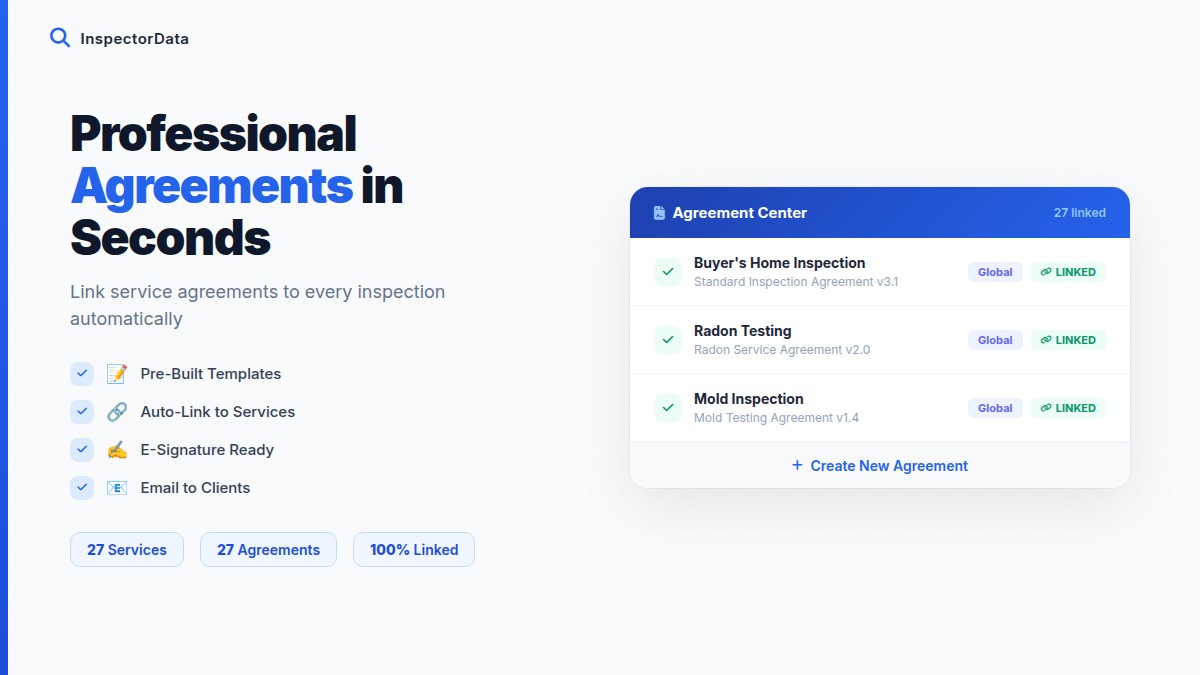
Your pre-inspection agreement (pre-inspection contract) is a critical liability management tool — often more important than insurance because it defines the scope and sets expectations before the inspection happens.
Must-Have Contract Provisions
- Scope of inspection: Explicitly state what is and isn't included. Reference your SOP (ASHI or InterNACHI). Name specific exclusions: underground utilities, inside walls, active pest infestation assessment, etc.
- Limitation of liability: Cap your financial liability to the inspection fee or a multiplier. Many states allow this; some don't — check with an attorney.
- Dispute resolution clause: Require arbitration or mediation before litigation. This dramatically reduces legal costs even when claims arise.
- Inspection standards reference: State which SOP you follow. Provides a professional standard to defend against.
- Third-party clause: Clarify that only the contracting client (not their agent, lender, or future buyer) is a party to the agreement.
- Signature requirement: Get signed agreement BEFORE you begin the inspection — not after. An unsigned agreement provides little protection.
Getting Your Contract Reviewed
Your inspection association (ASHI, InterNACHI) provides sample agreements. Have a local attorney review and customize one for your state's specific laws. The $500–1,500 one-time cost is one of the best risk-management investments you can make.
Report Language That Protects You
Vague or inconsistent report language is a major liability source. Clear, specific, appropriately hedged language protects you without undermining your credibility.
Defect Severity Language
Use consistent, defined terminology for severity ratings. Clients and agents understand what categories mean when you define them in the report:
- Safety Hazard: Conditions that pose immediate risk of injury or death. Recommend immediate action.
- Repair Now: Conditions requiring prompt attention by a qualified professional before or shortly after closing.
- Repair/Monitor: Conditions that should be repaired or monitored; not necessarily urgent.
- Maintenance: Normal homeowner maintenance items; recommend regular attention.
Limitation Language
Always state what you could and couldn't inspect: "The attic was not accessible due to a finished ceiling; visible areas of the attic were inspected from the access point." Never speculate about what you couldn't see. Acknowledge limitations explicitly.
Recommendation Language
Always recommend professional evaluation for anything beyond visual observation: "Recommend evaluation by a licensed electrician," not "The wiring is defective and unsafe." You're a generalist — recommend specialists for repair assessment.
Managing Scope of Inspection
Scope creep is a liability magnifier. The more you promise, the more you must deliver — and the more exposure you have when something is missed.
Clearly Define What You Don't Inspect
Every client should understand before booking what is not included in a standard inspection. Common exclusions:
- Underground utilities (sewer, septic, well, oil tanks)
- Hidden areas (inside walls, under insulation, below finished floors)
- Operational testing of systems requiring specialist setup (gas-fired appliances when gas is off)
- Pest/termite inspection (typically separate)
- Code compliance determination
- Environmental testing (asbestos, lead, radon) unless specifically contracted
Client Communication as Risk Management
Most inspection disputes begin with a communication failure, not an inspection failure. When clients feel informed and heard throughout the process, they're dramatically less likely to pursue legal remedies when issues arise post-closing.
The Pre-Inspection Communication
Before the inspection, confirm: what the inspection covers, what to expect during and after, how to prepare the property (accessible areas, utilities on, etc.), and how they'll receive the report. Clients who know what to expect are clients who don't feel blindsided.
The Post-Inspection Walk-Through
Walk through your major findings verbally with both the client and the agent before leaving. "I want to walk you through the three items I'd prioritize..." This conversation ensures your most important findings are heard and understood — and creates a record that you communicated them.
The Report Delivery Follow-Up Call
Call clients the day after sending the report to answer questions. This 5-minute call catches misunderstandings before they become claims. Clients who spoke with you are less likely to call an attorney over a dispute — they're more likely to call you first.
Business Structure and Asset Protection
How your business is legally structured affects your personal asset exposure if a claim exceeds your insurance coverage.
| Structure | Personal Asset Protection | Tax Treatment | Complexity |
|---|---|---|---|
| Sole proprietorship | None — full personal liability | Schedule C (simple) | Very low |
| LLC | Good — shields personal assets if maintained properly | Pass-through or S-Corp election | Low-medium |
| S-Corporation | Good | Salary + distributions (tax efficiency) | Medium |
| C-Corporation | Very good | Double taxation (rarely used for inspectors) | High |
Most inspection businesses benefit from an LLC or S-Corp structure. The LLC limits personal liability for business obligations, and the S-Corp election (made at the tax level) can save significant money in self-employment taxes once you're earning $100,000+. Consult a CPA and attorney to choose and maintain the right structure.
Critical: An LLC only protects you if you maintain the corporate veil — separate business accounts, no commingling of personal and business funds, proper record-keeping. A pierced corporate veil in a lawsuit eliminates the protection.
Liability management isn't about being defensive or doing less thorough inspections — it's about documentation, communication, and structure that ensure your excellent work is properly communicated and protected. The inspectors who get sued are rarely the worst inspectors. They're often the ones with poor contracts, vague reports, and inadequate follow-through communication.
Run a Professional, Protected Business
InspectorData helps you maintain professional documentation, deliver clear reports, and build the operational systems that reduce your risk exposure at every inspection.
Try InspectorData Free for 30 Days