- 1 Why Home Inspection Is One of the Best Businesses to Start
- 2 Licensing Requirements by State
- 3 Complete Startup Cost Breakdown
- 4 Legal Structure and Insurance
- 5 Setting Your Prices From Day One
- 6 Getting Your First Clients
- 7 First-Year Income Projections
- 8 The 30-Day Launch Checklist
- 9 Frequently Asked Questions
Home inspection is one of the best businesses to start in 2026: low startup costs, high demand, no products to sell, and income potential that reaches $100,000+ in year two for well-organized operators (see the full home inspector salary guide for the numbers). If you're considering a career change or starting your first business, this guide covers everything you need to go from zero to fully operational in 30–60 days.
Why Home Inspection Is One of the Best Businesses to Start
Most businesses ask you to gamble: lease a space, hire a team, or stock inventory before you've earned a dollar. Home inspection asks for almost none of that. Your "store" is your vehicle, your "inventory" is your expertise, and your only employee on day one is you. That structural advantage — high income ceiling, low fixed overhead — is why it consistently ranks among the best businesses a motivated person can start with limited capital. The table below puts it side by side with a typical service business.
| Business Factor | Home Inspection | Typical Service Business |
|---|---|---|
| Startup cost | $3,000 – $8,000 | $10,000 – $100,000+ |
| Income potential (Year 2) | $80,000 – $130,000 | Varies widely |
| Products to inventory | None | Often required |
| Employees needed to start | None (solo) | Often 1–3+ |
| Overhead costs | Very Low (vehicle + equipment) | Often High (rent, inventory) |
| Licensing barrier | Low-Medium (varies by state) | Varies |
| Market demand | Consistent (tied to housing) | Varies widely |
| Repeat client potential | Medium (referrals, not repeats) | Varies |
The other reason inspection beats most startups is demand stability. People buy and sell homes in every economic climate, and the vast majority of those transactions involve an inspection. That tie to an evergreen activity makes the business largely recession-resistant — even in slower markets, homes still change hands and still need inspecting. For the full earning picture across experience levels and states, see our home inspector salary & income guide.
Licensing Requirements by State
Before investing in equipment or training, check your state's licensing requirements. They vary significantly — from no state license at all (where you can be operational in weeks) to substantial supervised-experience requirements that add months to your timeline. This single factor often determines how fast you can launch, so confirm your state's category before you spend on anything else:
| License Category | States | Typical Requirements |
|---|---|---|
| No state license required | CA, CO, HI, ID, IA, KS, MI, MN, MO, ND, OH, PA, SD, UT, VT, WY | None (local may vary) — start in 2–4 weeks |
| Exam + training required | Most US states | 160–200 hours training + NHIE or state exam |
| Substantial experience required | TX, FL, NY, NC (others) | 100–250 hours supervised inspections + exam |
See the complete guide to states with no inspection license requirement for full details on the no-license states and what you still need to get started.
Complete Startup Cost Breakdown
| Item | Budget Option | Professional Option | Notes |
|---|---|---|---|
| Training course | $500 – $800 | $1,200 – $2,500 | Online vs. in-person |
| Association membership (InterNACHI/ASHI) | $300 – $500/year | $500 – $800/year | Required for CPI/ACI certs |
| State license/exam fees | $100 – $500 | $100 – $500 | Varies by state |
| E&O Insurance (annual) | $1,200 | $2,000 – $3,500 | Non-negotiable — get this first |
| General Liability Insurance (annual) | $600 – $1,000 | $1,000 – $1,800 | Required for most bookings |
| Inspection equipment kit | $1,500 – $2,500 | $3,000 – $5,000 | See equipment list below |
| Business formation (LLC) | $50 – $200 | $50 – $500 (attorney) | Form as LLC from day one |
| Website | $200 – $500/year | $1,000 – $3,000 | DIY vs. professional |
| Inspection software | $50 – $100/month | $100 – $200/month | InspectorData 30-day free trial |
| Marketing (first 3 months) | $500 – $1,000 | $1,500 – $3,000 | Business cards, GBP, initial ads |
| Total Startup (low end) | $4,950 – $7,500 | — | |
| Total Startup (professional) | — | $10,000 – $17,600 |
Two numbers matter most here. First, insurance is your largest required cost and the one item you must never skip — budget for E&O and general liability before your first paid inspection. Second, most of these costs recur: insurance, membership, and software are annual or monthly, not one-time. Plan for roughly $300–$600/month in baseline overhead once you're operational. For a complete, line-by-line breakdown including hidden costs and how fast you recover your investment, see our dedicated home inspection business startup costs guide.
Essential Equipment List
| Equipment | Budget | Professional |
|---|---|---|
| Electrical tester (outlet tester) | $20 | $40 |
| Moisture meter | $60 – $120 | $200 – $400 |
| Ladder (6-ft + 24-ft extension) | $150 – $300 | $300 – $600 |
| Flashlight/headlamp | $40 – $80 | $100 – $200 |
| Inspection mirror | $15 – $30 | $30 – $60 |
| Carbon monoxide detector | $40 – $80 | $150 – $300 |
| Gas leak detector | $50 – $100 | $200 – $400 |
| Smartphone or tablet (photos) | Existing device | $400 – $800 |
| Total Equipment | $375 – $730 | $1,380 – $2,760 |
Legal Structure and Insurance
Business Structure
Form an LLC (Limited Liability Company) before performing your first inspection. This separates your personal assets from business liability. In most states, LLC formation costs $50–$200 and can be done online in 1–2 days.
Insurance (Non-Negotiable)
Get E&O (Errors & Omissions) and General Liability insurance before your first inspection. Every day you inspect without E&O coverage is a day you're personally liable for anything you miss. Recommended carriers: OREP, InspectorPro, Verisk/ISO. Budget $1,800–$4,500 combined annually.
Setting Your Prices From Day One
Don't undercharge to get started. Undercharging attracts the wrong clients and is almost impossible to reverse. Research the top 5 inspectors in your market, price at the median, and raise prices after your first 50 inspections.
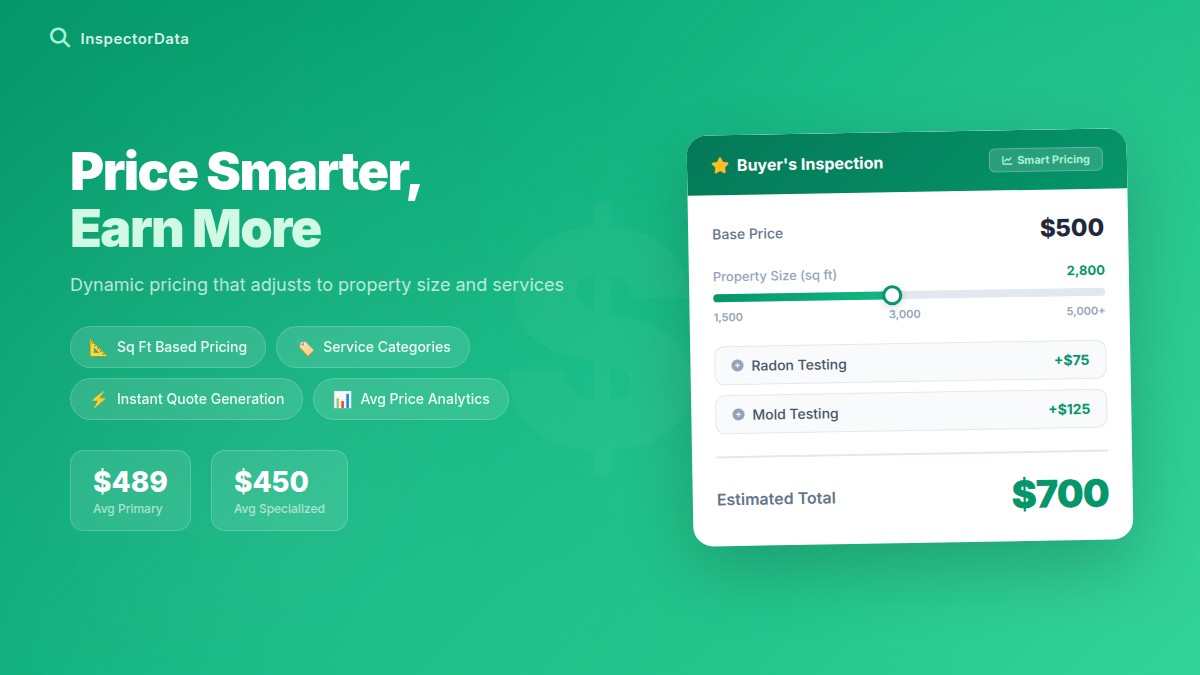
See the complete inspection pricing strategy guide for market-specific pricing recommendations.
Getting Your First Clients
Your first 10 clients are the hardest. Here's the exact sequence:
- Friends and family: Offer your first 3–5 inspections free or at a significant discount to build experience and get testimonials
- Agent outreach: Contact 20 buyer's agents via email or LinkedIn, introduce yourself, and explain your credentials and your fast, professional report turnaround
- Google Business Profile: Set up and fully complete your GBP immediately — it's free and will drive local search traffic within 30–60 days
- Angi/HomeAdvisor: Register on lead platforms for the first 60–30 days to supplement agent referral development
- Referral from the field: Every property you visit introduces you to potential clients — neighbors, contractors on-site, agents at the property
Agents are the engine of a referral business: one who trusts you can send 20–40 inspections a year. Treat those first ten relationships as your highest priority. For the complete playbook, see our guides on becoming the go-to inspector for realtors and marketing your inspection business.
First-Year Income Projections
| Month | Inspections | Monthly Revenue | Cumulative Revenue |
|---|---|---|---|
| 1 – 2 | 4 – 8 | $1,600 – $3,200 | $3,200 – $6,400 |
| 3 – 4 | 8 – 14 | $3,200 – $5,600 | $9,600 – $17,600 |
| 5 – 6 | 12 – 18 | $4,800 – $7,200 | $19,200 – $32,800 |
| 7 – 9 | 16 – 22 | $6,400 – $8,800 | $38,400 – $59,200 |
| 10 – 12 | 18 – 28 | $7,200 – $11,200 | $59,600 – $92,800 |
Most inspectors reach $5,000–$7,000/month income by month 6 with consistent marketing and quality work. Year 1 total income typically ranges from $50,000–$90,000 depending on start timing and market. See the detailed first-year inspector guide for a month-by-month roadmap, and our income by state guide to calibrate these numbers to your local market.
Two factors drive how quickly you climb this curve: marketing consistency and report turnaround. The inspectors who hit the high end aren't necessarily more technical — they simply book more inspections (relentless agent outreach) and deliver reports faster (so they can fit more jobs in a week without cutting corners). Once year one is behind you, the focus shifts to scaling: see our guide to growing your inspection business and the path from solo to a multi-inspector operation.
The 30-Day Launch Checklist
| Week | Tasks |
|---|---|
| Week 1 | Form LLC, open business bank account, choose business name, file for EIN |
| Week 2 | Purchase E&O + GL insurance, complete/enroll in training course, purchase equipment |
| Week 3 | Set up Google Business Profile, join InterNACHI or ASHI, create website, set up InspectorData trial |
| Week 4 | Complete state license application (if required), reach out to first 10 agents, schedule first practice inspections |
Launch Faster With InspectorData
New inspectors who start with InspectorData have AI-assisted reports, instant online quotes, online booking, a client CRM, e-sign agreements, and integrated payments (3.35%) from day one — the same all-in-one platform established inspectors use. $79/month introductory with a 30-day free trial. The trial covers your entire launch period, so you can be fully operational before you pay a cent.
Start Your 30-Day Free TrialFrequently Asked Questions
How do I write a home inspection business plan?
A home inspection business plan covers seven essentials: why the opportunity exists in your market, your state's licensing requirements, a startup cost budget, your legal structure and insurance, your pricing strategy, how you'll get your first clients, and a first-year income projection. Keep it practical and action-oriented rather than long. The goal is a clear 30-to-60-day path from zero to fully operational, with realistic numbers you can hold yourself to. A focused two-to-five page plan beats a 40-page document you never use.
How much does it cost to start a home inspection business?
Expect roughly $4,500 to $17,000 to start, depending on how lean you go. A budget launch — online training, a basic equipment kit, required E&O and general liability insurance, an LLC, a DIY website, and inspection software — runs about $4,500 to $7,500. A professional launch with premium gear and branded marketing runs $10,000 to $17,000 or more. Insurance and software are recurring costs, so budget them monthly and annually. See our full startup cost breakdown for every line item.
Is a home inspection business profitable?
Yes, and it reaches profitability faster than most service businesses because overhead is low — no storefront, no inventory, and no payroll when you operate solo. Most new inspectors recover their startup costs within the first 15 to 40 inspections and build toward a $50,000 to $90,000 first-year income with consistent marketing. Established solo inspectors regularly earn $100,000 or more, and multi-inspector business owners can exceed $200,000.
How long does it take to start a home inspection business?
In a state with no mandatory inspection license, you can complete the core steps — form an LLC, get insured, finish training, set up software and a website, and reach out to your first agents — in about 30 days. In licensed states, the state application and exam process typically adds 4 to 12 weeks. Plan your timeline around whichever category your state falls into.
Do I need a business plan to get started as a home inspector?
You don't need a formal investor-grade document, but you do need a plan. Even a one-page version that nails your startup budget, pricing, insurance, and first-client strategy dramatically improves your odds of a smooth, profitable launch. The plan's real value is forcing you to confront the numbers — startup costs, monthly overhead, and how many inspections you need to break even — before you spend money.