- 1 Why Licensing Varies So Much by State
- 2 States With No Home Inspection License Requirement
- 3 What You DO Need (Even Without a License)
- 4 States With Strict Licensing Requirements
- 5 Can You Really Make $100K in an Unlicensed State?
- 6 How to Start Fast in a No-License State
- 7 Frequently Asked Questions
In more than a dozen states, there is no government license required to call yourself a home inspector and start charging for inspections. That means no exam, no training hours, no waiting — just a business license, some equipment, and the knowledge to do the job. If you have been thinking about starting a home inspection business but assumed you needed to clear years of regulatory hurdles first, this guide may surprise you. The path to your first paid inspection could be weeks, not years, away.
Why Licensing Varies So Much by State
Home inspection licensing in the United States is entirely state-regulated. There is no federal licensing body, no national exam, and no single standard that applies across all 50 states. Each state legislature decides independently whether to regulate the home inspection profession, what requirements to impose, and how to enforce them. The result is a patchwork of regulations that ranges from near-zero oversight to some of the most demanding professional licensing programs in the country.
States began enacting home inspection regulations in the 1990s as the profession grew and consumer protection advocates pushed for minimum standards. The first states to regulate were often those with large real estate markets, active consumer protection lobbies, or high-profile cases of inspection failures that attracted legislative attention. Texas, for example, enacted some of the most comprehensive requirements in the nation, requiring inspectors to hold a license through the Texas Real Estate Commission. Other states followed with their own frameworks, often modeled loosely on Texas or on standards developed by organizations like the American Society of Home Inspectors (ASHI) and the International Association of Certified Home Inspectors (InterNACHI).
But dozens of states never passed licensing laws at all. In some cases, this is because the real estate market is smaller and lobbying for regulation simply did not gain momentum. In others, libertarian-leaning legislatures have historically resisted new professional licensing on principle. Whatever the reason, the practical result is the same: in those states, there is no state agency to register with, no mandated curriculum to complete, and no exam to pass before you can legally hang out your shingle as a home inspector.
It is also worth noting that licensing requirements can and do change. States occasionally pass new legislation that adds requirements where none existed before. Before you launch your business, always verify the current rules in your specific state directly with the relevant state agency or through a resource like InterNACHI's state requirements database. The information in this article reflects the regulatory landscape as of early 2026, but laws evolve and local jurisdictions sometimes add their own rules on top of state law.
States With No Home Inspection License Requirement
As of 2026, the following states have no state-level home inspection licensing requirement. You can legally perform home inspections for compensation in these states without obtaining a government-issued license. Note that carrying insurance and holding a voluntary certification is still strongly recommended — and in some cases, clients and real estate agents will expect it.
| State | License Required? | Notes |
|---|---|---|
| Colorado | No | No state license required. E&O insurance strongly recommended. InterNACHI certification widely expected by agents. |
| Georgia | No | No state license required. Business license needed to operate. Some metropolitan markets (Atlanta) are highly competitive — certification helps. |
| Idaho | No | No state licensing law. General liability and E&O insurance recommended. Growing market with increasing new construction. |
| Iowa | No | No state license required. Voluntary certification through InterNACHI or ASHI provides professional credibility. |
| Kansas | No | No state licensing requirement. Strong agricultural and residential markets. E&O insurance recommended. |
| Maine | No | No state license required. Seasonal real estate activity; strong summer/fall market. Certification builds agent referrals. |
| Massachusetts | No | No state license required. One of the highest-priced real estate markets in the country — inspection fees tend to be above average. E&O strongly recommended in this litigious market. |
| Michigan | No | No state licensing law. Large residential market across Detroit metro, Grand Rapids, and university towns. Certification differentiates you quickly. |
| Minnesota | No | No state license required. Active Twin Cities market. Note that Minnesota does require inspectors to use a written contract with clients — review state statutes before starting. |
| Missouri | No | No state licensing requirement. Active markets in Kansas City and St. Louis. General liability insurance highly recommended. |
| Montana | No | No state license required. Rapidly growing real estate market, especially in Bozeman and Missoula corridors. Low competition in rural areas. |
| North Dakota | No | No state licensing requirement. Lower transaction volume but minimal inspector competition. Strong opportunity for first movers. |
| South Dakota | No | No state license required. Growing Rapid City and Sioux Falls markets. E&O insurance recommended. |
| Vermont | No | No state licensing requirement. Smaller market but strong seasonal demand. Certification adds significant credibility in tight-knit agent community. |
| Wisconsin | No | No state license required. Large market spanning Milwaukee, Madison, and Green Bay. High demand for inspectors throughout the state. |
| Wyoming | No | No state licensing law. Fast-growing markets in Jackson Hole area. Very low inspector supply relative to demand in resort markets. |
What You DO Need (Even Without a License)
Not needing a government license does not mean you need nothing at all. Running a professional home inspection business — one that clients trust, agents refer, and that does not leave you financially exposed — requires several foundational elements. Here is what you need to put in place before your first paid inspection, even in a state with no licensing requirement.
Errors & Omissions (E&O) Insurance
E&O insurance is the single most important protection you can carry as a home inspector. If a client claims you missed something during an inspection and they suffer a financial loss as a result, E&O insurance covers your legal defense and any settlement or judgment. Without it, a single lawsuit could wipe out years of earnings. Annual E&O premiums for home inspectors typically run between $1,200 and $2,500 per year depending on your coverage limits and volume of inspections. Some insurers offer policies starting at $800 per year for new inspectors with limited volume. This is not optional — treat it as the cost of being in business.
General Liability Insurance
General liability insurance covers property damage and bodily injury that occurs in the course of your work. If you accidentally damage something at a property, or if a client trips and falls during an inspection you are conducting, GL insurance protects you. Most policies run $500 to $1,200 per year for home inspectors. Many real estate agents and brokerages will not refer an inspector who cannot provide proof of both E&O and GL coverage. Getting both also signals professionalism from day one.
Business License and Business Entity
Even if your state does not require a home inspection license, you still need to operate as a legitimate business. That means registering a business name with your state, obtaining a local business license if your city or county requires one, and considering forming an LLC to protect your personal assets. Filing an LLC is straightforward in most states and costs between $50 and $200 in state fees. An LLC creates a legal separation between your personal finances and your business, which is an important protection in a field where you are regularly entering people's homes and commenting on the condition of their largest asset.
InterNACHI or ASHI Certification
Voluntary certification is not legally required in an unlicensed state, but it is practically essential if you want to compete seriously. InterNACHI (International Association of Certified Home Inspectors) is the largest home inspector association in the world and offers free online courses and exams for members. ASHI (American Society of Home Inspectors) is another respected organization with its own certification pathway. Either certification demonstrates that you have completed professional training, understand inspection standards, and are committed to the profession. Real estate agents — your primary referral source — overwhelmingly prefer to recommend certified inspectors. In a competitive market, a certification distinguishes you from the rare inspector who hangs a shingle with zero training.
Equipment
A professional home inspection requires the right tools. Your essential starting kit should include:
- Flashlight (high-lumen) — You will be in attics, crawl spaces, and dark mechanical rooms. A quality headlamp and a powerful handheld flashlight are non-negotiable.
- Ladder — A 6-foot step ladder and an extension ladder (typically 24 feet) allow you to access roofs, attics, and elevated areas safely.
- Moisture meter — Detects elevated moisture levels behind walls and under floors that could indicate leaks, water intrusion, or mold risk. A reliable pin-type moisture meter runs $50 to $200.
- Thermal imaging camera — An infrared camera lets you see temperature differentials that reveal missing insulation, active water intrusion, electrical hot spots, and HVAC inefficiencies. Entry-level FLIR cameras start around $400; professional models run $2,000 or more. Even a budget thermal camera adds significant value to your reports.
- Voltage tester and outlet tester — Essential for checking electrical panels, outlets, and GFCIs without taking risks.
- Carbon monoxide and gas detector — Important safety tools for checking combustion appliances and identifying gas leaks.
- Inspection mirror and probe — For accessing tight spaces and testing wood members for rot or soft spots.
- Safety gear — Respirator, safety glasses, gloves, and knee pads for crawl space work.
A complete starter kit can be assembled for $800 to $2,000 depending on the quality of your thermal camera. You do not need the most expensive everything on day one — upgrade as your revenue grows.
Report Writing Software
Your inspection report is your product. It is what the client reads, what their agent refers to, and what everyone looks at if a dispute arises later. A professional, well-organized, photo-rich report delivered within hours of the inspection builds your reputation faster than almost anything else. Purpose-built inspection report software like InspectorData lets you capture photos on-site, attach comments, and generate polished PDF reports quickly. The alternative — Microsoft Word templates — produces reports that look amateurish and take three times as long to complete. For a new inspector trying to build a referral network with real estate agents, report quality is a genuine competitive advantage.
States With Strict Licensing Requirements
While the states listed above have no licensing requirement, many other states have established comprehensive regulatory frameworks that can take months or longer to complete before you can legally work. If you live in one of these states, your path to becoming a home inspector is longer — but the licensing also tends to reduce competition and can support higher inspection fees.
Texas has one of the most demanding home inspection licensing programs in the country, administered by the Texas Real Estate Commission (TREC). Applicants must complete 194 hours of approved coursework, pass the TREC inspector exam, complete a supervised field inspection requirement, and maintain continuing education to renew. The process typically takes three to six months and involves significant upfront cost. However, Texas is also one of the largest real estate markets in the world, and a full-time inspector in the Dallas, Houston, or Austin market can earn well above the national average.
Florida requires licensure through the Florida Department of Business and Professional Regulation. Inspectors must complete a state-approved training program, pass a state exam, carry a minimum of $300,000 in general liability coverage, and carry InterNACHI or ASHI membership or equivalent. Florida's licensing is particularly focused on wind mitigation and four-point inspections, which are critical add-on services given the state's insurance environment.
New York requires a home inspector license administered by the New York Department of State. Requirements include 140 hours of classroom instruction, 40 hours of field training under a licensed inspector, and passing the National Home Inspector Examination (NHIE). The New York City market is unique — co-op and condo transactions do not typically include traditional home inspections, but inspections on single-family homes and multi-family properties outside of NYC are common and well-compensated.
California currently does not have a statewide home inspection license requirement (it is technically an unlicensed state for general home inspection), but the complexity of California real estate law and the high-liability environment means that E&O insurance is essential and certification is nearly mandatory in practice. California real estate agents and brokerages routinely require proof of professional credentials and insurance before referring clients to an inspector.
New Jersey requires licensure through the New Jersey Home Inspection Advisory Committee. Applicants must complete 180 hours of approved education, pass the state exam, and complete a field training requirement before receiving their license.
For a deeper look at how income varies across states with different regulatory environments, see our complete Home Inspector Salary & Income Guide. Want to see where every state lands on licensing? Our home inspector license requirements by state guide has the full 50-state table, and our step-by-step how to become a home inspector guide walks through training, exams, and your first jobs.
Can You Really Make $100K in an Unlicensed State?
Absolutely — and the math is not complicated. The path to $100,000 per year as an independent home inspector in a no-license state is well within reach for anyone who treats the business professionally, builds strong agent relationships, and offers a well-rounded service menu. Let us break it down concretely.
The Base Calculation
Inspection pricing varies by state, property size, and local market conditions. Prices should be obtained from your local inspector. Using a hypothetical average for illustration:
| Inspections Per Week | Average Fee | Annual Revenue |
|---|---|---|
| 2 inspections/week | $400 | $41,600 |
| 3 inspections/week | $400 | $62,400 |
| 4 inspections/week | $400 | $83,200 |
| 5 inspections/week | $400 | $104,000 |
Four inspections per week — fewer than one per day on a typical five-day schedule — puts you at over $83,000 in annual revenue from base inspections alone. That is a strong middle-class income doing work that is genuinely different every day, never at a desk, and directly valuable to the people you serve.
Add-On Services Push You Over $100K
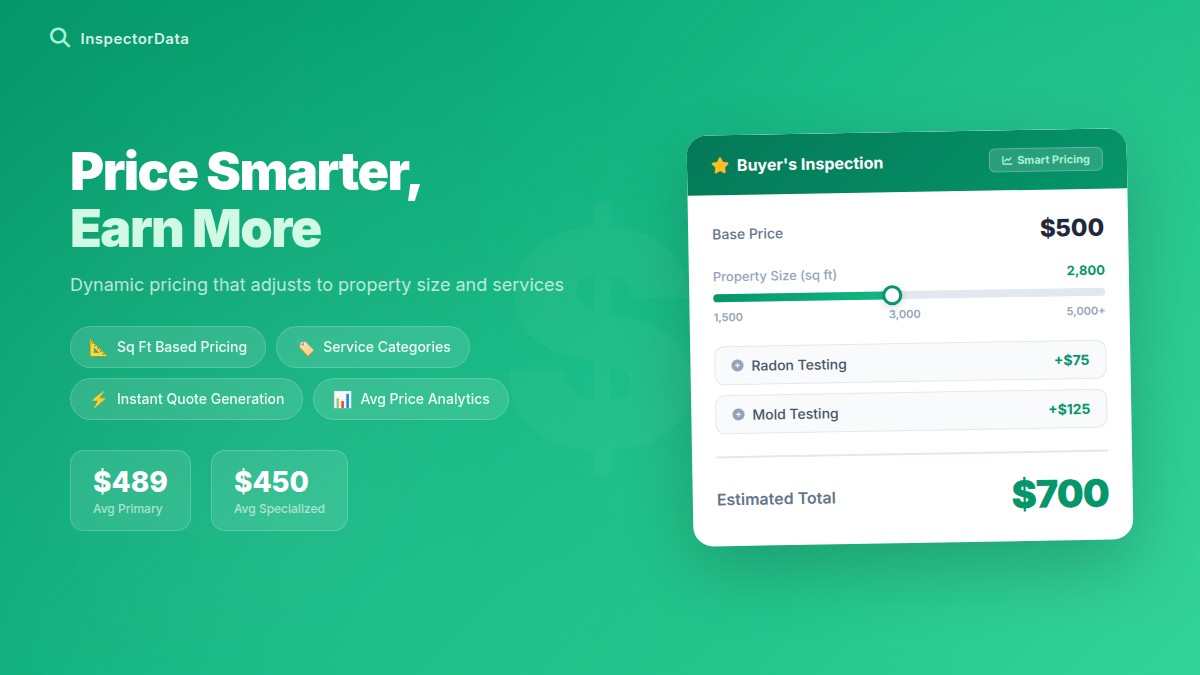
Add-on services are where the income really accelerates. Radon testing, mold sampling, sewer scope inspections, well water testing, pool inspections, and WDO (wood-destroying organism) inspections can each add $75 to $250 or more per visit. If you add radon testing ($150 average) and a sewer scope ($200 average) to even half of your inspections:
- 4 inspections/week × $400 = $83,200 base
- 2 radon tests/week × $150 × 50 weeks = $15,000
- 2 sewer scopes/week × $200 × 50 weeks = $20,000
- Total: $118,200 per year
That is $118,000 working fewer than five days per week with no employees, no storefront, and no inventory beyond your equipment and vehicle. In a no-license state, you can be generating that revenue within your first year of operation once you have built a solid referral base with local agents.
For a detailed breakdown of how inspectors maximize their income at every experience level, read our complete guide to home inspection add-on services.
How to Start Fast in a No-License State
One of the great advantages of starting in a no-license state is that your timeline to your first paid inspection is entirely within your control. There is no waiting for a state application to process, no exam date to schedule months out, and no mandatory training clock to run. Here is a practical step-by-step sequence for going from zero to a fully operating home inspection business as efficiently as possible.
Step 1: Join InterNACHI and Complete Free Online Training
InterNACHI's membership is free for qualifying inspectors and includes access to a comprehensive library of online courses covering every system in a home — roofing, electrical, plumbing, HVAC, structure, site, insulation, and more. Their online inspector exam is included. Many new inspectors complete the core coursework in two to four weeks of part-time study. You do not need to wait until you are finished with coursework to start preparing your business infrastructure — run these steps in parallel. Beyond the foundational courses, InterNACHI offers specialty certifications in radon testing, mold inspection, sewer scope, commercial inspection, and more. Start stacking certifications from the beginning — they show up on your profile and marketing materials immediately.
Step 2: Get Your E&O and General Liability Insurance
Before you perform a single paid inspection, get your insurance in place. Several insurers specialize in home inspector coverage: InspectorPro Insurance, OREP (Organization of Real Estate Professionals), and Markel are among the most commonly used by working inspectors. The application process is straightforward — expect to spend 20 to 30 minutes filling out an online application and receive a quote within 24 hours. Many companies offer monthly payment plans so you do not have to pay the full annual premium upfront. Having your certificate of insurance ready before your first agent meeting is a strong credibility signal.
Step 3: Form Your Business Entity and Get a Business License
Register an LLC in your state (or a sole proprietorship if you prefer to start lean — though an LLC provides important liability protection). Choose a business name that is professional and easy for real estate agents to remember and refer. Avoid overly generic names if your market is competitive. Check that your desired name is available in your state's business registry, then file online. Most states process LLC registrations within a few days to a couple of weeks. Separately, check your local city or county requirements for a business license — fees are typically $25 to $100 per year. Open a dedicated business checking account to keep business finances cleanly separated from personal funds.
Step 4: Get Your Equipment
You do not need to spend $10,000 on equipment before your first inspection. Start with the essentials: a quality headlamp and flashlight, a 6-foot step ladder and extension ladder, a moisture meter, a pin-type and non-contact voltage tester, an outlet tester, a carbon monoxide detector, and basic safety gear. A FLIR One or similar entry-level thermal camera is highly recommended — it adds visible value to clients and differentiates your reports. As your revenue grows, invest in higher-end thermal cameras, a sewer scope camera, and radon testing equipment (either purchase or use lab kits to start). Your vehicle needs to reliably haul a ladder — a pickup, SUV, or cargo van is standard. A magnetic vehicle sign with your company name and phone number turns your truck into a rolling advertisement.
Step 5: Set Up Your Report Writing Software
This step is critical and often underestimated by new inspectors. Your report is your primary work product and the thing that clients share with family, attorneys, and agents long after the inspection is over. Professional report writing software like InspectorData lets you write reports on-site from your phone or tablet, auto-generates professional-looking PDFs with your branding, and delivers them to clients by email the same day. Delivering a polished, photo-rich, clearly organized report within two to four hours of completing the inspection is one of the most effective ways to generate referrals. Agents notice. Clients tell their friends. Set up your software, customize your report templates for your market, and build your comment library before your first inspection.
Step 6: Market to Real Estate Agents
Real estate agents are your primary referral source, and the most efficient marketing you can do as a new inspector is direct outreach and relationship-building with active buyer's agents. Identify the top-producing buyer's agents in your market (Zillow, Realtor.com, and local MLS data can help), then reach out by phone, email, or in person at broker open houses and office meetings. Offer a free first inspection to agents who want to experience your process firsthand — most agents will take you up on it, and a single five-star review from a trusted agent is worth more than any advertising budget. Build a simple professional website (even a one-page site with your certifications, insurance info, service menu, pricing, and booking link), set up a Google Business Profile so you appear in local search results, and ask every satisfied client for a Google review. For a complete playbook on building your referral network and marketing strategy, see our inspector marketing guide and our complete guide to starting a home inspection business.
Frequently Asked Questions
Do I need a license to be a home inspector?
It depends on your state. As of 2026, approximately 16 states have no state-level home inspection licensing requirement, including Colorado, Georgia, Michigan, Minnesota, Wisconsin, and others. In those states, you can legally begin offering home inspection services without a government-issued license. However, most states do require a license, so always verify your state's current requirements before starting. Even in unlicensed states, carrying E&O and general liability insurance and holding a voluntary certification through InterNACHI or ASHI is strongly recommended.
What states have no home inspection license requirement?
As of 2026, the states with no home inspection license requirement include: Colorado, Georgia, Idaho, Iowa, Kansas, Maine, Massachusetts, Michigan, Minnesota, Missouri, Montana, North Dakota, South Dakota, Vermont, Wisconsin, and Wyoming. This is a total of 16 states. Note that laws change — always verify current requirements directly with your state's licensing authority or through InterNACHI's state requirements database before starting your business.
Is it legal to do home inspections without a license?
Yes, in states with no licensing requirement it is completely legal to perform home inspections for a fee without a government-issued license. You still need a business license to operate as a business entity, and carrying errors and omissions insurance and general liability insurance is strongly recommended to protect yourself legally and professionally. In licensed states, performing inspections without the required license is illegal and can result in significant fines and civil liability.
Should I get certified even if my state does not require it?
Yes, absolutely. Even in states with no license requirement, earning a certification through InterNACHI or ASHI dramatically increases your credibility with buyers and real estate agents, makes you more insurable (some insurers require certification), and helps you charge higher fees. InterNACHI offers free online courses that you can complete in days or weeks. A certification also signals your commitment to professional standards — which matters to the agents who will become your referral network and the clients who will trust you with one of the most significant financial decisions of their lives.
How much can I make as an unlicensed home inspector?
Your income potential is identical whether your state requires a license or not. The license (or lack of one) is a regulatory requirement, not a measure of earning potential. A full-time independent home inspector in a no-license state can realistically earn $75,000 to $100,000 or more per year by performing 3 to 5 inspections per week at $350 to $500 per inspection, with additional income from add-on services like radon testing, mold sampling, and sewer scope inspections. Top earners who build strong agent referral networks and offer a comprehensive service menu consistently exceed $100,000 per year even in smaller markets. See our complete home inspector salary guide for a full breakdown by experience level, market size, and service mix.
Ready to Start Your Inspection Business?
InspectorData gives you the software to write professional, photo-rich inspection reports from day one — on your phone, tablet, or laptop, delivered to clients the same day. Used by inspectors across the country, including in no-license states where your report quality is your primary credential.
Try it free for 30 days.
Start Your Free Trial