Radon. Mold. Sewer scope. These aren't in a standard home inspection — and that surprises a lot of buyers. A standard inspection is visual: the inspector evaluates what's accessible and visible. Add-on services go deeper, testing for hazards that can't be seen with the naked eye.
The right add-ons are almost always worth the investment. Here's exactly what each one does and when you should add it.
*All pricing shown is for general reference only and varies significantly by state and inspector. These figures are not a substitute for actual pricing — contact your local inspector for a quote.
1. Why Add-Ons Aren't Optional for Most Buyers
A standard home inspection is comprehensive — but it has hard limits. Your inspector doesn't test the air, scope the sewer line underground, or sample surfaces for mold spores. They evaluate the visible, accessible systems of the home.
Add-on services fill the gaps that matter most:
- Radon can't be seen, smelled, or felt — only tested
- Mold behind walls and in ducts isn't visible without sampling
- Sewer lines underground are invisible until they fail — at $5,000–$20,000 to repair
- Termites do billions in damage annually and are often undetectable without a specialist
A full suite of add-ons (radon + mold + sewer scope) is a fraction of the cost of the problems they catch, which can run $1,000–$30,000+ to fix. The math is obvious — but only if you know to ask for them.*
2. Radon Testing
Radon is a colorless, odorless radioactive gas that forms naturally from uranium decay in soil. It seeps into homes through foundation cracks, sump pits, and floor drains. It's the #1 cause of lung cancer in non-smokers and the #2 cause overall, responsible for approximately 21,000 deaths annually in the US.
How it works: A test device (charcoal canister or electronic monitor) is placed in the lowest livable area of the home for 48–96 hours. The results show radon concentration in pCi/L (picocuries per liter).
- Below 2 pCi/L — safe, no action needed
- 2–4 pCi/L — EPA recommends considering mitigation
- Above 4 pCi/L — EPA recommends mitigation
- Above 8 pCi/L — mitigate as soon as possible
Cost: $100–$250* for the test. Mitigation (a sub-slab depressurization system) typically costs $800–$2,500 installed.*
Who should test: Everyone. 1 in 15 US homes has elevated radon levels, and it's found in all 50 states. There's no way to know without testing — and it's one of the cheapest add-ons available.
If radon comes back above 4 pCi/L, you have two options: ask the seller to install a mitigation system before closing, or negotiate a credit and handle it yourself. Either way, you're protected — but only if you tested.
3. Mold Inspection
Mold is everywhere — but not all mold is a problem. A mold inspection determines whether mold levels inside the home are elevated above normal outdoor levels, where the moisture source is, and whether any toxic varieties (like Stachybotrys, commonly called "black mold") are present.
How it works: Air samples are collected in multiple locations (basement, living area, exterior for baseline) and sent to a lab. Results come back in 24–48 hours with mold type and spore counts.
What triggers the need for a mold inspection:
- Visible mold anywhere in the home
- Musty odor, especially in basement or crawl space
- History of water damage or flooding
- Any moisture findings in the standard inspection report
- Homes that have been vacant or had deferred maintenance
- Anyone in the household with respiratory sensitivities or allergies
Cost: $200–$800* depending on number of samples. Remediation cost ranges widely based on severity.*
Inspector tip: If your standard inspection report notes moisture staining, water damage, or high moisture readings, always follow up with a mold test. The standard inspection can't tell you whether mold is present — only a sample can.
4. Sewer Scope Inspection
A sewer scope sends a waterproof camera through the main sewer line from the house to the municipal connection or septic tank. It reveals what's happening underground — something completely invisible to a standard inspection.
What it finds:
- Root intrusion — tree roots growing into sewer lines, eventually causing blockages or collapses
- Offset joints — sections of pipe shifted out of alignment, usually from soil movement
- Cracks and collapses — pipe failure requiring excavation and replacement
- Bellies — low spots where waste pools, leading to buildup and eventual blockage
- Grease buildup — accumulated waste narrowing the pipe
- Wrong pipe material — Orangeburg (tar paper pipe from the 1940s–60s) that's deteriorating
Cost: $200–$400* for the scope. Sewer line repair costs vary widely depending on the issue and location. Sewer scope is the highest ROI add-on for homes built before 1980.*
Any home built before 1985. Homes with large trees near the foundation or property line. Homes with known history of slow drains. And honestly — any home you're seriously considering. You can't see what's underground any other way.
5. Termite / Wood-Destroying Organism (WDO) Inspection
Termites cause more than $5 billion in structural damage annually in the US — more than fires and floods combined. A WDO inspection checks for evidence of termites, carpenter ants, wood-boring beetles, and wood decay fungi.
Who performs it: A licensed pest control professional (not your general home inspector, in most states — separate certification required). Many home inspectors partner with a WDO inspector to offer it as a bundled service.
What they check: Foundation perimeter, basement, crawl space, attic, all wood components. They look for mud tubes, frass (sawdust-like droppings), damaged wood, and active infestations.
Cost: $75–$200* for the inspection. Treatment costs vary widely depending on the extent. Structural repairs from untreated termite damage can run into the tens of thousands.*
Required by lenders: Many mortgage products (FHA, VA) require a clear WDO report before closing. Even if not required, it's worth having.
6. Underground Oil Tank Scan
In homes that previously used oil heat (common in the Northeast and Midwest, homes built before the 1980s), there may be an abandoned underground oil storage tank on the property. If it leaked, you've inherited an environmental liability that can cost $10,000–$100,000+ to remediate.
How it works: A technician uses ground-penetrating radar or electromagnetic equipment to scan the yard for buried metal. Takes about an hour.
Cost: $150–$400* for the scan. Remediation if a leaking tank is found: highly variable.*
When to consider it: Any home that had or has oil heat, especially in the Northeast, Mid-Atlantic, or Midwest. Check the basement for an oil fill pipe, old oil lines, or a furnace that previously ran on oil.
7. For Inspectors: Add-On Services Boost Revenue Significantly
If you're an inspector, offering ancillary services is one of the highest-leverage ways to grow revenue without adding more inspections to your schedule.
At 4 inspections per week, offering radon and sewer scope to every client (50% uptake) adds roughly $900/week — over $46,000 annually on top of your base revenue. The startup costs are modest: a radon monitor ($300–$800), a sewer scope camera ($1,500–$4,000).
8. Which Add-Ons to Get for Your Home
| Add-On | Always Add | Add If... |
|---|---|---|
| Radon | Yes — every home | No exceptions |
| Sewer Scope | Homes built before 1985 | Large trees on property; older neighborhood |
| Mold | Any water damage history | Musty smell; moisture in report; allergies in household |
| Termite/WDO | Southern US; FHA/VA loans | Any home with crawl space; wood siding |
| Oil Tank Scan | Northeast/Midwest pre-1980 homes | Any sign of previous oil heat |
Inspectors: Add-Ons Are Easy to Offer With the Right Software
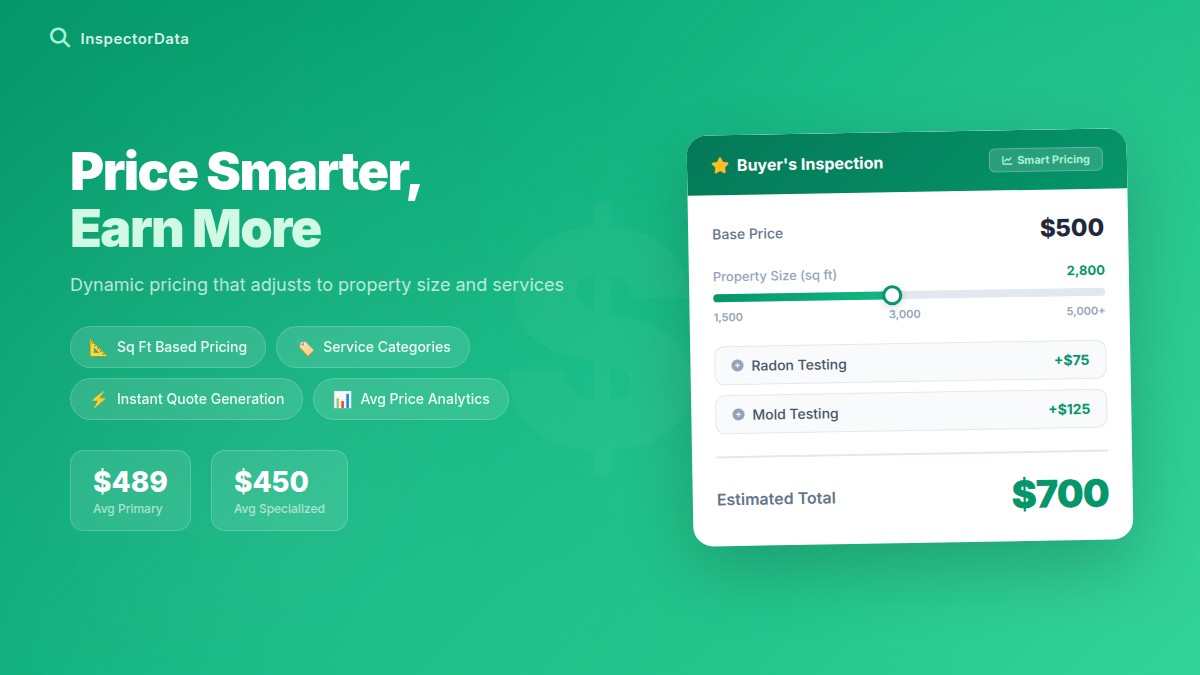
InspectorData lets you build radon, mold, and sewer scope into your quote calculator as optional add-ons. Clients see the price, check the box, and you collect more revenue from every inspection — automatically.
Try Free for 30 Days