Most home inspectors plateau at $60,000 to $70,000 per year — not because they lack skill, but because they never build the systems and strategies that turn a job into a business. (For a full breakdown of how much home inspectors make at each stage, start here.) The inspectors who reach $120K, $150K, and beyond aren't necessarily better at finding defects. They're better at running a business. This is the complete guide to growing your home inspection business at every stage — from your first inspection to your tenth inspector.
Why Most Inspectors Plateau at $60K
The $60K plateau is one of the most common patterns in the inspection industry. It happens because most inspectors build their business around their own personal capacity: they can only do so many inspections per day, and without systems to generate consistent referrals or leverage technology to work more efficiently, they hit a natural ceiling.
The three biggest causes of the plateau are:
- Inconsistent marketing: Business comes in waves rather than steady flow. Busy weeks are followed by dead weeks, making it impossible to plan or invest in growth.
- No referral system: New clients come from random sources rather than a predictable pipeline, so revenue is always unpredictable.
- Time spent on low-value tasks: Phone calls, manual scheduling, emailing reports, chasing invoices — these administrative tasks consume hours that could be spent on billable work or strategic growth.
The 5 Growth Stages of a Home Inspection Business
Successful inspection businesses follow a predictable growth pattern. Understanding which stage you're in tells you exactly where to focus your energy.
| Stage | Timeline | Annual Revenue | Key Focus | Biggest Mistake |
|---|---|---|---|---|
| 1. Survival | 0-6 months | $0 - $25K | Getting first clients | Underpricing to win jobs |
| 2. Traction | 6-18 months | $25K - $60K | Building referral network | Not asking agents for repeat business |
| 3. Momentum | 18 months - 3 years | $60K - $100K | Systems and pricing | Staying solo too long |
| 4. Scale | 3-5 years | $100K - $250K | Hiring and delegation | Hiring without SOPs |
| 5. Enterprise | 5+ years | $250K+ | Brand and exit planning | Being the bottleneck |
Most inspectors get stuck between Stage 2 and Stage 3 — they have enough work to be busy but not enough systems to grow beyond their personal capacity. The jump from Stage 3 to Stage 4 requires the most deliberate action: building systems, hiring, and transitioning from inspector to business owner.
Stage 1 & 2: Getting Your First 20 Clients
Your first 20 inspections are the hardest. You're building a reputation from scratch, and you don't yet have the referral flywheel running. Here's where to focus.
Real Estate Agent Relationships
Agents are the primary referral source for most inspection businesses. A single loyal agent can send 15-25 inspections per year. Your first job is to get in front of as many agents as possible and make a strong first impression.
- Visit real estate offices in person. Bring business cards and a leave-behind (a one-page summary of what you inspect and your turnaround time).
- Ask every agent you meet: "What do you wish your current inspector did better?" Then do that thing.
- Follow up every 30 days with a brief email — a tip they can share with clients, a market stat, or just a check-in.
InterNACHI Find-an-Inspector Directory
InterNACHI's directory is one of the most-visited inspector search tools online. If you're certified, make sure your profile is complete with photos, your service area, and a compelling bio.
Google Business Profile
Set this up on day one. It's free, and it's how buyers find you when they search "home inspector near me." Complete every field, add photos, and start collecting reviews immediately after every inspection.
Stage 3: Systematizing for Consistency
Once you're doing 10+ inspections per month, the biggest lever is systematization. This is what separates inspectors who stay at $60K from those who break through.
Report templates: Every inspection should use a consistent, professional template. This saves time and ensures nothing gets missed. Learn how to write reports 3x faster with the right system in place.
Online booking: If clients can't book you at 10pm on a Tuesday, you're losing business. Online booking eliminates phone tag and captures after-hours demand that would otherwise go to a competitor.
Automated follow-ups: After every inspection, send an automated thank-you email asking for a Google review. This takes zero time per inspection and compounds over months into a powerful review base.
Stage 3→4: Breaking the $100K Barrier
The path from $60K to $100K runs through three specific strategies:
Raise Your Prices
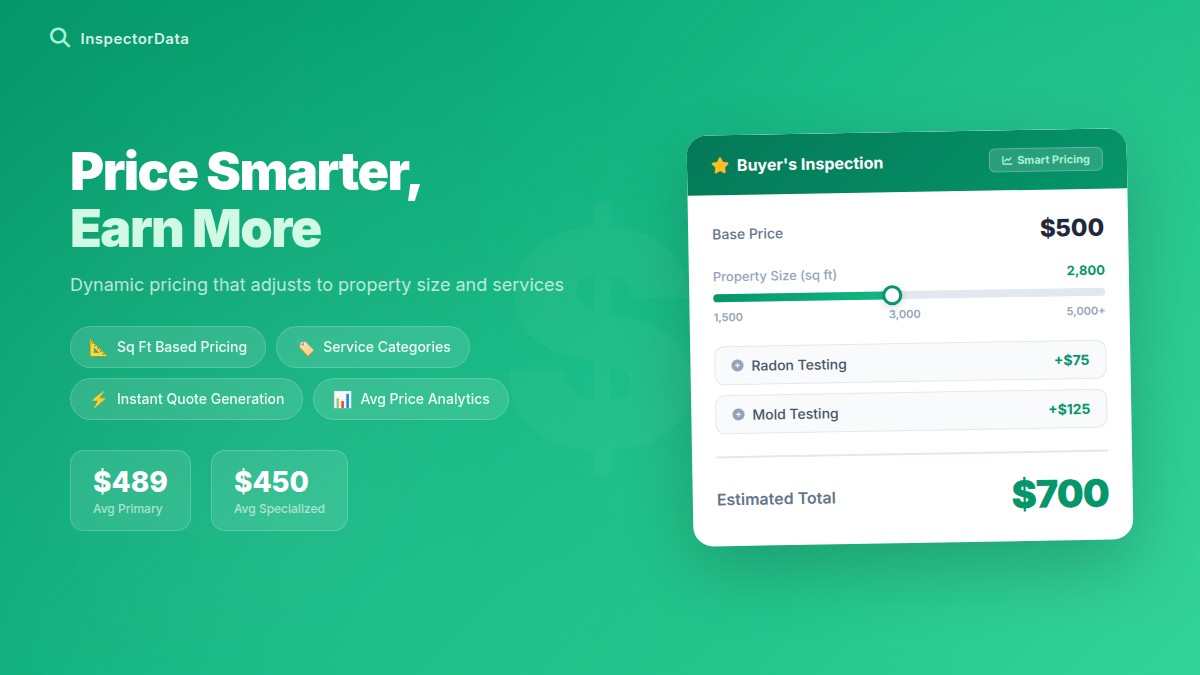
Most inspectors at Stage 3 are undercharging by $50-$100 per inspection. A $75 price increase on 200 inspections per year is $15,000 more revenue — for the exact same work. Check what competitors charge, then position yourself at market rate or slightly above based on your turnaround time and professionalism.
Add Services
Radon testing, mold inspection, and sewer scope are the three highest-ROI add-on services for most inspectors. Each one adds $100-$300 per job with minimal extra time. See the full income math for add-on services here.
Track Your Numbers
Revenue per inspection, referral source breakdown, report turnaround time, booking conversion rate — if you're not tracking these, you're flying blind. Inspectors who track KPIs consistently outperform those who don't.
Stage 4: Hiring Your First Inspector
The single biggest leap in inspection business growth is bringing on a second inspector. It doubles your theoretical capacity overnight. But it only works if you have systems in place first.
Signs you're ready to hire:
- You're turning away work on a weekly basis
- You're booked more than 2 weeks out consistently
- You have documented SOPs (Standard Operating Procedures)
- Your monthly revenue consistently exceeds $10,000
- You have report templates that a new inspector can follow
The financial case: If you pay an inspector $350 per inspection and charge clients $450, you net $100 per inspection they do — plus you free yourself to do additional inspections, business development, or management. At 60 inspections per month split between two inspectors, total revenue jumps from $27,000 to $27,000 + your additional capacity.
Stage 5: Building a Self-Sustaining Business
The goal of Stage 5 is a business that runs without you being on every roof. This requires:
- Documented SOPs for every process: booking, inspection, report, delivery, follow-up, payment
- Quality control systems that maintain consistency across inspectors
- A management layer — someone responsible for scheduling, client communication, and inspector coordination
- Financial systems — accounting, payroll, quarterly taxes, profit tracking
- Exit optionality — a business that runs without you is worth significantly more to a buyer
Inspectors who reach Stage 5 typically have annual revenues of $250,000 to $500,000+ and operate more like a small business than a solo practice. The lifestyle shift is dramatic — from doing inspections every day to running a team that does them for you.
How Software Accelerates Every Stage of Growth
The right software is a growth multiplier at every stage. Choosing the top inspection software for 2026 matters — InspectorData was built specifically to help inspection businesses grow from Stage 1 through Stage 5:
- Stage 1-2: Instant online quotes and professional reports make you look established from day one, helping you win business against more experienced competitors.
- Stage 3: Automated booking, reminders, and report delivery eliminate the administrative work that consumes solo inspectors' evenings and weekends.
- Stage 4: Multi-inspector scheduling, consistent report templates, and centralized client management make adding a second inspector operationally smooth.
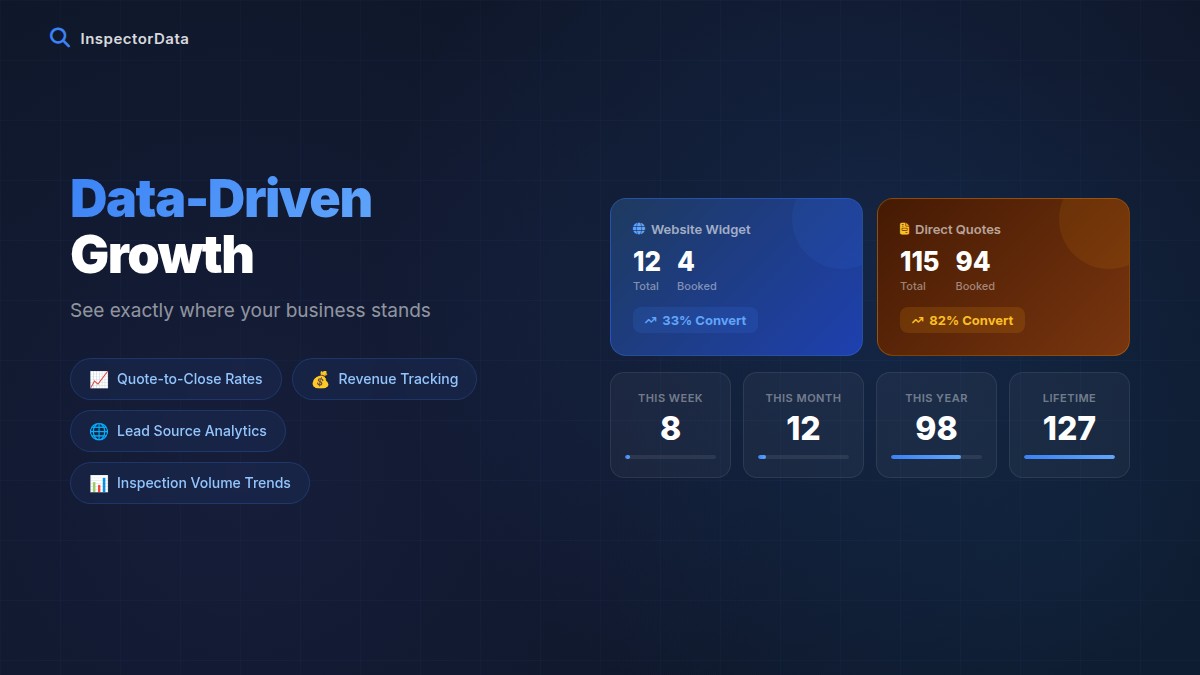
- Stage 5: Analytics dashboards, revenue tracking, and operational reporting give you the data to run a real business rather than guessing.
Inspectors who use InspectorData spend an average of 90 fewer minutes per day on administrative tasks — time that goes directly back into billable inspections or business growth.
Frequently Asked Questions
How long does it take to grow a home inspection business to $100K?
Most inspectors who follow a systematic approach — building agent relationships, pricing correctly, and using technology — reach $100K within 2-3 years. Inspectors in no-license states with strong real estate markets can hit this milestone faster. See our guide on states with no home inspection license requirement.
When should I stop doing inspections and focus on growing the business?
There's no single answer, but most inspection business owners start delegating inspections when they're consistently turning away work. The transition happens gradually — you hire one inspector, do fewer inspections yourself, and redirect that time to marketing and management.
How much does it cost to start a home inspection business?
Startup costs range from $2,000 to $10,000 depending on your state's licensing requirements, equipment choices, and insurance. In states with no license requirement, you can start with basic equipment and insurance for under $3,000.
What's the fastest way to get my first client?
Call or visit every real estate agent you know personally. Ask if they'd be willing to give you a try on their next buyer client. Offer to shadow their current inspector first if they're hesitant. One agent willing to take a chance on you can generate your first 10 bookings.
Is home inspection a good business to start in 2026?
Yes. The real estate market continues to generate consistent demand, more than a dozen states require no license to get started, and the income ceiling for a well-run inspection business is genuinely high — often $150K to $250K+ for multi-inspector operations.
Ready to Grow Your Home Inspection Business?
InspectorData gives you the booking system, report writer, quote calculator, and analytics dashboard you need to grow from your first inspection to a full-scale operation. Join inspectors across the country who use InspectorData to build businesses that pay them what they're worth.
Try InspectorData Free for 30 Days