You ran the camera through a 4-inch clay tile lateral, found significant root intrusion at the 35-foot mark, a belly at 52 feet, and a cracked section near the cleanout. You know exactly what this homeowner is dealing with. But when you hand them a USB drive with raw footage or email them three grainy screenshots with no labels, they have no idea what they are looking at -- and neither does their real estate agent, their contractor, or their attorney.
That gap between what you found and what the client can understand is costing you repeat business, referrals, and your shot at building real relationships with the real estate agents who send sewer scope work week after week. Studies consistently show that roughly 70% of residential sewer scope inspections reveal conditions requiring attention -- ranging from minor root intrusion that warrants monitoring to catastrophic structural failures requiring $10,000 to $40,000 in repairs or full lateral replacement. At those stakes, homeowners and agents deserve more than a video file.
In 2026, sewer scope report software makes it fast and easy to turn your camera findings into a professional written report with annotated stills, AI-generated condition descriptions, and a clear summary of recommended action. Here is what a professional sewer scope report should look like, and how to produce one efficiently on every job.
The Problem: Homeowners and Real Estate Agents Get Raw Footage with No Context
The sewer scope industry has an endemic deliverable problem. The technology for capturing underground pipe conditions is sophisticated and expensive. The documentation of those findings is, for most providers, an afterthought.
Raw Video Footage Is Not a Professional Deliverable
A 20-minute video of a sewer camera traveling through a dark pipe is incomprehensible to anyone who has not done it hundreds of times. Homeowners cannot identify root intrusion from scale buildup. They cannot distinguish a pipe belly from a minor sag. They cannot assess whether the condition at the 35-foot mark is a cosmetic concern or an urgent structural failure. When you hand a client raw footage without professional documentation, you are leaving the interpretation entirely to them -- and most of them get it wrong, or ignore it entirely.
Grainy Screenshots Without Context Are Worse Than Nothing
Some sewer scope providers take screenshots of key findings from the footage and send them to clients without any written explanation. This is marginally better than raw video, but only marginally. A blurry still image of root intrusion inside a clay tile pipe, with no scale reference, no location marker, no description of severity, and no recommended action, does not give the homeowner what they need to make a decision. It gives them anxiety and confusion -- which often translates into paralysis, disputes, or calling someone else.
The Stakes Make Documentation Non-Optional
Sewer lateral repairs are among the most expensive plumbing repairs a homeowner will face. A full lateral replacement in a typical residential property can run $8,000 to $25,000 or more, depending on depth, length, and access conditions. Trenchless repair methods can be similarly expensive. When a client is about to spend that kind of money -- or negotiate it into a real estate transaction -- they need documentation that holds up: timestamped, professionally written, with clear photographic evidence and explicit recommendations. Raw footage and verbal summaries do not meet that bar.
What a Professional Sewer Scope Report Should Include
A professional sewer scope report is a formal document that communicates findings clearly to four distinct audiences: the property owner, the real estate agent, the repair contractor, and any legal or insurance party that may review it later. Each audience has different needs, and a well-structured report serves all of them.
Property and Inspection Summary
The report should open with a cover page including the property address, inspection date and time, the name and license number of the inspector, the pipe access point used (main cleanout, roof vent, toilet), pipe material and diameter as observed, and a brief executive summary of the findings in plain language. This summary is what real estate agents read in the first 30 seconds. It should tell them, without technical jargon, whether the sewer system is in acceptable condition, needs monitoring, requires repair, or has a condition that should affect the transaction.
Section-by-Section Findings with Annotated Stills
Each significant finding in the pipe system should have its own section in the report, including a clear still image captured from the camera footage, the distance from the access point to the finding, the pipe material and condition at that location, a professional written description of the condition, a severity rating (informational, monitor, repair recommended, urgent), and recommended remediation action. This structure gives every audience the information they need without requiring them to watch the full video or decipher technical language.
Overall System Assessment
The report should conclude with a holistic system assessment -- whether the lateral is suitable for current use, whether it has conditions that are likely to worsen without intervention, and the inspector's overall recommendation. This section is where you give the client the professional judgment that raw footage can never convey.
How InspectorData Solves This: Stills, AI, PDF
InspectorData's sewer scope reporting workflow is built around three simple steps that take you from camera footage to delivered PDF in under 15 minutes.
Step 1: Capture Stills from Your Camera Footage
As you run the camera through the lateral, capture still images of each significant finding directly through the InspectorData mobile app. Screenshot root intrusion, pipe cracks, offset joints, heavy scaling, bellies, and any other conditions you want to document. Each still is automatically tagged with a timestamp and placed into the sewer scope report framework. You are building the documentation as you work, not reconstructing it later from memory or a video file.
For providers using dedicated sewer camera systems with their own display monitors, InspectorData supports uploading stills directly from the camera system's output. Photograph the monitor at key moments with your phone, or use the camera system's screenshot export feature and upload images to the report via the app. The result is the same: professionally organized photographic evidence within the report structure.
Step 2: AI Writes the Condition Descriptions
After capturing each still, tap the AI button. InspectorData analyzes the image and generates a professional written description of what it shows -- the pipe condition, the nature of the deficiency, its likely cause, and the recommended remediation approach. For common sewer scope findings like root intrusion, offset joints, cracked pipe sections, heavy grease accumulation, pipe belly, and severely deteriorated clay tile, the AI generates accurate, technically appropriate language that homeowners and agents can read and understand without requiring a technical background.
You review the AI comment, make any adjustments specific to what you observed, and approve it. What would have taken five minutes to write manually takes 30 seconds with AI assistance. Across 10 findings per scope, that is an additional 45 minutes returned to your day.
Step 3: Generate and Deliver the Professional PDF
When all findings are documented, tap Generate Report. InspectorData produces a branded PDF with your company name and logo on the cover, organized sections for each finding, annotated stills embedded adjacent to their descriptions, an overall system assessment, and a summary of recommended actions prioritized by urgency. Send the report to the homeowner and real estate agent directly from the app. They receive a professional document within minutes of completing the inspection.
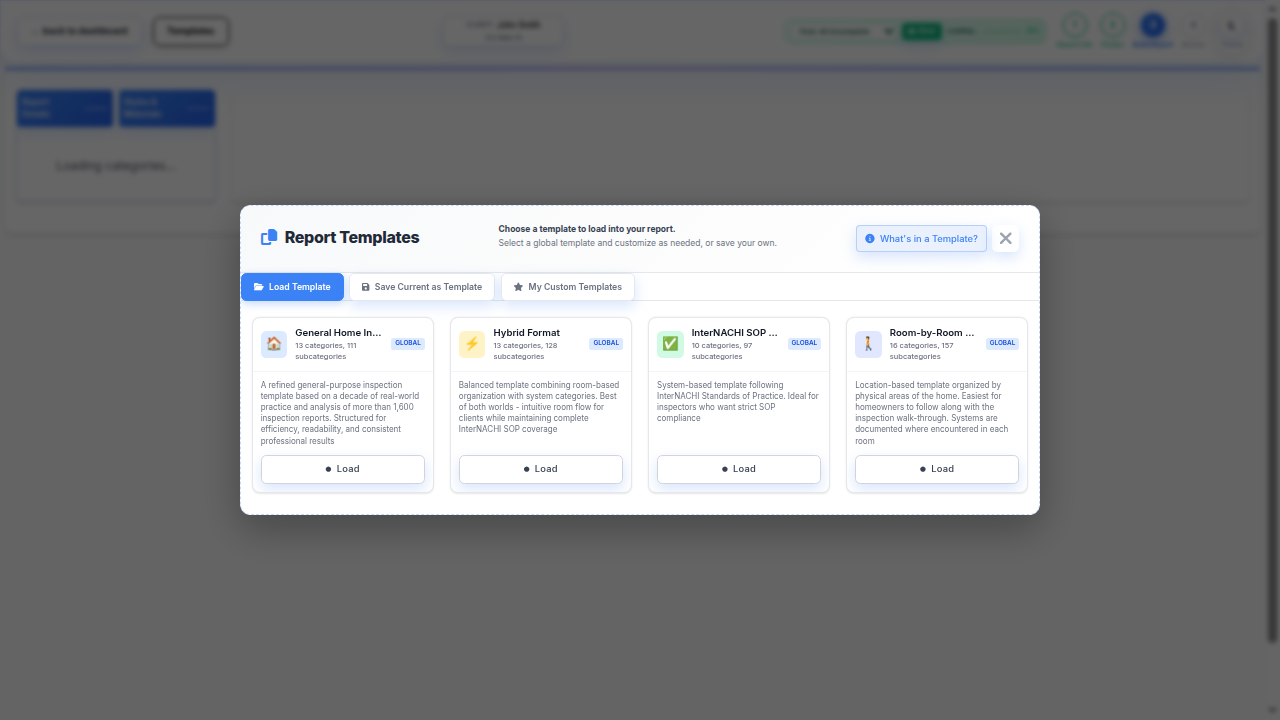
From Camera Footage to Professional PDF
Capture stills from your sewer camera footage, let AI write the condition descriptions, and deliver a polished branded report in minutes. No more blurry screenshots with no context.
See InspectorData for Sewer ScopeKey Features for Sewer Scope Professionals
InspectorData includes documentation features built around the specific needs of sewer scope professionals performing residential lateral inspections.
Sewer Scope Templates
InspectorData's template system lets you build a dedicated sewer scope inspection template covering every section of a residential lateral assessment: access point, cleanout condition, the building drain from access to the street connection, and all observable pipe conditions along the length of the run. Templates include pre-populated sections for pipe material identification, distance tracking, and standard finding categories -- root intrusion, offset joint, pipe belly, cracked section, heavy scale, grease accumulation, infiltration, and structural failure. Starting from a purpose-built template means the framework is already in place before you arrive on-site.
Image Annotation for Clarity
Sewer camera footage is dark, curved, and disorienting to anyone who has not seen it before. InspectorData's annotation tools let you add arrows, circles, and callout labels directly to your still images, pointing to the specific condition you are documenting. An annotated image of root intrusion with an arrow clearly indicating the affected area is dramatically more comprehensible to a homeowner or real estate agent than the same image without annotation. Annotation turns ambiguous footage into unambiguous documentation.
Distance and Location Tracking
Professional sewer scope reports document findings by their distance from the access point. InspectorData's report sections include distance fields for each finding, allowing you to record that the root intrusion begins at 28 feet, the pipe belly is centered at 51 feet, and the cracked joint is at 67 feet. Repair contractors use these measurements to locate conditions for excavation or trenchless repair. Without distance documentation, a repair crew has to run the camera again before they can plan the work -- a cost and time delay that a professional report eliminates.
PDF Delivery with Branding
Every report delivered through InspectorData carries your company name, logo, and contact information on the cover page. The PDF is formatted professionally with your brand identity throughout. When a real estate agent forwards that report to their client, their client's attorney, or the seller's agent, they are sharing a document that looks like it came from a professional operation -- because it did. That brand impression compounds over every report you deliver and every recipient who sees it.
How a Professional Sewer Scope Report Wins You More Work from Real Estate Agents
Real estate transactions are the primary growth engine for most residential sewer scope businesses. A transaction timeline is deadline-driven -- agents and buyers need information quickly, and they need it in a format they can act on. The sewer scope providers who capture and hold real estate agent referrals are overwhelmingly the ones who deliver professional written reports.
The $10K-$40K Threshold Changes Everything
The stakes of a residential sewer scope are not abstract. Studies of sewer lateral conditions in homes undergoing real estate transactions consistently show that roughly 70% of inspected laterals have conditions requiring some level of attention -- and a significant percentage of those have conditions that require $10,000 to $40,000 in repair or replacement work. At those dollar amounts, a buyer's agent has a professional obligation to ensure their client has clear documentation. An agent who receives raw footage cannot fulfill that obligation. An agent who receives a professional PDF report with annotated findings and clear repair urgency classifications can.
Agents Refer Who They Trust to Deliver
A residential real estate agent refers sewer scope work to a provider whose deliverable they can predict. If they have referred you twice and both times received a professional PDF report within an hour of the inspection, they trust that the next referral will produce the same result. If your documentation is inconsistent -- sometimes a report, sometimes just a video, sometimes a verbal summary -- they cannot count on you, and they will eventually find someone more predictable.
Professional sewer scope report software makes your deliverable consistent by making the documentation process systematic. Every inspection produces the same quality of report, in the same format, with the same professional appearance. That consistency is what transforms a one-time referral into a long-term referral partnership with agents who call you first on every transaction.
Your Report Travels Further Than You Do
When a real estate agent forwards your sewer scope report to their buyer's attorney, the seller's agent, the title company, or the repair contractor, your brand goes with it. A professional PDF report introduces your company to people who were not in the room when you ran the camera. Some of them will call you directly on their next property. Some will recommend you to a client. A blurry video screenshot sitting in an email thread does none of that.
Frequently Asked Questions
What should a professional sewer scope report include?
A professional sewer scope report should include a cover page with property address and inspection date, clear still images captured from the camera footage with annotations highlighting specific conditions, professionally written descriptions of each finding, pipe material and diameter documentation, distance measurements to key findings, severity ratings for each condition, and a summary of recommended repairs with estimated urgency. Raw video footage alone is not a professional deliverable -- the report translates what the camera found into actionable information for homeowners and real estate agents.
How much do sewer scope inspections cost, and what issues do they typically find?
Sewer scope inspection costs vary by state and provider — contact your local inspector for accurate pricing.* Studies consistently show that roughly 70% of sewer scopes reveal conditions requiring some level of attention -- ranging from minor root intrusion to major structural failures. Given those stakes, homeowners and real estate agents need a professional written report explaining exactly what was found, not just a raw video file or a verbal summary they cannot share or reference later.
How does InspectorData help sewer scope professionals win more real estate agent referrals?
Real estate agents refer sewer scope work to providers who deliver clear, professional written reports their clients can understand and act on. InspectorData lets sewer scope professionals capture stills from their camera footage, generate AI-written descriptions of each finding, and deliver a polished branded PDF within minutes of completing the inspection. Agents who receive that level of deliverable consistently refer more work to the same provider -- because professional documentation protects their clients and reflects well on the agent who recommended the service.
Start Delivering Professional Sewer Scope Reports
InspectorData turns your sewer camera findings into professional PDF reports with AI-generated descriptions, annotated stills, and branded PDF delivery. $79/month -- free for 30 days.
Start Your 30-Day Free Trial