Most residential electricians leave a service call with a two-line invoice and a handshake. That gap between the technical work performed and the documentation delivered is costing electricians referrals, exposing them to liability disputes, and leaving real money on the table. In 2026, dedicated electrician inspection report software closes that gap -- turning every service visit into a professional, photo-backed PDF delivered to the homeowner before you pull out of the driveway.
The residential electrical market is more competitive than ever. Homeowners and real estate agents have more choices, and they increasingly favor tradespeople who communicate in writing. A professional inspection report after a residential panel upgrade, a pre-sale electrical assessment, or an AFCI/GFCI evaluation tells a client two things: you are thorough, and you stand behind your work. Neither message comes across in a handwritten work order.
This guide covers why electricians need dedicated report software, what capabilities to prioritize, how AI has transformed the documentation process, and how to evaluate which approach works best for your business.
Why Electricians Need Dedicated Report Software
The case for written documentation in residential electrical work comes down to three factors: liability protection, perceived value, and referral generation.
Liability Protection
When a homeowner calls their insurer or an attorney months after your service visit, the question is always the same: what did the electrician find, and what did they recommend? A two-line invoice does not answer that question. A timestamped inspection report with annotated photos, documented conditions, and written recommendations does. That documentation is the most important protection you have if a dispute arises after the fact.
This matters especially in pre-sale electrical assessments and diagnostic visits where you are observing and documenting conditions rather than repairing them. A formal written report with clear scope-of-work language and findings creates a record that protects you and gives the homeowner a clear understanding of what you were retained to evaluate.
Perceived Value and Premium Pricing
Homeowners cannot see the quality of the work behind their walls. What they can see is the quality of the document you leave behind. Electricians who deliver a polished 10-page PDF with annotated photos consistently command higher service fees because the deliverable is tangibly more valuable than a verbal summary. The report makes your expertise visible.
This effect compounds in real estate transactions. Listing agents and buyers' agents want written documentation from licensed electricians, not just verbal assurances. Electricians who can provide professional written reports are positioned to capture pre-listing and pre-purchase assessment work at premium rates.
Referral Generation
A professional report is a marketing asset. Homeowners share reports with spouses, with neighbors, with real estate agents. Every person who sees your report with your company name and logo is a potential referral. Electricians who deliver professional documentation after every residential visit consistently report higher word-of-mouth referral rates -- not because they do better electrical work than the competition, but because the documentation makes their professionalism visible.
What to Look for in Electrician Report Software
Not all field service software is built for inspection-quality documentation. When evaluating electrician inspection report software, these four capabilities separate purpose-built platforms from generic alternatives.
Mobile-First Design
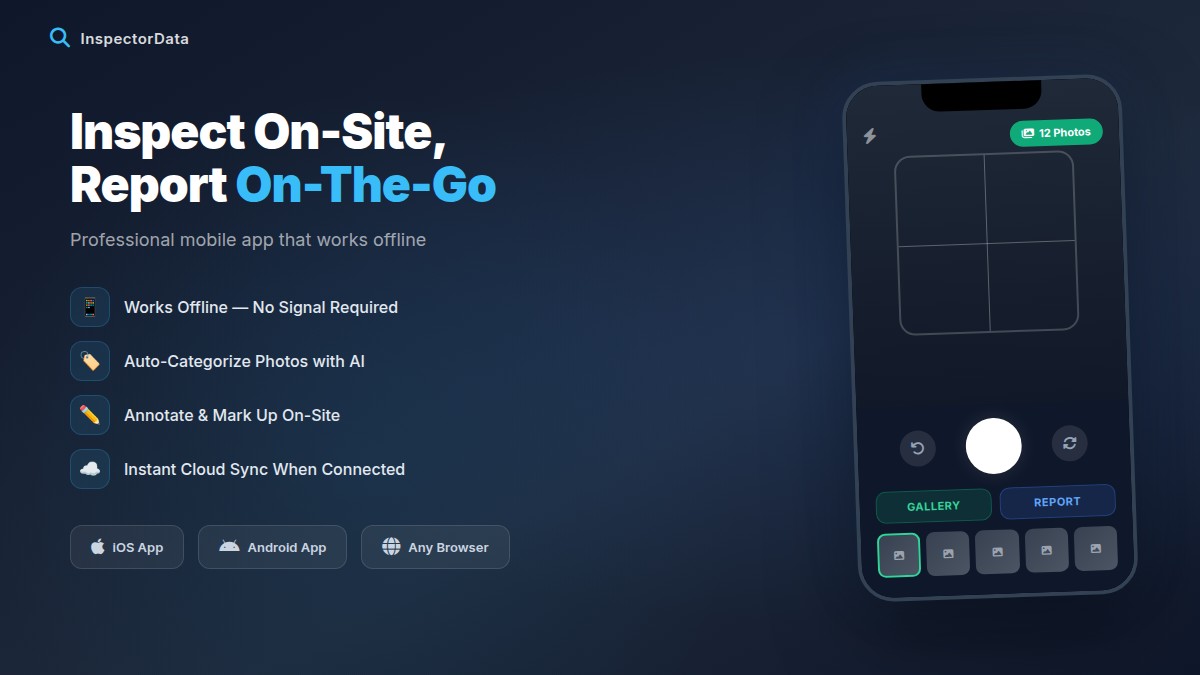
You are working in attics, panel rooms, crawl spaces, and finished basements -- not at a desk. Your report software needs to work on a phone or tablet in the field, with the ability to shoot photos directly into the report, dictate observations by voice, and complete the full documentation workflow without sitting down at a computer. Software that requires desktop finishing adds time rather than saving it.
Structured Inspection Templates
A residential electrical assessment has a predictable structure: service entry, main panel, subpanels, branch circuits, outlets, switches, fixtures, and specialty systems. Good report software ships with pre-built electrical inspection templates that give you this structure ready to go. You document what you found in each section; the template handles everything else. This is the difference between a coherent navigable report and a flat list of notes.
Photo Documentation with Annotation
Photos are the backbone of a credible inspection report. Your software should let you capture images directly into the relevant report section, add annotation arrows to highlight specific issues, and organize photos by component or system. A photo of a double-tapped breaker with an arrow pointing to the specific terminal is far more compelling -- and far more defensible -- than a written description alone.
Professional PDF Output
The final report must look like it came from a professional operation. That means a branded cover page, organized system sections, photos embedded adjacent to relevant comments, clear severity indicators, and a professional summary section. The PDF should be something a homeowner would email to their real estate agent without hesitation.
How AI Speeds Up Documentation
The single biggest barrier to professional documentation for working electricians is time. Writing accurate, professional descriptions of electrical findings takes expertise and effort. AI-powered report software eliminates that barrier by generating the written language automatically from your photos.
The workflow is straightforward. You photograph a condition -- a missing panel knockout, ungrounded outlets in a bathroom, knob-and-tube wiring in the attic -- and the AI analyzes the image and produces a professionally written comment describing the component, the observed condition, the safety implication, and the recommended correction. You review the comment, make any adjustments, and move to the next finding. The AI handles the blank-page problem; you apply your professional judgment to the result.
For common electrical findings that repeat across dozens of service calls -- reversed polarity, missing GFCI protection, double-tapped breakers, improper conductor sizing, missing anti-oxidant compound on aluminum connections -- the AI-generated comment is typically accurate and ready to use with minimal editing. This compresses the documentation time for a typical residential electrical assessment from 45 to 60 minutes of desk work down to 10 to 15 minutes of field documentation.
AI-Generated Electrical Inspection Reports
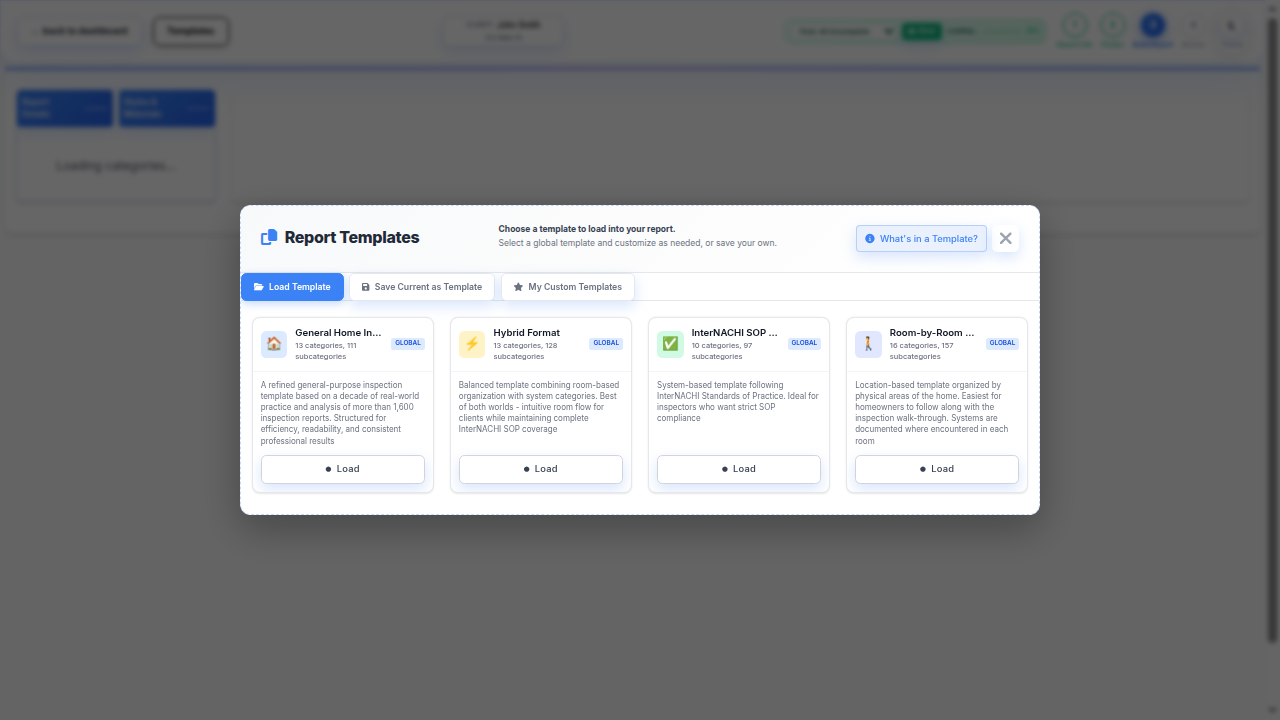
Photograph panels, wiring, outlets, and GFCI locations. InspectorData's AI writes the professional report language automatically -- you review, approve, and deliver a polished PDF before you leave the property.
See InspectorData for ElectriciansComparing Documentation Approaches
Residential electricians currently use one of four documentation approaches. Each has a distinct cost-benefit profile.
| Approach | Time Per Report | Professional Output | Liability Protection |
|---|---|---|---|
| Handwritten invoice / verbal summary | 2 - 5 min | None | Minimal |
| Word processor or Google Docs | 30 - 60 min | Moderate | Moderate |
| Generic field service app | 15 - 30 min | Low | Low - Moderate |
| Purpose-built inspection report software with AI | 10 - 20 min | High | Strong |
Generic field service apps -- work order platforms, invoice software, general-purpose job management tools -- are built for tracking and billing, not for inspection-quality documentation. They lack the hierarchical structure (systems, components, conditions) that produces a navigable report. They have no AI writing assistance, so every word still comes from you. And their PDF output looks like an invoice, not a professional assessment.
Word processors give you flexibility but no structure. A Google Doc can be formatted to look professional, but building and maintaining consistent templates across dozens of reports per month is a significant overhead. Every time you open a blank document, you are starting from scratch on structure, headers, and layout.
Purpose-built inspection report software with AI writing assistance gives you the structure, the AI, and the professional output -- in less time than any other approach.
InspectorData for Electricians
InspectorData is a residential service inspection platform built around a four-step workflow that takes you from job site to delivered report in under 20 minutes.
On arrival at the property, you open the mobile app and work through the home's electrical system, photographing each component and finding directly into the appropriate report section. The app organizes photos automatically -- service entry, main panel, subpanels, branch circuits, outlets, switches, fixtures. You are building the report as you inspect, not reconstructing it afterward from memory.
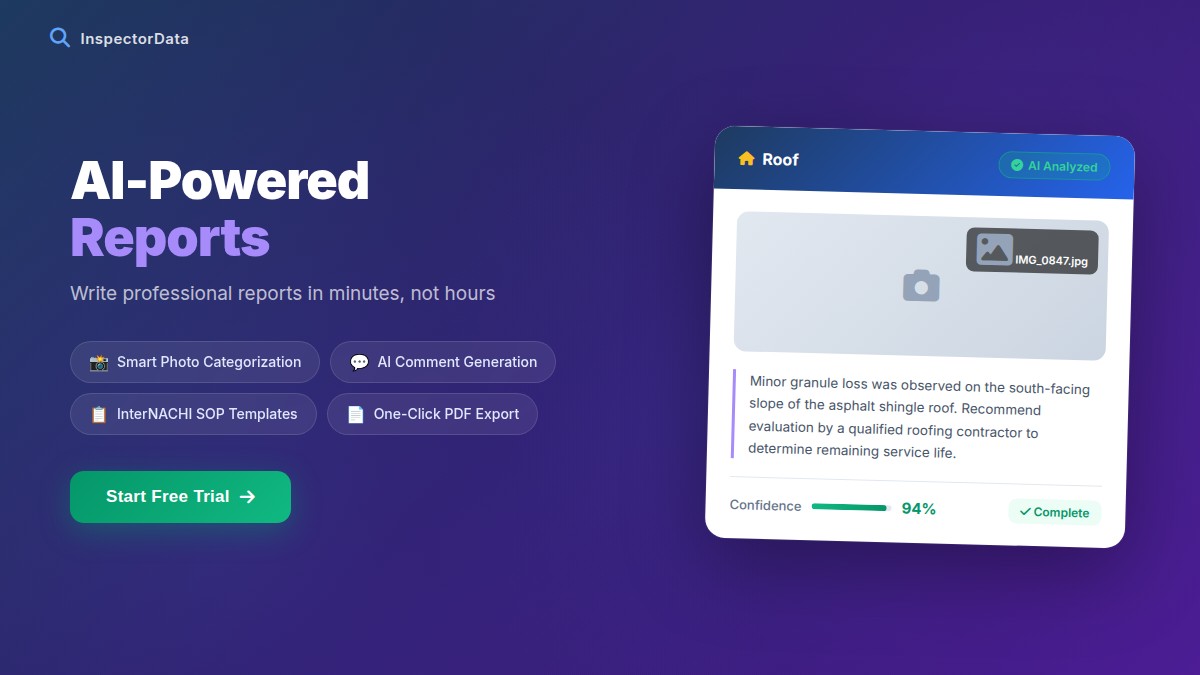
After capturing each photo, the AI analyzes the image and generates a professionally written comment: the component type, the observed condition, the deficiency if present, and the recommended correction. For common findings like missing GFCI protection, double-tapped breakers, ungrounded outlets, or improper wire gauge, the AI comment is typically accurate and ready to use. You review, adjust where needed, and move to the next item.
When the assessment is complete, you generate the PDF with one tap. InspectorData produces a branded, professional document organized by system, with photos and comments formatted for clarity. You deliver the report by email from the app before you leave the property. The homeowner receives a polished PDF that makes the value of your visit immediately apparent.
Getting Started
The fastest path to professional documentation is to start with one template and one inspection type. Set up your standard residential electrical assessment template with your company branding, your most common sections, and two or three pre-written library comments for your most frequent findings. The setup takes about 30 minutes.
On your next residential service call, run the full workflow: photos into the app, AI generates comments, you review, PDF delivered on-site. Time that session. Most electricians complete the full documentation process in 12 to 18 minutes on the first try, and under 10 minutes by the third or fourth report.
From that point, the process is repeatable. Every residential service call produces a professional report. Every report is a liability asset, a marketing asset, and a customer retention tool. The compounding effect of consistent professional documentation is one of the highest-return workflow improvements available to a residential electrician in 2026.
Start Delivering Professional Electrical Inspection Reports
InspectorData gives residential electricians the tools to document every service call with photos, AI-generated comments, and professional PDFs. Free for 30 days.
Start Your 30-Day Free Trial