- 1 Your Inspection Report Is Your Negotiation Weapon
- 2 Understanding Your Inspection Report
- 3 What You Can Negotiate
- 4 What You Should Not Negotiate
- 5 5 Negotiation Strategies That Work
- 6 Sample Negotiation Letter Template
- 7 When to Walk Away: Deal-Breaker Defects
- 8 Market Conditions and Negotiation Power
- 9 Working with Your Agent During Negotiations
- 10 Frequently Asked Questions
You got the inspection report back, and it is 40 pages of findings, photos, and recommendations. Some items look serious. Others seem minor. Now you need to figure out what to ask for -- and how to ask for it without killing the deal. This guide walks you through exactly how to negotiate after a home inspection, from understanding your report to crafting a repair request that sellers actually respond to.
The inspection report isn't for the buyer. It's for the negotiation. Most buyers read it like a to-do list. Smart buyers use it as leverage. Lead with safety, not savings — "the panel is a fire hazard" works better than "we want $3,000 off."
Seller credits are usually better than asking for repairs. You control the contractor, the timing, and the quality. Know the 10% rule: if repairs exceed 10% of the home price, most buyers walk. This guide covers all of it — including a sample negotiation letter you can use today.
Your Inspection Report Is Your Negotiation Weapon
A home inspection report is not just a list of problems -- it is the single most powerful negotiation tool a buyer has after going under contract. According to industry data, approximately 86% of home inspections uncover at least one defect the buyer was unaware of. Roughly 20-30% of inspections reveal issues significant enough to change the sale price or terms.
The key is understanding that your ability to negotiate after a home inspection depends entirely on two things: the quality of your inspection report and how you present your requests. A vague complaint about "the roof looks old" carries no weight. A detailed finding that states "the roof has multiple layers of shingles, active leaks at two penetration points, and an estimated remaining life of 1-2 years -- replacement cost $8,500 to $12,000" is a completely different conversation.
This is why the inspection itself matters so much. A thorough inspector who documents findings with photographs, measurements, and professional language gives your agent the ammunition needed to negotiate effectively on your behalf. A thin report with generic comments makes it much harder to justify your requests.
Understanding Your Inspection Report
Before you can negotiate after a home inspection, you need to understand what you are looking at. Most professional inspection reports organize findings by severity. Here is how to think about the three tiers:

Safety Hazards -- Immediate Action Required
These are findings that pose a direct risk to the occupants of the home. They carry the most negotiating weight because they must be addressed regardless of the sale.
- Electrical hazards -- double-tapped breakers, ungrounded outlets in wet areas, exposed wiring, Federal Pacific or Zinsco panels
- Gas leaks or improperly vented gas appliances (carbon monoxide risk)
- Structural deficiencies -- cracked foundations, sagging beams, compromised load-bearing walls
- Water intrusion that has led to active mold growth
- Missing or non-functional safety devices -- no smoke detectors, missing handrails on elevated decks, absence of GFCI protection in kitchens and bathrooms
Major Defects -- Expensive to Repair
These are systems or components that are significantly deficient or at the end of their useful life. They may not be immediately dangerous, but they represent substantial costs the buyer will face.
- Roof nearing end of life -- curling shingles, granule loss, multiple layers, evidence of past leaks
- HVAC system failure or system beyond expected lifespan with poor performance
- Plumbing deficiencies -- galvanized pipes with restricted flow, polybutylene piping, main sewer line issues
- Water heater beyond its expected life or showing signs of failure
- Foundation issues -- significant settling, horizontal cracks in block walls, bowing basement walls
- Moisture and drainage problems -- poor grading directing water toward the foundation, failed sump pump, inadequate guttering
Minor and Maintenance Items -- Low Priority
These are items that are normal wear and tear, deferred maintenance, or minor cosmetic issues. They are worth knowing about for your maintenance planning, but they generally should not be part of your repair request after inspection.
- Caulking that needs refreshing around tubs, windows, or exterior trim
- Minor cosmetic damage -- small nail pops in drywall, scuffed paint, worn carpet
- Dirty HVAC filter (a $10 fix)
- Loose doorknobs, sticky windows, running toilets
- Aged but functional appliances
What You Can Negotiate
When you negotiate after a home inspection, you have four main options. Your agent can help determine which approach works best for your specific situation and market conditions.
1. Request Repairs Before Closing
You ask the seller to fix specific items before the closing date. This is the most straightforward approach, but it has risks: you are relying on the seller to hire qualified contractors and complete the work properly. Some buyers attend a re-inspection to verify the repairs were done correctly.
Best for: Safety issues that must be fixed (electrical hazards, gas leaks, structural repairs) and items where the quality of repair matters and you want to verify the work.
Watch out for: Sellers hiring the cheapest contractor or doing shoddy DIY repairs. If you go this route, specify that repairs must be done by licensed professionals and that you will verify with a re-inspection.
2. Request a Seller Credit at Closing
Instead of asking the seller to make repairs, you ask for a credit at closing -- essentially a reduction in your closing costs that gives you cash to handle repairs yourself after you move in. This is the most popular approach because it gives you control over the work.
Best for: HVAC replacement, roof work, plumbing updates, and other items where you want to choose your own contractor and oversee the work quality.
Watch out for: Lender limits on seller credits. FHA loans cap seller concessions at 6% of the purchase price. Conventional loans cap them at 3-6% depending on down payment. Your lender can confirm the maximum credit allowed.
3. Negotiate a Price Reduction
You ask the seller to lower the purchase price to account for needed repairs. This is different from a closing credit because it actually changes the sale price, which affects your mortgage amount, property taxes, and the home's appraised value.
Best for: Situations where the total needed repairs significantly affect the home's value, or when seller credits would exceed lender limits.
Watch out for: A lower sale price could affect the appraisal. If the home already appraised right at the contract price, a price reduction could push it below the appraised value -- which is actually fine for the buyer. But if the appraisal was already tight, this approach is less likely to create issues than you might think.
4. Request a Home Warranty
You ask the seller to purchase a home warranty that covers major systems and appliances for the first year of ownership. This is a common request when the inspection reveals aging systems that are still functional but may fail in the near future.
Best for: Aging HVAC, water heater, or appliances that are working now but approaching the end of their lifespan. Also useful as a compromise when the seller resists larger repair requests.
| Negotiation Option | Buyer Advantage | Typical Amount |
|---|---|---|
| Seller Repairs | Issue fixed before you move in | Varies by scope |
| Closing Credit | You control the contractor and quality | $1,000 - $15,000+ |
| Price Reduction | Lower mortgage, lower taxes | $2,000 - $20,000+ |
| Home Warranty | Coverage for aging systems | Varies by provider |
What You Should Not Negotiate
Knowing what not to ask for is just as important as knowing what to request. Overreaching with your repair request after inspection is one of the fastest ways to antagonize a seller and derail the deal. Here are the items that should generally stay off your negotiation list:
| Negotiate This | Do Not Negotiate This |
|---|---|
| Roof replacement (end of life, active leaks) | Cosmetic roof wear with years of life remaining |
| Electrical panel replacement (safety hazard) | Outdated but safe and functional electrical |
| Foundation repair (structural concern) | Hairline settling cracks (normal in most homes) |
| HVAC replacement (system failed or failing) | HVAC that works but is not the newest model |
| Plumbing repairs (active leaks, sewer issues) | Slow drains or minor faucet drips |
| Mold remediation (confirmed mold growth) | General musty smell in basement |
| Missing smoke/CO detectors (safety code) | Paint touch-ups, nail pops, worn carpet |
The general rule: If the issue existed when you toured the home and made your offer, it is not an inspection finding -- it is something you already factored into your offer price (or should have). The inspection contingency is designed to protect you from hidden defects, not to renegotiate the price of a home you already agreed to buy.
Similarly, cosmetic issues, normal wear and tear, and deferred maintenance items that do not affect the home's safety or structural integrity are typically not appropriate repair requests. A list that includes "repaint the master bedroom" and "replace the kitchen faucet" alongside "fix the cracked foundation" undermines the credibility of the entire request.
5 Negotiation Strategies That Work
After reviewing thousands of inspection reports and the home inspection negotiations that follow, these are the strategies that consistently produce results for buyers.

Strategy 1: Lead with Safety, Not Cost
Frame your requests around safety and code compliance first, not money. Safety-based requests are harder for a seller to refuse because they create liability if ignored.
❌ "We want $3,000 off the price for the electrical panel."
✅ "The inspector identified a Federal Pacific panel with documented fire hazard risk. We request the seller replace it with a 200-amp panel by a licensed electrician prior to closing."
The first is a negotiating position. The second is a documented safety finding the seller's agent cannot ignore without accepting liability.
Strategy 2: Get Contractor Estimates
Do not guess at repair costs. Before submitting your repair request, get written estimates from licensed contractors for the major items. When your request says "licensed roofer estimates replacement at $9,200 -- see attached estimate," the seller cannot argue with the number. Without an estimate, the seller will assume you are inflating the cost.
Strategy 3: Prioritize and Bundle
Organize your requests into "must-have" and "nice-to-have" categories. Lead with your must-haves -- the safety issues and major defects that genuinely affect the home's value and livability. Include the nice-to-haves as a secondary list. This gives both sides room to negotiate without sacrificing the items that matter most to you.
Strategy 4: Offer Flexibility on the Solution
Instead of demanding one specific outcome, offer the seller options. For example: "We request either (a) the seller repair the roof prior to closing by a licensed contractor with a transferable warranty, or (b) a closing credit of $9,200 for the buyer to handle the repair after closing." This shows good faith and makes it easier for the seller to say yes.
Strategy 5: Keep Emotion Out of It
This is a business transaction. Your repair request should read like a professional document, not a complaint letter. Stick to facts: what the inspector found, what it means, and what it costs to fix. Avoid language like "we are shocked" or "this is unacceptable." The tone should be matter-of-fact, not adversarial.
Sample Negotiation Letter Template
Your real estate agent will typically draft the formal repair request (also called a "repair addendum" or "inspection response"), but it helps to know what an effective one looks like. Here is a template structure that works well when you negotiate after a home inspection:
Subject: Buyer's Inspection Response -- [Property Address]
Following the home inspection conducted on [date] by [Inspector Name, Certification], the Buyer requests the following based on the findings documented in the attached inspection report:
Safety and Structural Items (Must Address):
1. Electrical Panel: The inspector identified double-tapped breakers and evidence of overheating at the main panel (Report p.12, Photos 18-20). Buyer requests seller replace the electrical panel with a 200-amp panel by a licensed electrician prior to closing. Estimated cost: $2,200-$2,800.
2. Roof: The inspection revealed active leaking at two flashing points and shingles beyond their serviceable life with an estimated 1-2 years remaining (Report p.8, Photos 5-11). Buyer requests a closing credit of $9,200 based on the attached contractor estimate from [Roofing Company].
3. Foundation: Horizontal cracking was observed along the east basement wall with inward bowing of approximately 3/4 inch (Report p.22, Photos 31-34). Buyer requests seller obtain a structural engineer's evaluation and complete recommended repairs prior to closing.
Major System Items (Request Credit):
4. HVAC: The furnace (manufactured 2006, 20 years old) is operating beyond its expected lifespan and showed a cracked heat exchanger (Report p.15). Buyer requests a closing credit of $5,500 for replacement.
Alternative: In lieu of the above individual items, Buyer will accept a total closing credit of $[amount] or a purchase price reduction of $[amount] to address all items listed above.
Buyer retains the right to a re-inspection to verify any repairs completed by the Seller prior to closing.
When to Walk Away: Deal-Breaker Defects
Many buyers and agents use a simple benchmark: if the total cost of necessary repairs exceeds 10% of the home's purchase price, the math often favors walking away.
Example: On a $350,000 home, $35,000 in required repairs changes your effective purchase price to $385,000 — and you take on all the project risk on top of that.
This isn't a hard rule. Use it as a starting point for a conversation with your agent, not an automatic trigger.
Sometimes the inspection reveals problems so significant that no amount of negotiation can make the deal work. Your inspection contingency exists specifically to protect you in these situations. Here are the home inspection findings that most often justify walking away:
- Major structural failure -- severely compromised foundation, significant load-bearing wall damage, or extensive settling that would cost tens of thousands to repair with no guarantee of a permanent fix
- Extensive mold or environmental contamination -- widespread mold throughout the home, asbestos in deteriorating condition, or soil contamination that creates health risks and remediation costs exceeding $20,000+
- Sewer or septic system failure -- collapsed sewer line requiring full replacement, failed septic system requiring new drainfield, or municipal requirements to connect to city sewer at $10,000-30,000+
- Unpermitted additions or major modifications -- room additions, finished basements, or electrical/plumbing work done without permits that the city may require you to tear out or bring to code at enormous expense
- Seller unwillingness to negotiate -- if the seller refuses to address legitimate safety concerns that would cost you $15,000-20,000+ out of pocket immediately after closing, the home may not be worth the agreed-upon price
- Water damage with unknown scope -- when the inspection reveals moisture damage but the full extent is hidden behind walls, under flooring, or in inaccessible areas, the repair cost becomes a gamble you may not want to take
Walking away is not failure. It is the inspection contingency working exactly as intended. If the home has problems that fundamentally change its value or livability, and the seller will not make it right, the smartest move is often to cancel the contract, get your earnest money back, and find a home that does not come with a six-figure repair list.
That said, most deals do not reach this point. The majority of home inspection negotiations result in a compromise both parties can live with -- a credit here, a repair there, maybe a home warranty to cover aging systems. Walking away is the last resort, not the first reaction.
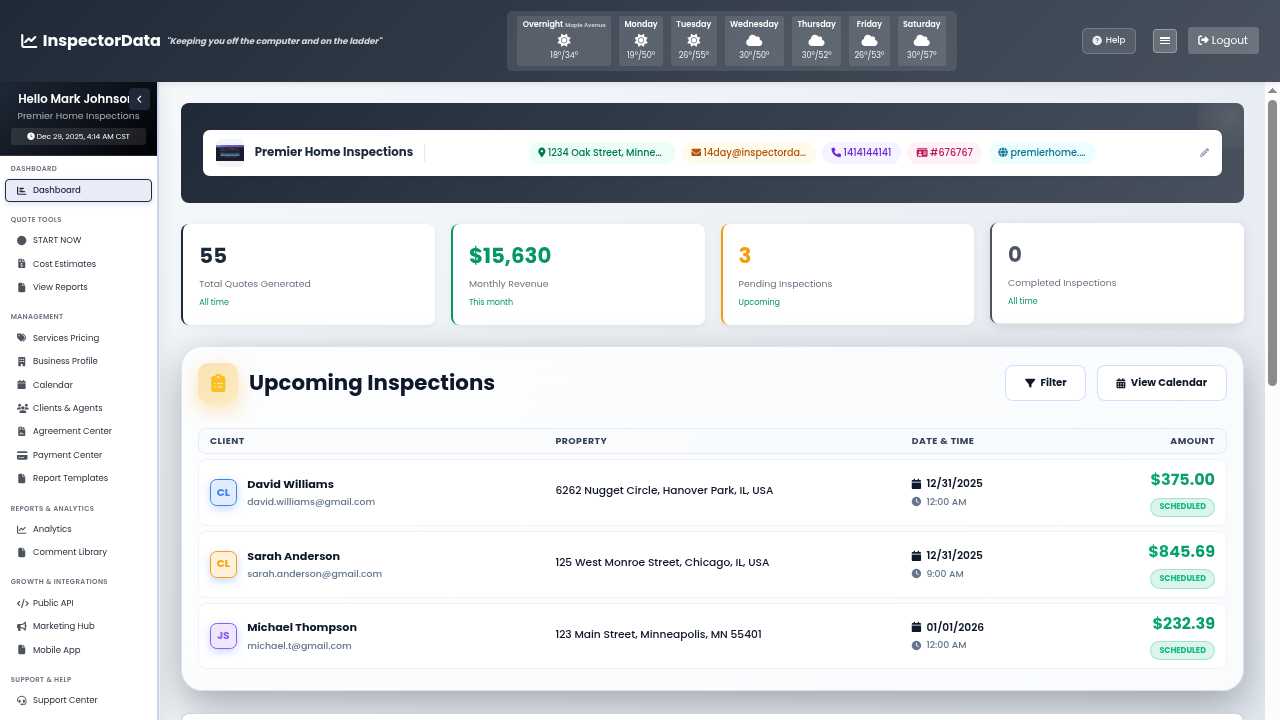
Reports That Give Buyers Negotiating Power
InspectorData's AI-powered report writer produces detailed, photo-rich inspection reports with professional narratives. Every finding is documented with clarity that holds up in negotiations.
See the Report WriterMarket Conditions and Negotiation Power
Your ability to negotiate after a home inspection depends heavily on local market conditions. The same inspection findings can lead to very different outcomes depending on whether you are buying in a buyer's market or a seller's market.
Buyer's Market (Advantage: You)
When inventory is high and homes are sitting on the market, buyers have significant negotiation leverage. In a buyer's market:
- Sellers are more likely to agree to repair requests because they know finding another buyer may take weeks or months
- Larger credits and price reductions are more common
- You can push harder on major defects without worrying about the seller simply moving to the next offer
- Inspection contingencies are standard and expected
Seller's Market (Advantage: Seller)
When inventory is low and multiple offers are common, sellers have less incentive to negotiate. In a seller's market:
- Many buyers waive the inspection contingency entirely to make their offer more competitive (this is risky and generally not recommended)
- Sellers may refuse any repair requests because they have backup offers ready
- Focus your requests only on safety hazards and true deal-breakers -- the seller is less likely to negotiate on anything else
- A seller credit or home warranty may be a more realistic ask than demanding repairs or price reductions
Balanced Market
In a balanced market, most sellers will negotiate on legitimate safety and major system concerns. This is where the quality of your inspection report matters most. A well-documented finding with contractor estimates makes it hard for the seller to say no. A vague complaint makes it easy for them to push back.
Working with Your Agent During Negotiations
Your real estate agent is your negotiation partner. They have experience with dozens or hundreds of inspection negotiations and know what works in your local market. Here is how to work with them effectively:
Before the Inspection
- Ask your agent to recommend a thorough, well-credentialed inspector who produces detailed reports -- this is the foundation of your negotiating position
- Discuss your deal-breakers in advance so your agent knows your priorities
- Understand your inspection contingency timeline -- most contracts give you 7-10 days to complete the inspection and submit requests
After the Inspection
- Share the full report with your agent immediately
- Walk through the findings together and categorize them: safety, major, minor
- Let your agent advise on what to include in the repair request based on their knowledge of the seller's situation and motivation
- Get contractor estimates for the biggest items before your agent submits the request
- Trust your agent's judgment on tone and approach -- they know the seller's agent and the dynamics of the negotiation
During Negotiations
- Be prepared for a counter-offer -- the seller may agree to some items and reject others
- Know your walkaway number in advance so you can make decisions quickly
- Let your agent handle all communication with the seller's side -- that is what they are trained for
- Stay focused on the big picture: is this the right home at the right price with the right terms?
Frequently Asked Questions
Can a seller refuse to negotiate after a home inspection?
Yes. The seller is not obligated to repair anything or offer any credit. They can accept your requests, counter with a partial response, or refuse entirely. If they refuse and you have an inspection contingency in your contract, you can typically cancel the purchase and get your earnest money back. The inspection contingency protects your right to walk away if the findings are unacceptable.
How much can I ask for after a home inspection?
There is no fixed limit, but your requests should be proportional to the findings and supported by documentation. Let the inspection findings and contractor estimates drive the number, not a percentage you picked in advance. Reasonable repair credits based on documented safety and major system issues are common and expected.
Should I negotiate repairs or a credit?
In most cases, a closing credit is the better option for the buyer. It gives you control over who does the work, when they do it, and to what standard. When you ask the seller to make repairs, you are trusting them to hire qualified contractors and ensure quality work -- and their incentive is to spend as little as possible. The exception is safety items that must be fixed before you move in (gas leaks, electrical hazards), where asking the seller to complete the repair before closing makes more sense.
What if the appraisal is lower than the agreed price after my inspection negotiation?
If you negotiated a price reduction and the appraisal comes in at or above the new price, you are fine. If the appraisal comes in lower than even the reduced price, you have additional negotiation leverage -- now the lender's appraisal supports an even lower value. Your agent can help navigate this situation, which sometimes results in a further price reduction.
How long do I have to negotiate after a home inspection?
Your purchase contract specifies the inspection contingency period, typically 7-30 days from the date the contract is executed. You need to complete the inspection, review the report, gather any contractor estimates, and submit your repair request within this window. Missing the deadline can mean losing your right to negotiate or your ability to cancel based on inspection findings.
Can I negotiate after a home inspection on new construction?
Yes, and you should. New construction inspections frequently find code violations, incomplete work, and installation defects. Builders are generally responsive to inspection findings because they have warranty obligations and do not want code violation documentation floating around. A pre-closing inspection on new construction is one of the smartest investments a buyer can make.
Inspectors: Reports That Win Negotiations
InspectorData's AI-powered report writer produces the detailed, photo-rich reports that give buyers real negotiating power. 8,000+ professional comments, drag-and-drop photos, and one-click delivery -- $79/month, 30-day free trial.
Start Your Free Trial