- 1 Average Home Inspection Cost
- 2 Costs by Region
- 3 Home Inspection Cost by State
- 4 Costs by Property Type & Size
- 5 What Affects the Price
- 6 Additional Services & Add-Ons
- 7 Who Pays for the Inspection?
- 8 Is a Home Inspection Worth the Cost?
- 9 How to Get the Best Value
- 10 For Inspectors: Setting Your Prices
- 11 Frequently Asked Questions
Skipping a home inspection to save money — or to win a bidding war — is how buyers end up buying a $300,000 home with a $30,000 foundation problem they didn't know about. The inspection isn't the expense. Not getting one is.
Home inspection costs vary significantly by state, property size, age, and the services you add. Pricing differs across every market — contact your local inspector for an accurate quote. We do not provide pricing for individual contractors. This guide explains the factors that influence what you'll pay.
Quick Answer
A home inspection costs $300-$500 on average for a standard single-family home. Prices vary by square footage, location, age of home, and additional services like radon testing or sewer scopes. Most inspectors charge a base fee plus add-ons.
Average Home Inspection Cost in 2026
Based on industry data and pricing from inspectors across the country, here are the baseline numbers:
These prices cover a standard visual inspection of the home's major systems: structural components, exterior, roofing, plumbing, electrical, HVAC, interior, insulation, and ventilation. The inspector produces a detailed report with findings, photographs, and recommendations.
Home Inspection Costs by Region
Geography is one of the biggest factors in inspection pricing. Cost of living, state licensing requirements, and local market competition all influence what inspectors charge in your area.
Metropolitan areas consistently run higher than rural areas within the same region. A home inspection in downtown Denver or Seattle may cost 20-30% more than one in a small town an hour away. This reflects higher operating costs for the inspector, not necessarily a better inspection.
Inspectors: Let Clients See Your Pricing Instantly
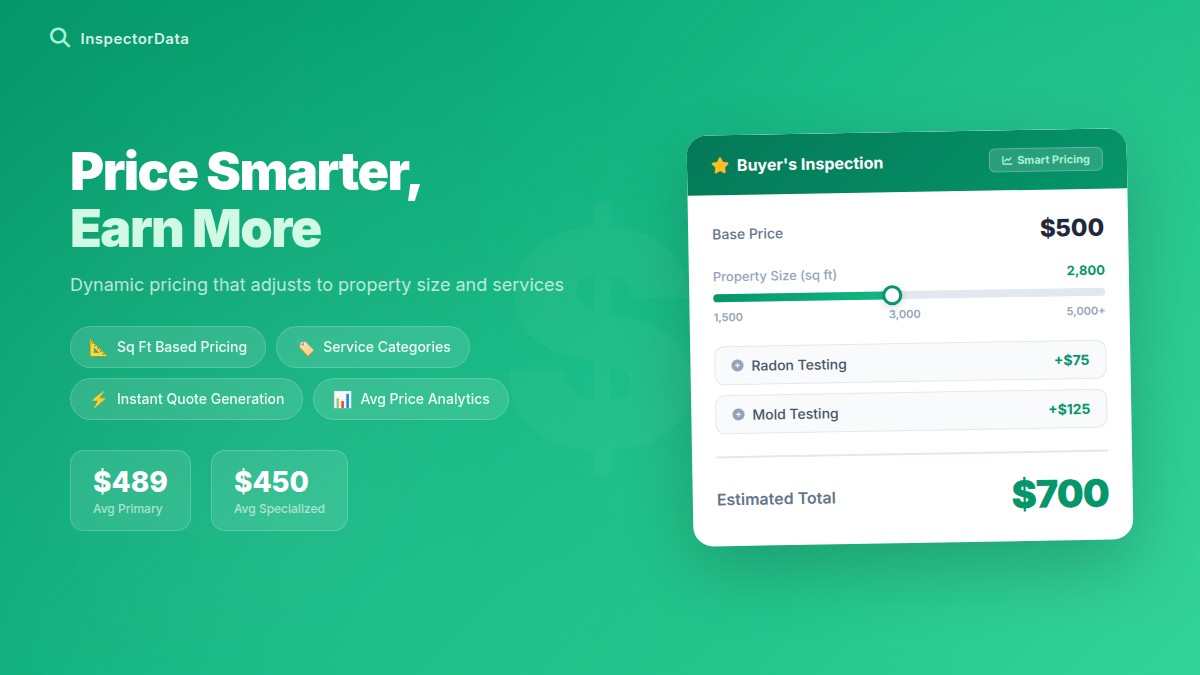
InspectorData's embeddable quote calculator shows homebuyers an instant price based on property size, age, and services. More transparency means more bookings.
See the Quote CalculatorHome Inspection Cost by State (2026 Estimates)
State-level pricing is shaped by cost of living, licensing and continuing-education requirements, insurance costs, and how competitive the local inspection market is. The ranges below reflect defensible industry estimates for a standard single-family home inspection — they are not quotes for any specific inspector, and individual pricing in your city may fall outside these bands. For an exact figure, contact a licensed inspector in your area.
| State | Typical Cost Range | Cost Tier |
|---|---|---|
| California | $400 - $650 | Higher |
| Washington | $400 - $625 | Higher |
| New York | $400 - $650 | Higher |
| Massachusetts | $400 - $625 | Higher |
| Oregon | $375 - $575 | Higher |
| Colorado | $375 - $575 | Higher |
| New Jersey | $400 - $600 | Higher |
| Connecticut | $400 - $600 | Higher |
| Virginia | $350 - $525 | Moderate |
| Arizona | $350 - $525 | Moderate |
| Nevada | $350 - $525 | Moderate |
| Illinois | $350 - $525 | Moderate |
| Florida | $300 - $500 | Moderate |
| Georgia | $325 - $500 | Moderate |
| North Carolina | $325 - $500 | Moderate |
| Texas | $300 - $500 | Moderate |
| Pennsylvania | $325 - $500 | Moderate |
| Minnesota | $325 - $500 | Moderate |
| Tennessee | $300 - $475 | Lower |
| Ohio | $300 - $475 | Lower |
| Michigan | $300 - $475 | Lower |
| Indiana | $300 - $450 | Lower |
| Missouri | $300 - $450 | Lower |
| Alabama | $300 - $450 | Lower |
| Oklahoma | $300 - $450 | Lower |
| Kentucky | $300 - $450 | Lower |
| Iowa | $300 - $450 | Lower |
| Kansas | $300 - $450 | Lower |
| Most other states | $300 - $500 | Varies |
A few patterns hold across nearly every state. First, metro areas consistently price 15–30% above rural areas in the same state. Second, states with mandatory licensing and continuing education tend to support slightly higher fees because the barrier to entry is higher. Third, the figures above are for the base inspection only — in states like Florida, where wind mitigation and 4-point inspections are commonly required for insurance, buyers frequently add those services, raising the total out-of-pocket cost.
Costs by Property Type & Size
Property characteristics directly impact how long an inspection takes and therefore how much it costs.
By Square Footage
Most inspectors use square footage as a primary pricing factor. Larger homes take longer to inspect because there are more systems, more rooms, and more components to evaluate.
| Home Size | Typical Inspection Time | Estimated Cost |
|---|---|---|
| Under 1,000 sq ft | 1.5 - 2 hours | $350 - $475 |
| 1,000 - 2,000 sq ft | 2 - 3 hours | $400 - $575 |
| 2,000 - 3,000 sq ft | 3 - 4 hours | $500 - $675 |
| 3,000 - 4,000 sq ft | 3.5 - 4.5 hours | $575 - $800 |
| 4,000+ sq ft | 4+ hours | $700 - $1,000+ |
By Property Type
| Category | Price Range | Average |
|---|---|---|
| Standard Home Inspection | $400 - $700 | $500 - $550 |
| Condo / Townhouse | $350 - $500 | $400 - $450 |
| Large Home (3,000+ sq ft) | $550 - $900+ | $600 - $700 |
| Older Home (pre-1970) | $500 - $800 | $550 - $650 |
| New Construction | $450 - $650 | $500 - $550 |
- Multi-family (duplex, triplex, fourplex) -- Expect to pay more per additional unit due to separate kitchens, bathrooms, and systems
- Commercial properties -- Commercial inspections are a different scope entirely and typically start at $1,000+
What Affects the Price of a Home Inspection?
Beyond square footage and location, several other factors influence your final inspection cost:
Age of the Home
Older homes typically take longer to inspect because they have more potential issues. A home built in 1960 likely has different plumbing, wiring, and structural considerations than one built in 2020. Inspectors may charge more for homes over 40-50 years old to account for the additional time and attention required.
Number of Bedrooms and Bathrooms
More bathrooms mean more plumbing fixtures, more GFCI outlets to test, more exhaust fans to evaluate, and more tile and caulking to inspect. Some inspectors base their pricing partly on bedroom/bathroom count rather than square footage alone.
Crawl Space vs. Basement vs. Slab
Properties with both a basement and a crawl space take longer to inspect than slab-on-grade homes. Crawl spaces require physical entry (when accessible and safe), which adds time to the inspection.
Accessibility and Condition
Vacant homes with all utilities on are the easiest to inspect. Occupied homes with cluttered areas, pets that need to be managed, or utilities that are turned off create additional challenges that may affect the inspector's ability to complete a thorough evaluation.
Inspector Qualifications
Experience and credentials affect pricing. A Certified Master Inspector (CMI) with thousands of inspections will typically charge more than a recently certified inspector -- and the higher price usually reflects a more thorough inspection based on field-tested knowledge of what to look for.
Additional Services & Add-Ons
A standard home inspection covers the major systems, but many inspectors offer add-on services for a more complete picture of the property. These are priced separately and are worth considering based on the property's characteristics.

| Add-On Service | Typical Cost | When to Get It |
|---|---|---|
| Radon Testing | Varies by inspector | Recommended in radon-prone areas (most of the US except coastal regions) |
| Sewer Scope / Camera Inspection | Varies by inspector | Strongly recommended for homes over 20 years old; identifies root intrusion, bellied lines, and deterioration |
| Termite / Wood-Destroying Insect | Varies by inspector | Often required by lenders; essential in termite-prone regions (Southeast, Southwest) |
| Mold Testing | Varies by inspector | When visible mold or moisture issues are present; lab analysis of air or surface samples |
| Well Water Testing | Varies by inspector | Required for homes on private wells; tests for bacteria, nitrates, and other contaminants |
| Septic Inspection | Varies by inspector | Required for homes on private septic systems; includes tank pumping and evaluation |
| Thermal Imaging | Varies by inspector | Can reveal hidden moisture, insulation gaps, and electrical hotspots not visible to the naked eye |
| Pool / Spa Inspection | Varies by inspector | For homes with in-ground or above-ground pools; evaluates equipment, surface, and safety features |
| Wind Mitigation (FL) | Varies by inspector | Florida-specific; documents roof construction for insurance discount eligibility |
| 4-Point Inspection (FL) | Varies by inspector | Florida-specific; evaluates roof, electrical, plumbing, and HVAC for insurance qualification |
Who Pays for the Home Inspection?
In the vast majority of real estate transactions, the buyer pays for the home inspection. This is because the inspection is performed for the buyer's benefit -- it helps you understand what you are purchasing and gives you leverage for negotiations.
There are some exceptions:
- Pre-listing inspections -- Some sellers order an inspection before listing to identify and address issues proactively. The seller pays in this case.
- Negotiated arrangements -- In some markets or situations, the seller may agree to cover the inspection cost as part of the negotiation.
- New construction -- Builders may include an inspection as part of the sale, though buyers are generally better served by hiring their own independent inspector.
The home inspection fee is typically paid directly to the inspector at or before the time of the inspection, not through the closing process. Most inspectors accept credit cards, checks, and sometimes electronic payment.
Is a Home Inspection Worth the Cost?
Absolutely. Here is the math that makes the case:
A home inspection represents a small fraction of the total purchase price — typically well under 1%. On a major purchase, the cost of a professional inspection is one of the best investments you can make.
What you get for that 0.1%:
- Knowledge of hidden defects that could cost thousands or tens of thousands to repair
- Negotiating leverage -- inspection findings commonly result in seller credits or price reductions of $2,000 to $10,000+
- Walk-away protection -- if the inspection reveals deal-breaking issues, most purchase contracts allow you to cancel during the inspection contingency period
- Safety awareness -- electrical hazards, gas leaks, carbon monoxide risks, and structural concerns identified before you move in
- Maintenance roadmap -- the report serves as a guide for what to maintain and what to budget for in the coming years
According to industry data, approximately 86% of home inspections identify at least one defect that the buyer was unaware of. Roughly 20-30% of inspections find issues significant enough to affect the sale price or terms.
An inspection that identifies a major foundation issue before you close is not an expense -- it is one of the best investments in the entire home-buying process.
How to Get the Best Value
We do not recommend choosing your inspector based on price alone. Instead, focus on getting the best value:
- Check qualifications. Look for certifications like InterNACHI Certified Professional Inspector (CPI) or Certified Master Inspector (CMI). These require demonstrated experience and ongoing education.
- Read reviews. Google reviews, Yelp, and referrals from your real estate agent can help identify inspectors known for thoroughness.
- Ask about the report format. A modern, photo-rich digital report is far more useful than a handwritten checklist. Ask to see a sample report before booking. Inspectors who use dedicated report writing software tend to produce more consistent, professional results.
- Bundle add-on services. Getting radon testing and a sewer scope at the same time as your inspection saves scheduling hassle and often comes with a package discount.
- Attend the inspection. Being present lets you ask questions and see issues firsthand -- getting more value from the fee you are already paying.
- Use the report for negotiations. A detailed inspection report with professional photos and descriptions gives your agent stronger ammunition for repair requests or price adjustments.
Find a Qualified Inspector Near You
InspectorData-powered inspectors deliver AI-enhanced reports with detailed photos and professional narratives. Find one in your area.
Browse InspectorsFor Inspectors: Setting Your Prices Right
If you are a home inspector reading this, pricing your services correctly is one of the most important business decisions you will make. Charge too little and you devalue the profession while working harder for less. Charge too much without the credentials and report quality to back it up, and you lose bookings to competitors.
Factors to Consider When Setting Your Rates
- Your local market -- Research what other inspectors in your area charge. You do not need to be the cheapest, but you should be competitive for your experience level.
- Your operating costs -- Software, insurance (E&O and general liability), vehicle expenses, continuing education, marketing, and your time all need to be covered by your pricing.
- Your experience and credentials -- As you gain experience and certifications, you can and should increase your rates. A CMI with 10 years of experience should not charge the same as a first-year inspector.
- Value-based pricing -- Price based on the value you deliver, not just the time you spend. If your AI-powered reports and extensive comment library produce a better product, that warrants premium pricing.
Making Pricing Easy for Clients
One of the biggest friction points in getting bookings is the quoting process. When a potential client has to call or email for a price, many will move on to a competitor who shows pricing online. An instant quote calculator on your website removes this friction entirely -- the client enters the property details, sees the price, and books immediately.
Frequently Asked Questions
How much does a home inspection cost in 2026?
A standard home inspection costs $300 to $500 on average for a typical single-family home in 2026, with most markets falling between $350 and $550. Larger homes, older homes, and add-on services like radon testing or a sewer scope push the total higher. Prices vary by state, square footage, and the inspector's experience, so contact a local inspector for an exact quote.
What is the average home inspection cost by state?
Home inspection costs are highest in high-cost-of-living states such as California, Washington, New York, and Massachusetts, where a standard inspection commonly runs $450 to $650 or more. Lower-cost states across the Midwest and parts of the South often fall in the $300 to $450 range. The difference reflects local cost of living, licensing requirements, and market competition rather than inspection quality.
Why are home inspections more expensive for larger or older homes?
Larger homes have more rooms, systems, and components to evaluate, which takes more time. Older homes (typically pre-1970) often have aging plumbing, wiring, and structural elements that require closer attention. Both factors increase the hours an inspector spends on site, which is why a 4,000-square-foot or pre-1970 home costs more to inspect than a small or newly built one.
How much do home inspection add-ons cost?
Common add-ons such as radon testing, a sewer scope, mold testing, termite inspection, and thermal imaging are priced separately from the base inspection. Costs vary widely by inspector and region, but bundling several add-ons with the standard inspection usually costs less than scheduling each one as a separate visit. Ask your inspector about package pricing. For a detailed breakdown, see our sewer scope, mold, and radon inspection cost guide.
Who pays for the home inspection, the buyer or the seller?
In most transactions the buyer pays for the home inspection, because it is performed for the buyer's benefit and provides negotiating leverage. Exceptions include pre-listing inspections (paid by the seller) and negotiated arrangements where the seller agrees to cover the cost. The fee is usually paid directly to the inspector at the time of the inspection, not through closing.
Is a home inspection worth the cost?
Yes. A home inspection typically costs well under 1% of the purchase price, yet it can uncover defects costing thousands to repair and often produces seller credits or price reductions of $2,000 to $10,000 or more. The inspection also provides safety awareness and a maintenance roadmap, making it one of the highest-value steps in the home-buying process.
Inspectors: Price Smarter, Book More
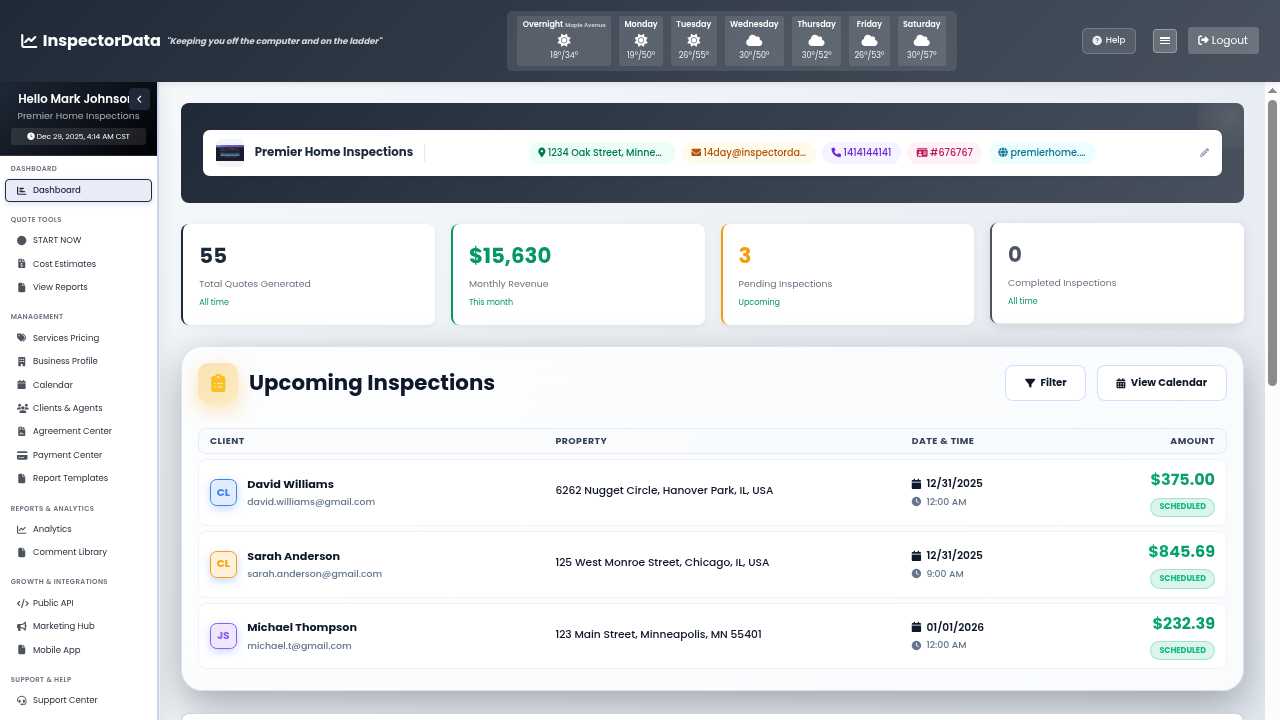
InspectorData's instant quote calculator lets clients see your pricing and book 24/7. Combined with AI reports and 8,000+ comments, it is the complete inspection business platform -- $79/month, 90-day free trial.
Start Your Free Trial