A 4-point inspection is a focused insurance inspection that evaluates four major systems — roof, electrical, plumbing, and HVAC. It typically costs $75 to $150, far less than a full home inspection, because of its narrow scope. This guide explains what it covers, when insurers require it, what affects the price, and how it differs from a standard home inspection.
Quick Answer
A 4-point inspection costs about $75 to $150, with most homeowners paying around $100. It evaluates four systems — roof, electrical, plumbing, and HVAC — and is usually required by insurers before they will write or renew a policy on a home that is 25 to 40 years old or older.
What Is a 4-Point Inspection?
A 4-point inspection is a limited-scope inspection that homeowners insurance companies use to evaluate the condition and risk of an older home. Rather than examining the entire property the way a full home inspection does, it focuses on the four systems most likely to cause expensive claims: the roof, electrical, plumbing, and HVAC. Hence the name — four points.
The inspection produces a standardized report that the insurer reviews to decide whether to issue, renew, or decline a policy. Because the scope is narrow, a 4-point inspection is quick — often 30 minutes to an hour — and inexpensive compared with a comprehensive home inspection.
4-Point Inspection Cost in 2026
The cost of a 4-point inspection is one of its main advantages — it is one of the most affordable inspections you can order. Pricing varies by region, the inspector's overhead, and whether you bundle it with another service.
| Scenario | Typical Cost | Notes |
|---|---|---|
| Standalone 4-point inspection | $75 - $150 | Most common; around $100 in many markets |
| 4-point + wind mitigation bundle | $125 - $225 | Frequently bundled in Florida; saves vs. booking separately |
| Added to a full home inspection | $50 - $100 add-on | Cheapest way to get one if you are already inspecting |
| Larger or multi-unit property | $150 - $250+ | More systems to document raises the fee |
Compared with a standard home inspection that often runs $300 to $500, a 4-point inspection is a fraction of the cost because it skips the structure, foundation, exterior, interior, appliances, and most other components. You are paying for a quick, targeted look at four systems and a standardized report the insurer can act on.
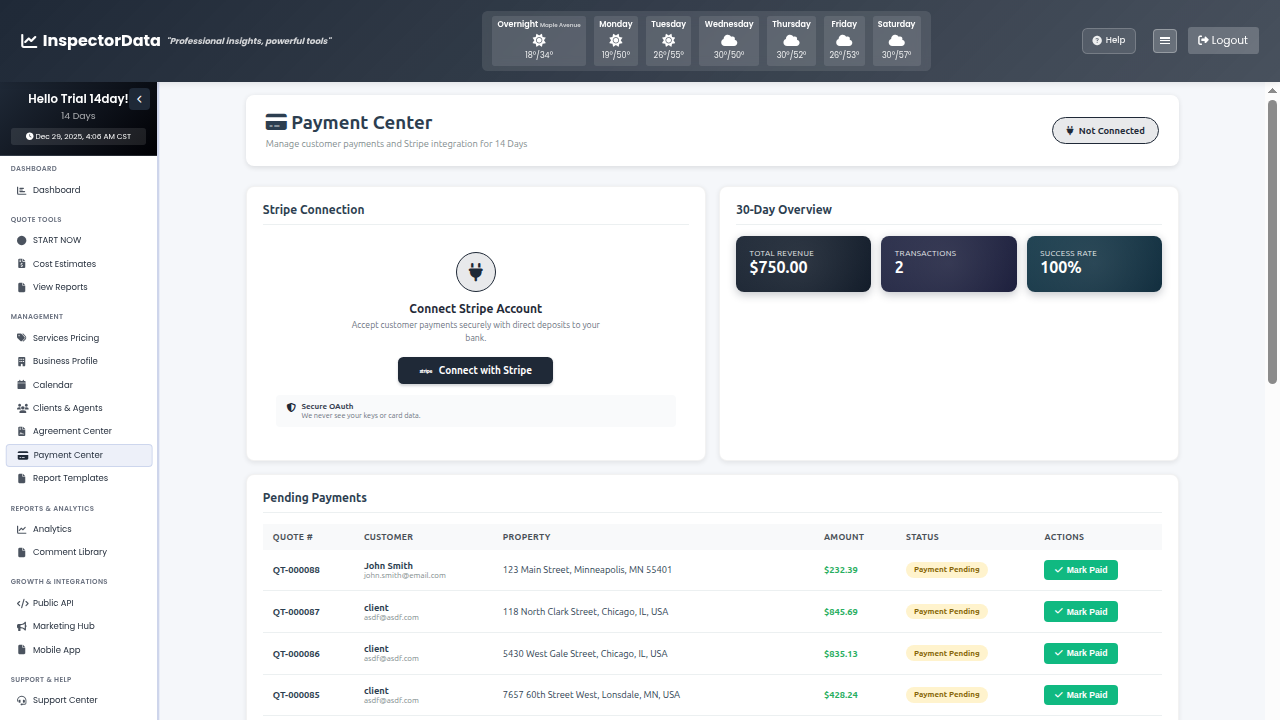
Inspectors: Bill Add-Ons and Get Paid the Same Day
4-point inspections are fast and cash-flow friendly. With InspectorData you can quote, schedule, and collect payment on site with simple 3.35% + $0.40 processing — no chasing invoices.
See Payment ProcessingWhat the Four Points Cover
Each of the four systems is evaluated for age, condition, and any safety or insurability concerns. Here is what the inspector documents in each category.
1. Roof
The roof is often the single most important point for an insurer. The inspector records the roof covering material, its age, its estimated remaining useful life, and any visible damage, leaks, or deferred maintenance. Insurers frequently decline coverage on roofs nearing the end of their service life, so a recently replaced roof is a strong positive.
2. Electrical
The inspector documents the type of electrical panel, the service amperage, the wiring type, and any hazards. Outdated or recalled panel brands, knob-and-tube wiring, aluminum branch wiring, and double-tapped breakers are common red flags that can affect insurability.
3. Plumbing
Plumbing evaluation covers the supply pipe material (copper, PEX, CPVC, or older polybutylene and galvanized), the water heater age and condition, and any visible leaks or corrosion. Materials like polybutylene supply lines are frequently a problem for insurers.
4. HVAC
The heating, ventilation, and air conditioning system is documented for type, age, and operating condition. An aging or non-functional system can be a coverage issue, and insurers want to know the equipment is operational and reasonably maintained.
When Is a 4-Point Inspection Required?
Insurance companies, not buyers, drive demand for 4-point inspections. An insurer typically requires one when:
- The home is older. The most common triggers are homes 25, 30, or 40 years old, depending on the insurer and state. Older homes are statistically more likely to have aging systems.
- You are switching insurers or shopping for a new policy on an older home.
- You are renewing a policy and the insurer wants to re-evaluate risk.
- You are buying an older home and need to bind coverage before closing.
4-point inspections are especially common in Florida, where the combination of older housing stock and a difficult property-insurance market means insurers scrutinize homes closely. They are also widely requested in other coastal and southern states, but an insurer in nearly any state may ask for one on an aging property.

4-Point Inspection vs. Full Home Inspection
This is the most common point of confusion. The two inspections are not interchangeable — they have different scopes, costs, audiences, and purposes.
| Factor | 4-Point Inspection | Full Home Inspection |
|---|---|---|
| Typical cost | $75 - $150 | $300 - $500 |
| Scope | 4 systems only | Entire property |
| Time on site | 30 min - 1 hour | 3 - 4 hours |
| Who orders it | Insurer (via homeowner) | Buyer |
| Purpose | Insurability / risk | Understand home condition |
| Covers structure/foundation? | No | Yes |
If you are buying an older home in Florida or a similar market, you may end up needing both: a full home inspection to understand the property, plus a 4-point (and often a wind mitigation inspection) to secure insurance. Many inspectors can perform all of these in a single visit, which saves on trip fees.
What Affects the Cost of a 4-Point Inspection
Although 4-point inspections are inexpensive, several factors move the price within the typical range:
Bundling
The single biggest cost lever is whether you bundle. Adding a 4-point to a full home inspection or to a wind mitigation inspection is far cheaper than ordering it as a standalone visit, because the inspector is already on site and only one trip fee applies.
Property Size and Type
A small single-family home is at the low end of the range. Larger homes, multi-unit buildings, and properties with multiple HVAC systems or electrical panels take longer to document and cost more.
Region and Demand
In high-demand insurance markets, established inspectors may charge slightly more simply because the volume of 4-point requests is high. Cost of living also plays a role, just as it does with standard inspections.
Turnaround Speed
Some homeowners need a 4-point report quickly to bind a policy before closing. Rush or same-day service can carry a premium with some inspectors.
What Makes a Home Pass or Fail a 4-Point Inspection
Technically a 4-point inspection does not "pass" or "fail" the way a test does — it documents conditions, and the insurer decides. But certain findings commonly lead insurers to decline coverage or require repairs:
- Roof at or near end of life — often the number-one reason for a declination.
- Outdated or recalled electrical panels and unsafe wiring types.
- Polybutylene or aging galvanized plumbing prone to leaks.
- Non-functional or very old HVAC equipment.
- Active leaks, corrosion, or visible damage in any of the four systems.
If a 4-point report turns up problems, the homeowner usually has options: make the repairs and have the items re-documented, shop for an insurer with looser requirements, or negotiate repairs as part of a purchase. A clean, professional 4-point report with clear photos — the kind produced by modern home inspection software — makes this process far smoother.
For Inspectors: Pricing and Billing 4-Point Inspections
If you are a home inspector, 4-point inspections are some of the most efficient revenue you can generate. They are quick, in steady demand wherever there is older housing stock, and they pair naturally with wind mitigation and full home inspections.
Price for Volume and Bundles
Most inspectors price standalone 4-points modestly and rely on bundling to make the trip worthwhile. Offer a clear bundle price — for example a 4-point plus wind mitigation, or a 4-point added to a full inspection — so clients see the savings and book the combination.
Make Booking and Payment Frictionless
Because 4-points are small-dollar, fast-turnaround jobs, friction kills your margin. An online quote calculator that lets homeowners and agents see the price and book instantly removes phone tag, and on-site payment means you are not invoicing for a $100 job and waiting weeks to get paid.
Frequently Asked Questions
How much does a 4-point inspection cost in 2026?
A 4-point inspection typically costs $75 to $150, with most homeowners paying around $100. It is far cheaper than a full home inspection because it only evaluates four systems — roof, electrical, plumbing, and HVAC — rather than the entire property. Pricing varies by region and by whether you bundle it with another inspection.
What does a 4-point inspection cover?
A 4-point inspection covers four major systems: the roof (age, condition, and remaining life), the electrical system (panel type, wiring, and hazards), the plumbing (pipe materials, water heater, and leaks), and the HVAC system (age and operating condition). It does not cover the structure, foundation, appliances, or cosmetic issues like a full home inspection does.
Why do insurance companies require a 4-point inspection?
Insurers require a 4-point inspection — most commonly for homes 25 to 40 years or older — to assess the risk of insuring the property. The four systems it evaluates (roof, electrical, plumbing, and HVAC) are the most common sources of expensive claims. If these systems are outdated or in poor condition, the insurer may decline coverage, charge a higher premium, or require updates before issuing a policy.
Is a 4-point inspection the same as a home inspection?
No. A 4-point inspection is a limited insurance inspection covering only four systems, while a full home inspection is a comprehensive evaluation of the entire property — structure, foundation, exterior, interior, appliances, and more. A 4-point inspection is requested by an insurer to issue or renew a policy; a home inspection is ordered by a buyer to understand the condition of a home before purchase.
How long does a 4-point inspection take?
A 4-point inspection usually takes 30 minutes to an hour because it focuses on only four systems. This shorter scope is the main reason it costs much less than a full home inspection, which can take three to four hours.
Who needs a 4-point inspection?
Homeowners and buyers of older homes — commonly 25, 30, or 40 years old depending on the insurer — typically need a 4-point inspection to obtain or renew homeowners insurance. It is most common in Florida and other states with older housing stock and high insurance scrutiny, but insurers in many states request them for aging properties.
Inspectors: Bill Add-Ons, Get Paid On Site
4-point, wind mitigation, sewer scope, and more — quote, schedule, report, and collect payment in one platform with simple 3.35% + $0.40 processing. $79/month, 30-day free trial.
Start Your Free Trial