Most home inspection business owners think of their exit only when they're ready to leave. The inspectors who sell for top dollar start planning 3–5 years in advance — building the revenue, systems, and documentation that make their business attractive to buyers. Here's everything you need to know about inspection business valuation and how to maximize your sale price.
How Home Inspection Businesses Are Valued
Most small business buyers and brokers use a multiple of Seller's Discretionary Earnings (SDE) — the business profit plus owner compensation. This reflects what a new owner could actually earn from the business.
SDE Calculation
| Item | Amount |
|---|---|
| Annual gross revenue | $450,000 |
| Less: Operating expenses (non-owner) | -$180,000 |
| Less: Owner's salary/draws | -$120,000 |
| = Seller's Discretionary Earnings (SDE) | $150,000 |
| At 2x multiple | $300,000 sale price |
| At 3x multiple | $450,000 sale price |
What Determines the Multiple
| Factor | 1x Multiple | 3x Multiple |
|---|---|---|
| Revenue dependency on owner | Owner does all inspections | Team runs without owner |
| Revenue diversification | Single service, few clients | Multiple services, diversified client base |
| Agent concentration | 80%+ from 1–2 agents | No single agent > 15% of revenue |
| Systems and documentation | Owner knowledge only | Full SOPs, documented processes |
| Financial records | Messy, incomplete | Clean 3-year P&L, tax returns |
| Growth trajectory | Flat or declining | Growing 15%+ per year |
What Buyers Look For in an Inspection Business
Understanding the buyer's perspective is essential for exit planning. Most buyers — whether individual operators, regional inspection companies, or private equity — are looking for the same core qualities:
Transferable Revenue
Revenue that will continue after the owner leaves. Agent relationships tied personally to the owner are at risk of leaving too. Revenue from a recognizable brand, strong online presence, and diversified referral network transfers more reliably.
Documented Systems
A buyer is essentially purchasing a set of systems: how inspections are scheduled, how reports are written, how clients are followed up, how agents are maintained. If these systems only exist in the owner's head, they don't transfer with the sale.
Clean Financials
Three years of clean, accountant-prepared financial statements. Buyers will not pay a premium for businesses with unclear accounting, cash transactions not reported, or intermingled personal and business expenses.
No Single Points of Failure
Any single source generating more than 20% of revenue (one agent, one builder, one zip code) represents a risk that most buyers will discount heavily or reject entirely.
How to Increase Your Business Valuation
These are the highest-impact steps you can take in the 2–3 years before a sale:
| Action | Valuation Impact | Timeline to Implement |
|---|---|---|
| Build a team (don't be the only inspector) | Move 1x → 2.5x multiple | 12 – 24 months |
| Document all processes (SOPs) | +$20,000 – $50,000 | 3 – 6 months |
| Diversify agent referral base (no >15% concentration) | +0.5x multiple | 12 – 24 months |
| Add recurring or contracted revenue | +$30,000 – $80,000 | 6 – 18 months |
| Clean up financials (3 years clean) | Required for premium pricing | Start now |
| Build a recognizable local brand (reviews, web presence) | +$15,000 – $40,000 | 6 – 12 months |
Finding Buyers for Your Inspection Business
Individual Operators
Experienced inspectors looking to buy rather than build from scratch. Typically pay 1.5–2x SDE. Often financed with SBA loans, which require clean financials and a reasonable valuation. These buyers are motivated but may lack capital for premium pricing.
Regional Inspection Companies
Multi-inspector firms in your region looking to expand territory. They pay strategic premiums for established businesses in new markets — often 2–3x SDE if the revenue base is strong and the team stays.
Private Equity and Roll-Up Groups
A growing number of PE-backed roll-up groups are acquiring inspection businesses as part of multi-state platforms. These buyers pay the highest multiples (2.5–4x) for established, systematized businesses with $500,000+ in annual revenue. They're looking for quality more than price.
Business Brokers
A broker who specializes in home services businesses can find qualified buyers, manage the process, and often achieves a 20–30% higher sale price than owner-direct sales. Broker commissions typically range from 8–12% of the sale price.
The Sale Process Step by Step
| Step | Timeline | Activity |
|---|---|---|
| 1. Exit Planning | 3–5 years before sale | Build systems, team, financials, diversify revenue |
| 2. Business Valuation | 12 months before | Get a third-party business valuation |
| 3. Prepare Materials | 6–12 months before | 3-year P&L, client lists, SOPs, system documentation |
| 4. Find Buyers | 3–6 months | Broker, network, direct outreach to regional competitors |
| 5. Offers and Due Diligence | 1–3 months | Review offers, negotiate terms, allow buyer due diligence |
| 6. Closing | 30–60 days | Legal documents, asset transfer, training period |
| 7. Transition | 3–12 months post-sale | Owner training, relationship handoffs, brand continuity |
Exit Mistakes That Cost Owners Money
- Waiting until burnout to sell: A business declined from burnout sells for far less than one sold from a position of strength
- Not cleaning up financials: 3 years of unclear books cost you more at closing than any accounting fee
- Owner dependency: A business that only works with the current owner isn't worth 3x — it's worth 1x at best
- Overpricing: An unrealistic asking price keeps qualified buyers away; a broker can set realistic expectations
- No non-compete clarity: Define what territory and services you're agreeing not to compete in — vague non-competes kill deals
- Neglecting the business during the sale: Revenue drops during a sale process scare buyers. Maintain operations as normal throughout
When to Start Planning Your Exit
The answer is always: now — regardless of how far away your exit feels. Even if you plan to work for 20 more years, building a business that could be sold (even if you choose not to sell it) means building a business with documented systems, a capable team, diversified revenue, and clean financials. That business is simply better to run, more profitable, and more resilient than a business built entirely around the owner.
Start by reading the complete guide to growing your inspection business — the same steps that grow your business are the same steps that prepare it for a premium exit.
Build a Business Worth Selling
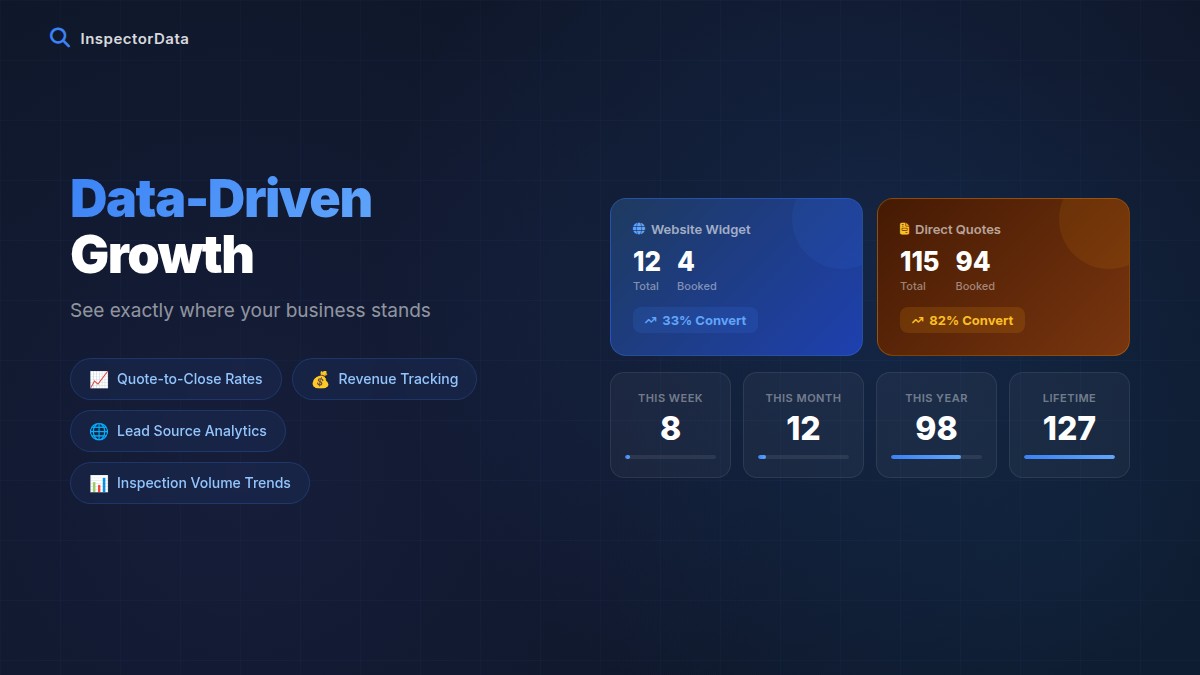
InspectorData's analytics dashboard tracks the revenue, volume, and source data that buyers use to value inspection businesses. Every report you deliver through the platform builds documented history. Every automated system you set up reduces owner dependency. Start building a more valuable business from day one. Try it free for 30 days.
Try InspectorData Free for 30 Days