- 1 What Is Radon and Why It Matters
- 2 How Radon Testing Works During a Home Inspection
- 3 Short-Term vs Long-Term Testing Methods
- 4 Understanding Radon Levels
- 5 High-Risk Radon Zones by Region
- 6 Cost of Radon Testing
- 7 Radon Mitigation: What Happens If Levels Are High
- 8 Negotiating Radon Mitigation After a Home Inspection
- 9 Frequently Asked Questions
Radon is a colorless, odorless radioactive gas that seeps into homes from the ground -- and it is the number one cause of lung cancer among non-smokers in the United States. A radon test during your home inspection is a straightforward, affordable add-on that can reveal a hidden health hazard before you close on a property. This guide explains how radon testing works during a home inspection, what the results mean, and what to do if levels come back high.
Radon testing is one of the highest-ROI add-ons an inspector can offer — it adds revenue on the majority of jobs where clients would have said yes if you'd simply asked. This article breaks down exactly how radon testing works so you can explain it confidently to every client.
*All pricing shown is for general reference only and varies significantly by state and inspector. These figures are not a substitute for actual pricing — contact your local inspector for a quote.
What Is Radon and Why It Matters
Radon is a naturally occurring radioactive gas produced by the decay of uranium in soil, rock, and groundwater. It exists everywhere in trace amounts, but when it accumulates inside a building -- particularly in basements and lower levels -- it becomes a serious health concern.
The statistics are sobering. According to the Environmental Protection Agency (EPA), radon is responsible for approximately 21,000 lung cancer deaths per year in the United States, making it the second leading cause of lung cancer overall and the leading cause among people who have never smoked. The Surgeon General has warned that radon is the second leading cause of lung cancer in America today.
Radon enters homes through cracks in foundations, gaps around pipes, construction joints, and any opening where the building contacts the soil. It can also dissolve into groundwater and enter homes through well water. Once inside, radon becomes trapped and concentrates to levels that pose a real health risk with prolonged exposure.
The good news is that radon testing is simple, and radon mitigation is effective. Elevated radon levels do not have to be a deal-breaker when buying a home -- but you need to know about them before you commit.
How Radon Testing Works During a Home Inspection
When you add radon testing to your home inspection, the process is straightforward and minimally invasive. Here is what typically happens:
- Device placement. The inspector places a radon testing device in the lowest livable level of the home -- usually the basement or ground floor. The device is positioned away from drafts, exterior walls, and high humidity areas to ensure an accurate reading.
- Closed-house conditions. For accurate results, the home must maintain "closed-house conditions" for at least 12 hours before testing begins and throughout the testing period. This means all windows and exterior doors remain closed (except for normal entry and exit). HVAC systems can operate normally.
- Monitoring period. The testing device collects air samples continuously over a minimum of 48 hours. Most inspectors who offer radon testing as a home inspection add-on use continuous radon monitors (CRMs) that record hourly readings.
- Results and reporting. After the monitoring period, the inspector retrieves the device and includes the radon test results in the inspection report. Results are expressed in picocuries per liter (pCi/L).
Because radon testing requires a minimum 48-hour monitoring window, the inspector typically places the device at the beginning of the inspection process and retrieves it two or more days later. Your radon results may be delivered as an addendum to the main inspection report.
Short-Term vs Long-Term Testing Methods
There are two primary categories of radon testing, and understanding the difference helps you interpret your results correctly.
Short-Term Testing (2 to 7 days)
Short-term radon tests are the standard method used during real estate transactions because they deliver results quickly -- typically within 48 to 96 hours. The two most common types are:
- Continuous Radon Monitor (CRM) -- An electronic device that records radon levels every hour. This is the preferred method for home inspections because it provides hour-by-hour data, which helps identify any tampering or unusual conditions. Most professional home inspectors use CRMs.
- Charcoal canisters -- Passive devices that absorb radon over a set period (usually 2 to 7 days) and are then sent to a laboratory for analysis. These are less expensive but provide only an average reading, not hourly data. They are sometimes used by homeowners for initial screening but are less common in professional inspections.
Long-Term Testing (90+ days)
Long-term radon tests use alpha track detectors or electret ion chambers that remain in the home for 30 days to one year. Because radon levels fluctuate seasonally -- typically higher in winter when homes are sealed up and lower in summer when windows are open -- long-term tests give a more accurate picture of average annual exposure.
| Testing Method | Duration | Cost | Best For |
|---|---|---|---|
| Continuous Radon Monitor | 48 - 96 hours | $100 - $300* | Home inspections, real estate transactions |
| Charcoal Canister | 2 - 7 days | $15 - $40 (DIY) | Initial screening by homeowners |
| Alpha Track Detector | 30 days - 1 year | $25 - $50 (DIY) | Accurate annual average for current homeowners |
| Electret Ion Chamber | 30 days - 1 year | $25 - $50 (DIY) | Long-term monitoring, post-mitigation verification |
For a radon test during a home inspection, the continuous radon monitor is the gold standard. It provides detailed hourly data that professionals can analyze for accuracy, and it delivers results fast enough to keep a real estate transaction on schedule.
Understanding Radon Levels
Radon levels are measured in picocuries per liter of air (pCi/L). Here is what the numbers mean:
| Radon Level (pCi/L) | Risk Level | Recommended Action |
|---|---|---|
| Below 2.0 pCi/L | Low risk | No action needed; retest every 2-5 years |
| 2.0 - 3.9 pCi/L | Moderate risk | Consider mitigation; EPA recommends fixing at this level |
| 4.0 pCi/L and above | High risk -- EPA action level | Mitigation strongly recommended; address before occupying |
| 8.0+ pCi/L | Very high risk | Immediate mitigation required |
The EPA action level is 4.0 pCi/L. At or above this concentration, the EPA strongly recommends installing a radon mitigation system. However, the EPA also notes that there is no truly "safe" level of radon -- any exposure carries some risk, and they recommend considering mitigation even for levels between 2.0 and 4.0 pCi/L.
To put this in perspective: the average outdoor radon level is about 0.4 pCi/L, and the average indoor level in American homes is approximately 1.3 pCi/L. A reading of 4.0 pCi/L means the home has roughly three times the national indoor average and ten times the outdoor level.
High-Risk Radon Zones by Region
The EPA has mapped the entire United States into three radon zones based on predicted average indoor radon levels:

- Zone 1 (Highest potential) -- Predicted average indoor levels above 4.0 pCi/L. States with significant Zone 1 areas include Iowa, Minnesota, North Dakota, South Dakota, Nebraska, Kansas, Montana, Wyoming, Colorado, Pennsylvania, Ohio, Indiana, and parts of New York and New England.
- Zone 2 (Moderate potential) -- Predicted average indoor levels between 2.0 and 4.0 pCi/L. Most of the remaining continental United States falls into this category.
- Zone 3 (Lower potential) -- Predicted average indoor levels below 2.0 pCi/L. Primarily coastal areas and parts of the Deep South.
However, this zoning system has important limitations. The EPA emphasizes that elevated radon has been found in homes in all 50 states. A home in a Zone 3 area can still have dangerously high radon levels, while a home in Zone 1 can test below 2.0 pCi/L. Local geology, soil composition, foundation type, and even individual lot characteristics all influence radon entry. The zone map is a general guide, not a guarantee.
| Region | Radon Risk | Testing Recommendation |
|---|---|---|
| Upper Midwest (IA, MN, ND, SD, NE) | Very high | Essential -- test every home |
| Northern Plains & Rockies (MT, WY, CO, UT) | High | Strongly recommended |
| Northeast (PA, NY, NJ, CT, MA, ME) | High to moderate | Strongly recommended |
| Appalachian Region (OH, WV, VA, KY, TN) | High to moderate | Strongly recommended |
| Southeast (FL, GA, SC, AL, MS) | Lower (but variable) | Recommended -- do not skip based on zone alone |
| West Coast (CA, OR, WA) | Variable by county | Recommended -- significant county-level variation |
| Southwest (AZ, NM, TX) | Lower to moderate | Recommended in elevated areas and granitic soils |
The bottom line: regardless of where you are buying a home, a radon test during the home inspection is a worthwhile investment. It is a small price to pay for peace of mind about a risk you literally cannot detect with your senses. Contact your local inspector for current pricing.*
Cost of Radon Testing
Radon testing is one of the most affordable home inspection add-ons available, and it delivers some of the highest-value information you can get about a property.
| Testing Scenario | Typical Cost | Notes |
|---|---|---|
| Radon test as home inspection add-on | $100 - $300* | Most common; bundled with standard inspection |
| Standalone professional radon test | $150 - $350* | Separate trip; higher cost due to dedicated visit |
| DIY charcoal test kit | $15 - $40 | Available at hardware stores; includes lab analysis |
| DIY long-term test kit | $25 - $50 | Alpha track detector; 30-day minimum exposure |
| Continuous radon monitor (purchase) | $150 - $300* | Consumer-grade devices for ongoing monitoring |
Adding radon testing to your home inspection is almost always cheaper than scheduling it separately because the inspector is already at the property. Many inspectors offer bundle pricing when you combine radon testing with other add-ons like sewer scope inspections or termite inspections.
Radon and mold testing aren't just valuable for buyers — they're significant income for inspectors who offer them consistently.
| Base inspection (4/week × $450) | $93,600/year |
| + Radon testing (80% attach rate × $150) | +$24,960/year |
| + Mold screening (40% attach rate × $200) | +$16,640/year |
| Total with add-ons | $135,200/year |
4 inspections/week × $450 = $93,600/year. Add radon + mold and you're over $110K. The math works. Follow @InspectorData_ for more income-building tips.
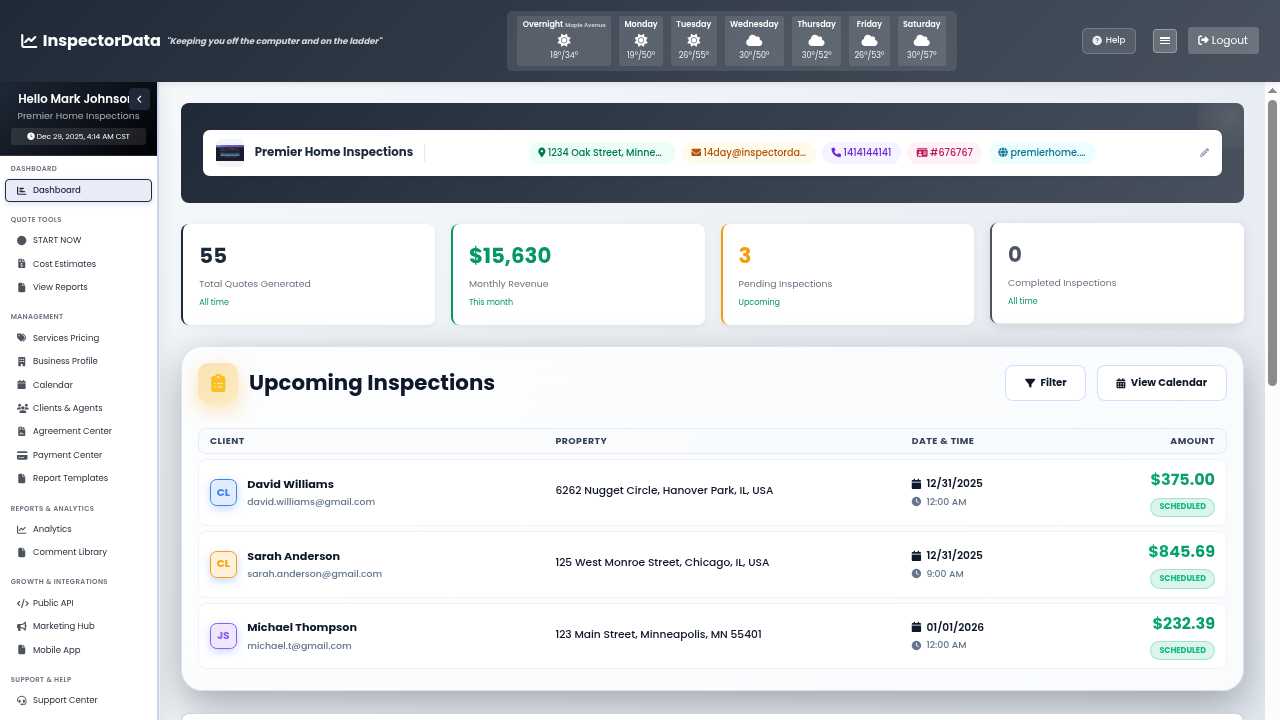
Inspectors: Show Add-On Pricing Instantly
InspectorData's embeddable quote calculator lets clients see your radon testing, sewer scope, and other add-on prices instantly. More transparency means more bookings and higher average order values.
See the Quote CalculatorRadon Mitigation: What Happens If Levels Are High
If your radon test comes back at or above 4.0 pCi/L, the next step is radon mitigation. The good news: radon mitigation is a well-established, highly effective process. A properly installed mitigation system can reduce radon levels by up to 99%, often bringing a home from dangerous levels down to below 2.0 pCi/L.
How Radon Mitigation Systems Work
The most common radon mitigation approach is called sub-slab depressurization (also known as active soil depressurization). Here is how it works:
- A hole is drilled through the basement floor or slab into the crushed rock or soil beneath.
- A PVC pipe is installed running from below the slab, up through the house, and out through the roof.
- A radon fan is attached to the pipe, typically installed in the attic or on the exterior of the home. This fan runs continuously, creating negative pressure beneath the slab.
- Radon gas is drawn from under the foundation and vented safely above the roofline, where it dissipates harmlessly into outdoor air.
The system operates 24/7 and is designed to be permanent. The fan uses about the same electricity as a 75-watt light bulb, costing roughly $8-15 per month in electricity.
Radon Mitigation Costs
| Mitigation Component | Cost Range | Notes |
|---|---|---|
| Standard sub-slab system (installed) | $800 - $3,000* | Most common; covers majority of single-family homes |
| Complex installation | $2,500 - $4,000+ | Multiple suction points, crawl space + basement combos |
| Crawl space encapsulation + mitigation | $2,000 - $5,000 | Includes vapor barrier and depressurization |
| Annual electricity cost | $100 - $200* | Fan runs continuously; low power consumption |
| Fan replacement (every 5-10 years) | $200 - $500* | Only moving part; long lifespan |
Radon mitigation is a one-time cost that permanently solves the problem. Costs vary by home and region — contact a local radon mitigation professional for a quote. When you consider that the health risk of living with elevated radon is comparable to smoking, it is one of the most cost-effective home safety improvements you can make.*
Negotiating Radon Mitigation After a Home Inspection
If your radon test during the home inspection reveals levels at or above 4.0 pCi/L, you have several options for how to proceed within the real estate transaction. Elevated radon is a common finding and an entirely solvable problem -- it should not cause panic, but it does need to be addressed.
Option 1: Ask the Seller to Install Mitigation
This is the most common approach. You request that the seller hire a licensed radon mitigation contractor to install a system before closing. The seller pays for the installation, and a post-mitigation radon test confirms the system has brought levels below 4.0 pCi/L (ideally below 2.0).
Option 2: Negotiate a Seller Credit
Instead of requiring the seller to manage the installation, you can negotiate a credit at closing to cover the cost of mitigation. This gives you control over choosing the contractor and overseeing the installation after you take ownership. A typical credit amount is $1,000-$1,500, based on average mitigation costs in your area.
Option 3: Negotiate a Price Reduction
Some buyers prefer to reduce the purchase price rather than receive a credit. The effect is similar -- the buyer effectively pays less for the home to account for the mitigation expense -- but the mechanics differ in terms of financing and closing costs.
Option 4: Walk Away
If you are within your inspection contingency period, you have the right to walk away from the deal based on the radon results. In practice, this is rarely necessary since radon mitigation is effective and relatively affordable. However, if the seller refuses to address the issue and the levels are significantly elevated, walking away is a legitimate option.
What If the Home Already Has a Mitigation System?
Some homes -- particularly in high-radon areas -- already have mitigation systems installed from previous owners. If the home you are buying has an existing system, the radon test during your home inspection serves as a verification that the system is working properly. If the levels are still elevated despite the existing system, the system may need repair, a more powerful fan, or additional suction points. Your inspector can note the condition of the existing system in the inspection report.
Frequently Asked Questions
Should I get a radon test during my home inspection?
Yes. The EPA recommends that all homebuyers test for radon as part of the home-buying process. Radon testing during a home inspection is the most convenient and cost-effective time to do it because the inspector is already at the property and can manage the testing process for you. It is a minimal cost for critical health information about a home you are about to invest hundreds of thousands of dollars in. Contact your local inspector for current radon testing pricing.*
Can I do a radon test myself instead of hiring an inspector?
You can purchase DIY radon test kits from hardware stores or online for $15-$40. These charcoal-based kits work, but they have limitations: they provide only an average reading (no hourly data), they can be affected by improper placement or conditions, and results from a DIY test may carry less weight in a real estate negotiation than results from a professional test with a calibrated, tamper-evident continuous radon monitor. For a real estate transaction, a professional radon test is strongly recommended.
How long does radon testing take?
A standard short-term radon test requires a minimum of 48 hours of monitoring. The EPA recommends closed-house conditions beginning at least 12 hours before the test starts and continuing through the entire testing period. In practice, most inspectors leave the monitor in place for 48 to 96 hours. You will typically have results within a day of the monitor being retrieved.
Do new homes need radon testing?
Absolutely. New construction is just as susceptible to radon as older homes because radon comes from the soil beneath the foundation, not from the building materials. In fact, newer homes that are built tighter for energy efficiency may trap radon more effectively than older, draftier homes. Many new homes in high-radon areas are built with passive radon-resistant features (a layer of gravel under the slab and a vertical pipe for future fan installation), but even these should be tested to confirm the passive system is adequate.
What if my radon test shows 3.5 pCi/L -- just below the action level?
A result between 2.0 and 4.0 pCi/L is in a gray area. While it is technically below the EPA's action level of 4.0, the EPA still recommends considering mitigation at these levels, particularly because radon concentrations fluctuate seasonally. A reading of 3.5 in summer could be 5.0 or higher in winter when the home is sealed up. Discuss this with your inspector and consider long-term testing after purchase to get a more accurate annual average.
Can radon levels change over time?
Yes. Radon levels fluctuate due to seasonal changes (typically higher in winter), weather patterns, changes in soil moisture, and even home renovations that alter the foundation or ventilation. The EPA recommends retesting every two to five years, even if initial levels were low. If you install a mitigation system, test again within 30 days of installation and then retest every two years to ensure the system continues to work effectively.
Does radon affect the resale value of a home?
Untested homes in high-radon areas may face buyer hesitation, but a home with a properly installed and documented radon mitigation system is not penalized in resale value. In fact, having a mitigation system already in place can be a selling point -- it demonstrates that the issue has been addressed and removes uncertainty for the next buyer. The key is documentation: keep your test results, mitigation installation records, and post-mitigation verification tests.
Inspectors: Add Radon Testing to Your Service Menu
InspectorData lets you configure radon testing as an add-on service with custom pricing, include it in your online quote calculator, and deliver professional radon reports alongside your inspection. AI-powered reports, 8,000+ comments, full business management -- $79/month, 30-day free trial.
Start Your Free Trial