If you are buying a home, you will likely encounter two important steps that sound similar but serve entirely different purposes: the home inspection and the home appraisal. Understanding the difference between a home inspection vs appraisal is critical because each one protects you in a different way -- one safeguards your investment from hidden defects, the other ensures you are not overpaying. This guide breaks down exactly what each process involves, what it costs, and why skipping either one is a risk you should not take.
Two Processes, Two Purposes
The simplest way to understand the home inspection vs appraisal distinction is this: a home inspection answers the question "What condition is this property in?" while a home appraisal answers "What is this property worth?"
Both happen during the due diligence period after you have an accepted offer, but they are performed by different professionals, they evaluate different things, and they serve different parties in the transaction.
- A home inspection is a detailed, hands-on evaluation of the property's physical condition -- structure, systems, and components. It is performed for the buyer's benefit and is typically optional (though strongly recommended).
- A home appraisal is a professional opinion of the property's fair market value. It is performed for the lender's benefit and is required by virtually every mortgage lender before they will approve a loan.
Both are essential parts of the home-buying process, but they protect against different risks. The inspection protects you from buying a money pit. The appraisal protects both you and the lender from overpaying.
What Is a Home Inspection?
A home inspection is a comprehensive, visual examination of a property's physical condition performed by a licensed or certified home inspector. The inspector evaluates the major systems and components of the home and produces a detailed report documenting their findings.
What a Home Inspection Covers
A standard property inspection follows guidelines set by organizations like InterNACHI (International Association of Certified Home Inspectors) or ASHI (American Society of Home Inspectors) and includes evaluation of:
- Structural components -- Foundation, framing, floors, walls, ceilings, and roof structure
- Exterior -- Siding, trim, grading, drainage, driveways, walkways, and decks
- Roofing -- Shingles or other covering, flashing, gutters, downspouts, and penetrations
- Plumbing -- Supply lines, drain lines, water heater, fixtures, and functional flow
- Electrical -- Service panel, wiring, outlets, GFCI protection, and grounding
- HVAC -- Heating system, cooling system, ductwork, thermostats, and filters
- Interior -- Walls, ceilings, floors, doors, windows, stairs, and railings
- Insulation and ventilation -- Attic insulation levels, vapor barriers, and exhaust systems
- Fireplaces and chimneys -- Dampers, fireboxes, hearths, and visible flue liners
A thorough buyer inspection typically takes 2 to 4 hours depending on the size and condition of the property. The inspector will physically walk the roof (when safe), enter crawl spaces, test electrical outlets, run plumbing fixtures, operate the HVAC system, and check hundreds of individual components.
What You Get from an Inspection
The result is a detailed report -- often 30 to 60 pages -- with photographs and descriptions of every deficiency found. A good inspection report categorizes findings by severity: safety hazards, major defects that need immediate attention, maintenance items, and general observations. Inspectors who use an inspection report writer with built-in photo management and comment libraries produce these reports faster and with more consistency. This report gives you the information you need to negotiate repairs, request seller credits, or walk away from the deal if the problems are too significant.
What Is a Home Appraisal?
A home appraisal is a professional assessment of a property's fair market value performed by a licensed appraiser. Unlike a home inspection, which focuses on condition, the appraisal focuses on value -- specifically, whether the agreed-upon purchase price is supported by comparable sales data and current market conditions.
What a Home Appraisal Covers
The appraiser evaluates the property through a different lens than an inspector:
- Property characteristics -- Square footage, lot size, number of bedrooms and bathrooms, layout, and overall quality of construction
- Comparable sales -- Recent sales of similar properties in the same area (typically within the past 6 months and within a 1-mile radius)
- Market conditions -- Local real estate trends, supply and demand, and neighborhood factors
- Location factors -- School districts, proximity to amenities, neighborhood desirability, and environmental considerations
- Upgrades and improvements -- Renovated kitchens, finished basements, added square footage, and other value-adding improvements
- General condition -- A high-level assessment of whether the property is in good, average, or poor condition relative to comparable properties
The appraiser will visit the property, take measurements, photograph the interior and exterior, and note the overall condition. However, the visit is typically much shorter than an inspection -- usually 30 minutes to an hour. The appraiser is not opening electrical panels, testing outlets, running water, or climbing on the roof. They are looking at the property from a valuation perspective, not a condition perspective.
What You Get from an Appraisal
The appraisal report provides a single dollar figure: the appraiser's opinion of the property's fair market value. This number determines how much the lender is willing to finance. If you are purchasing a home for $400,000 and the appraisal comes in at $400,000 or higher, the loan proceeds as planned. If it comes in lower -- say $380,000 -- you have an appraisal gap that needs to be addressed before closing.
Side-by-Side Comparison: Home Inspection vs Appraisal
Here is how the two processes compare across every major dimension:
| Factor | Home Inspection | Home Appraisal |
|---|---|---|
| Primary Purpose | Evaluate physical condition | Determine market value |
| Who It Serves | The buyer | The lender (and buyer) |
| Who Performs It | Licensed/certified home inspector | Licensed property appraiser |
| Who Pays | Buyer (paid directly to inspector) | Buyer (paid through lender) |
| Required? | No (but strongly recommended) | Yes (required by lender) |
| Duration | 2 - 4 hours on-site | 30 minutes - 1 hour on-site |
| Report Length | 30 - 60 pages with photos | 10 - 20 pages with comps |
| Typical Cost | Varies by state and inspector | Varies by lender and location |
| What It Evaluates | Structure, systems, safety, defects | Market value, comparables, location |
| Outcome | List of findings and recommendations | Single dollar value estimate |
| Can Kill the Deal? | Yes (buyer can walk away) | Yes (lender may refuse to finance) |
As the comparison shows, the home inspection vs appraisal distinction comes down to condition versus value. Both can affect whether the deal closes, but they do so for entirely different reasons.
When You Need Both
In a standard home purchase with a mortgage, you will need both a home inspection and an appraisal. Here is the typical timeline:

- Offer accepted -- The clock starts on your due diligence period (usually 7-30 days for the inspection contingency)
- Home inspection (Days 3-7) -- You schedule and complete the property inspection. Based on the findings, you may negotiate repairs, credits, or a price reduction with the seller.
- Appraisal (Days 7-21) -- Your lender orders the appraisal. The appraiser visits the property and delivers their report. If the value supports the purchase price, the loan moves forward.
- Closing (Days 30-45) -- Both the inspection and appraisal results are settled, and you proceed to closing.
There are a few scenarios where you might not need both:
- Cash purchase -- No lender means no appraisal requirement. However, many cash buyers still get one to confirm they are paying a fair price. You should absolutely still get a buyer inspection regardless of how you are paying.
- Waived inspection contingency -- In competitive markets, some buyers waive the inspection contingency to make their offer more attractive. This is risky and generally not recommended, but it does happen. The appraisal is still required by the lender.
- VA or FHA loans -- These government-backed loan programs have appraisals that include a slightly more detailed property condition assessment than conventional appraisals. However, even VA and FHA appraisals are not a substitute for a full home inspection.
Can an Appraisal Replace an Inspection?
No. This is one of the most common misconceptions in real estate, and it is a dangerous one.
While an appraiser does note the general condition of the property, their evaluation is surface-level compared to what a home inspector does. An appraiser might note that the roof appears to be in "average" condition. An inspector will tell you that the roof has 3 layers of shingles (a code violation in most areas), the flashing around the chimney is deteriorated, and there are signs of active leaking in the attic that will require a $12,000 replacement within the next year.
Here is what an appraisal does not do that an inspection does:
- Does not test systems -- The appraiser does not turn on the HVAC, run water, test electrical outlets, or operate appliances
- Does not enter confined spaces -- No crawl space entry, no attic inspection beyond what is visible from the access point
- Does not evaluate safety -- No checking for GFCI protection, proper grounding, carbon monoxide risks, or fire hazards
- Does not identify hidden defects -- No assessment of moisture intrusion behind walls, drainage problems, or structural settlement patterns
- Does not provide repair recommendations -- An appraisal says "the property is worth $X." An inspection says "the foundation has a structural crack that needs immediate attention from a structural engineer."
Treating an appraisal as a substitute for an inspection is like treating a blood pressure reading as a substitute for a full physical exam. One data point does not give you the complete picture.
Cost Comparison: Inspection vs. Appraisal
Both processes cost roughly the same amount, but the payment structure differs:
| Cost Factor | Home Inspection | Home Appraisal |
|---|---|---|
| Typical Cost | Varies by state and inspector | Varies by lender and location |
| Average (Standard Home) | Contact your local inspector | Contact your lender |
| When You Pay | At or before the inspection | At loan application or closing |
| Paid To | Inspector directly | Lender (who pays the appraiser) |
| You Choose the Professional? | Yes | No (lender assigns the appraiser) |
| Add-Ons Available? | Yes (radon, sewer scope, mold, etc.) | No (standard scope) |
For a typical home purchase, the combined cost of both the inspection and appraisal represents a very small percentage of the purchase price — a small amount for the protection both services provide. Contact your local inspector and lender for current pricing in your area.
One notable difference: you get to choose your home inspector, so you can research qualifications, read reviews, and select someone you trust. With the appraisal, the lender assigns an appraiser through an appraisal management company (AMC), and you have no say in who performs it. This was established by the Home Valuation Code of Conduct (HVCC) and subsequent Dodd-Frank regulations to prevent undue influence on the valuation.
What Happens When Inspection and Appraisal Results Conflict
Sometimes the inspection and appraisal tell different stories about the same property. Here are the most common scenarios and how to handle them:
Scenario 1: Inspection Finds Major Issues, Appraisal Comes in at Full Value
This is the most common conflict. The appraiser may not have noticed or may not have the expertise to identify the issues the inspector found. For example, the inspector finds significant electrical deficiencies and a failing HVAC system totaling $15,000 in repairs, but the appraisal comes in at or above the purchase price.
What to do: Use the inspection findings to negotiate with the seller for repairs or a price reduction. The appraisal supports the value, so the lender is not concerned -- but you as the buyer need to account for the repair costs in your decision. You might ask for a $15,000 seller credit to handle the repairs after closing.
Scenario 2: Inspection Is Clean, Appraisal Comes in Low
The home is in great condition, but the appraiser determines the market value is less than the agreed-upon purchase price. This creates an appraisal gap.
What to do: You have several options -- renegotiate the purchase price to match the appraised value, pay the difference out of pocket, request the lender to order a second appraisal, or walk away if the contract allows it. A low appraisal has nothing to do with the physical condition; it means the comparable sales data does not support the price.
Scenario 3: Both Find Problems
The inspection reveals significant defects, and the appraisal comes in low -- possibly because the appraiser noticed condition issues that affect value. This is actually the most straightforward scenario because both reports support a price renegotiation.
What to do: You have strong leverage to negotiate. The inspection documents the specific defects, and the appraisal confirms the home is not worth what the seller is asking. Present both reports to the seller and negotiate a price that accounts for the necessary repairs and the actual market value.
Inspection Reports That Speak for Themselves
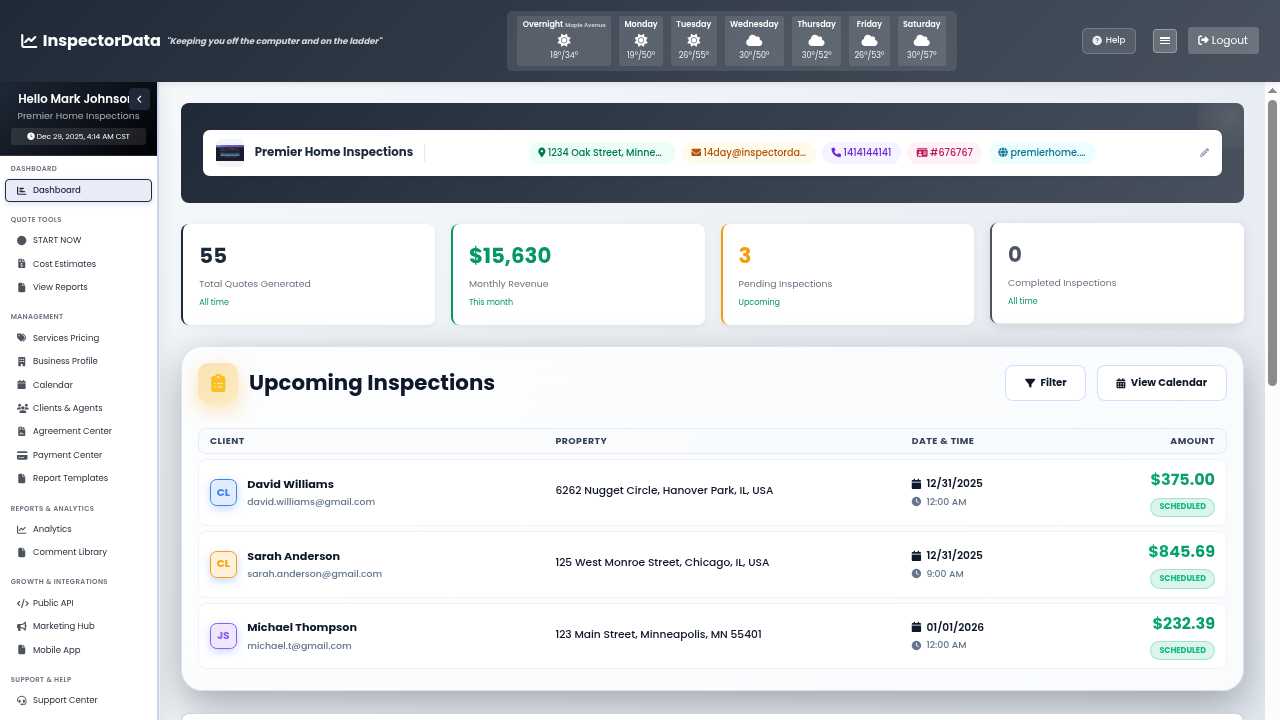
InspectorData's AI-powered report writer helps inspectors deliver clear, detailed, photo-rich reports that give buyers the information they need to make confident decisions.
See the Report WriterFrequently Asked Questions
Do I need both a home inspection and an appraisal?
If you are financing your purchase with a mortgage, the appraisal is required by your lender -- you cannot skip it. The home inspection is technically optional, but skipping it is one of the riskiest decisions you can make as a buyer. The inspection is the only way to get a thorough, professional evaluation of the property's condition before you commit. For the cost of the inspection, it is the best insurance policy in the entire home-buying process.
Which comes first -- the inspection or the appraisal?
The home inspection almost always comes first. It is typically scheduled within the first week after the offer is accepted, while the appraisal is ordered by the lender and may take 2-3 weeks to complete. Getting the inspection done first is strategically smart because it gives you the opportunity to renegotiate or walk away before you have invested in the appraisal fee.
Can an inspector also do the appraisal?
No. Home inspectors and home appraisers have different licenses, different training, and different regulatory oversight. A home inspector is trained in building science, construction methods, and system evaluation. An appraiser is trained in real estate valuation, market analysis, and financial regulation. The two roles require separate certifications and cannot be performed by the same person on the same transaction.
What if I am paying cash -- do I still need an appraisal?
If there is no lender, there is no appraisal requirement. However, many cash buyers still order an appraisal to confirm they are paying a fair price. It is a smart move, especially in fast-moving markets where bidding wars can push prices above market value. Even without a lender, you want to know that your $450,000 purchase is actually worth $450,000.
Can inspection findings affect the appraisal?
Indirectly, yes. If the inspection leads to a price renegotiation, the lower purchase price may align better with the appraised value. Additionally, if the inspection uncovers major condition issues and the appraiser visits afterward, the appraiser may note those conditions (if visible) and factor them into the valuation. However, the appraiser does not have access to the inspection report unless someone shares it, and appraiser evaluations are independent of inspection findings.
What happens if the appraisal comes in lower than the purchase price?
A low appraisal creates what is known as an appraisal gap. You have four main options: ask the seller to lower the price to the appraised value, cover the difference between the appraised value and purchase price with additional cash, request a reconsideration of value from the lender (providing additional comparable sales data), or exercise your appraisal contingency and walk away from the deal.
Is a home appraisal the same as a property inspection?
No. Despite the similar-sounding names, a home appraisal and a property inspection are fundamentally different processes. The appraisal determines home value for lending purposes. The inspection evaluates physical condition for the buyer's protection. Different professionals perform them, they evaluate different things, and they serve different parties in the transaction. Understanding this distinction between home inspection vs appraisal is essential for every homebuyer.
Inspectors: Deliver Reports Buyers Trust
InspectorData helps home inspectors produce detailed, photo-rich reports with AI-powered narratives and an 8,000+ comment library. Give your clients the clarity they need -- $79/month, 30-day free trial.
Start Your Free Trial