- 1 Why Sewer Scope Inspections Are Growing
- 2 What Is Sewer Scope Report Software?
- 3 Key Features to Look For
- 4 How InspectorData's Sewer Scope Report Writer Works
- 5 Why AI-Powered Reports Save Time
- 6 Common Pipe Materials and What They Mean
- 7 How to Price Sewer Scope Inspections
- 8 Choosing the Right Software
- 9 Getting Started
Why Sewer Scope Inspections Are Growing
Sewer scope inspections have gone from a niche add-on service to one of the fastest-growing revenue streams for home inspectors across the country. Real estate agents are recommending them on nearly every transaction involving homes older than 20 years. Buyers are requesting them proactively after hearing horror stories about $15,000 sewer line replacements discovered weeks after closing. And municipalities in states like Colorado, Minnesota, and Oregon are increasingly requiring sewer inspections as part of the sale process.
For home inspectors, this growth represents a significant opportunity. A single sewer scope inspection adds $150 to $350 to each job, with minimal additional time on site. But here is the challenge: the reporting side of sewer scope work has traditionally been slow and inconsistent. Many inspectors are still writing sewer scope reports by hand, attaching camera screenshots to a Word document, or using general-purpose home inspection software that was never designed for pipe-specific reporting.
That is where dedicated sewer scope report software changes the equation. Purpose-built tools with AI-powered analysis, pipe material identification, and standardized defect reporting let you produce professional sewer scope inspection reports in a fraction of the time -- and at a quality level that builds trust with agents and buyers alike.
What Is Sewer Scope Report Software?
Sewer scope report software is a specialized tool designed to help home inspectors document, analyze, and report on the condition of residential sewer lines. Unlike general home inspection report writers that cover roofing, electrical, HVAC, and structural systems, sewer camera inspection software is built specifically for the unique requirements of pipe inspection work.
At its core, this type of software handles three things that general inspection tools handle poorly:
- Pipe-specific data fields -- Material type, diameter, depth, slope, distance from the house, connection type to the municipal main, and the location of cleanouts. These are not standard fields in a home inspection report.
- Video and image documentation -- Sewer cameras generate video footage and still captures that need to be organized by distance marker, annotated with defect descriptions, and linked to specific sections of the pipe run.
- Standardized defect classification -- Cracks, offsets, root intrusion, bellies, channeling, scaling, and joint separation each have specific implications for repair cost and urgency. Good software provides structured ways to categorize and describe these findings.
The newest generation of sewer scope report software adds AI-powered analysis to this foundation. Instead of manually typing out descriptions of each finding, you upload camera captures and the AI generates professional narrative descriptions that identify the defect type, assess severity, and recommend next steps -- all in a matter of seconds.
Key Features to Look For
Not all pipe inspection report writer tools are created equal. When evaluating sewer scope report software for your inspection business, these are the features that separate productive tools from time-wasters:
1. Pipe Material Identification
The software should include built-in options for all common residential pipe materials: clay tile, PVC, ABS, cast iron, Orangeburg, concrete, and galvanized steel. Each material has different expected lifespans, common failure modes, and replacement cost implications. The report should automatically include this context when you select a material type.
2. AI Photo Analysis
This is the feature that delivers the biggest time savings. Upload a still frame from your sewer camera, and the AI identifies visible defects -- root intrusion, cracks, offsets, belly sections, scale buildup -- and generates a professional description. The best implementations let you review and edit the AI output before it goes into the final report.
3. Progress Tracking and Pipe Mapping
Good sewer scope software lets you document findings by distance from the access point. A report that says "root intrusion observed at 47 feet from the cleanout" is dramatically more useful to a plumber than "roots were found in the line." Distance-based tracking also helps when comparing pre-purchase and post-repair scopes.
4. Photo Documentation with Annotations
Camera captures need context. Look for software that supports arrow annotations, text overlays, and the ability to highlight specific areas within a pipe image. A well-annotated photo communicates more to a buyer than three paragraphs of text.
5. YouTube Video Embedding
Many inspectors upload their full sewer camera footage to YouTube (unlisted) and include a link in the report. The best software supports embedding these videos directly into the report so clients can watch the footage alongside the written findings without leaving the document.
6. Professional PDF Generation
The final output needs to look professional. This means clean formatting, your company branding, a summary of findings with severity ratings, all photos with captions, and a clear recommendation section. The PDF should be ready to send to the client, their agent, and any plumbers they consult -- without manual formatting work on your part.
How InspectorData's Sewer Scope Report Writer Works
InspectorData's sewer scope report writer was built by a Certified Master Inspector who has personally performed hundreds of sewer scope inspections. The workflow is designed around how inspectors actually work in the field -- not how a software developer imagines they work.
The entire process breaks down into three steps:
Step 1: Enter Property and Pipe Details
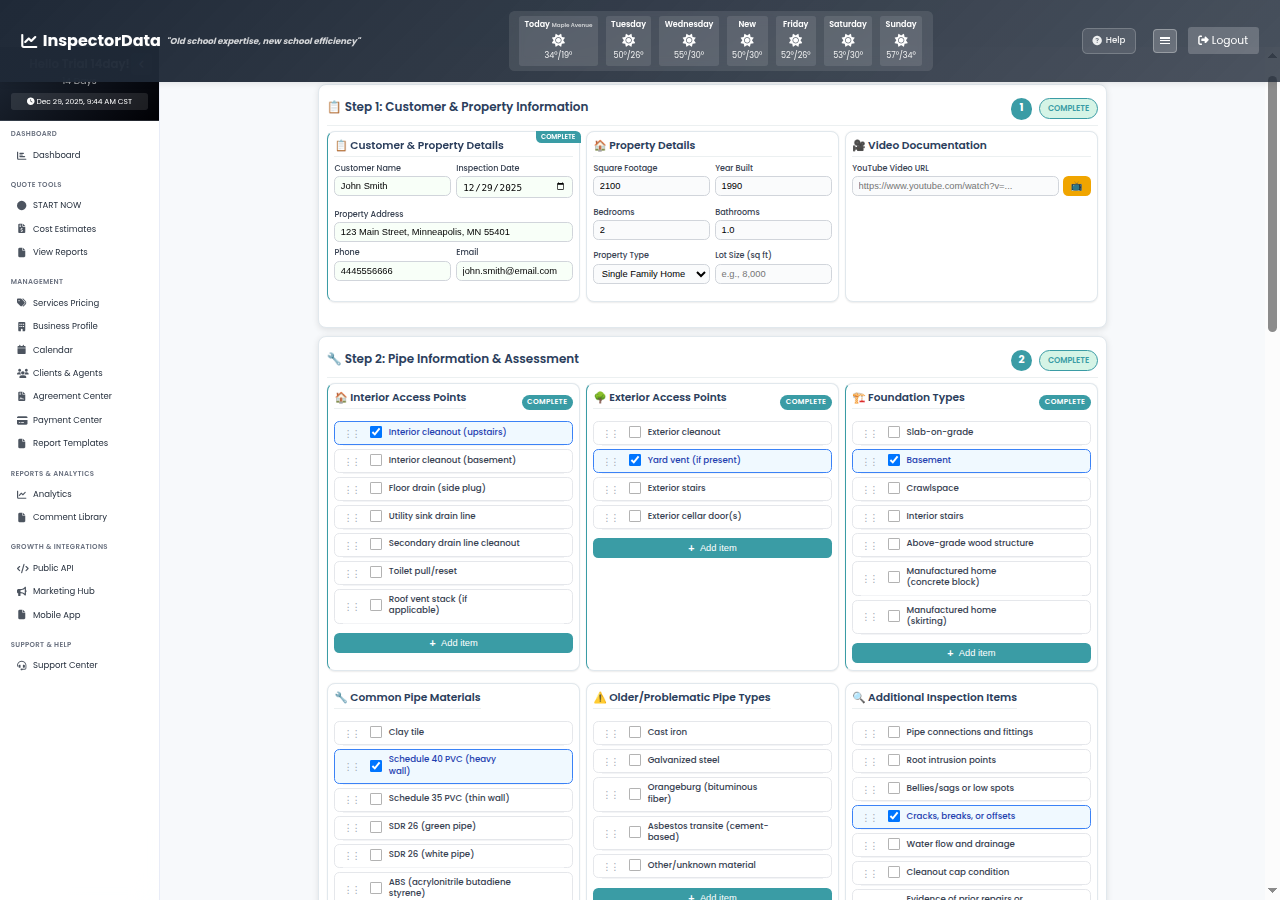
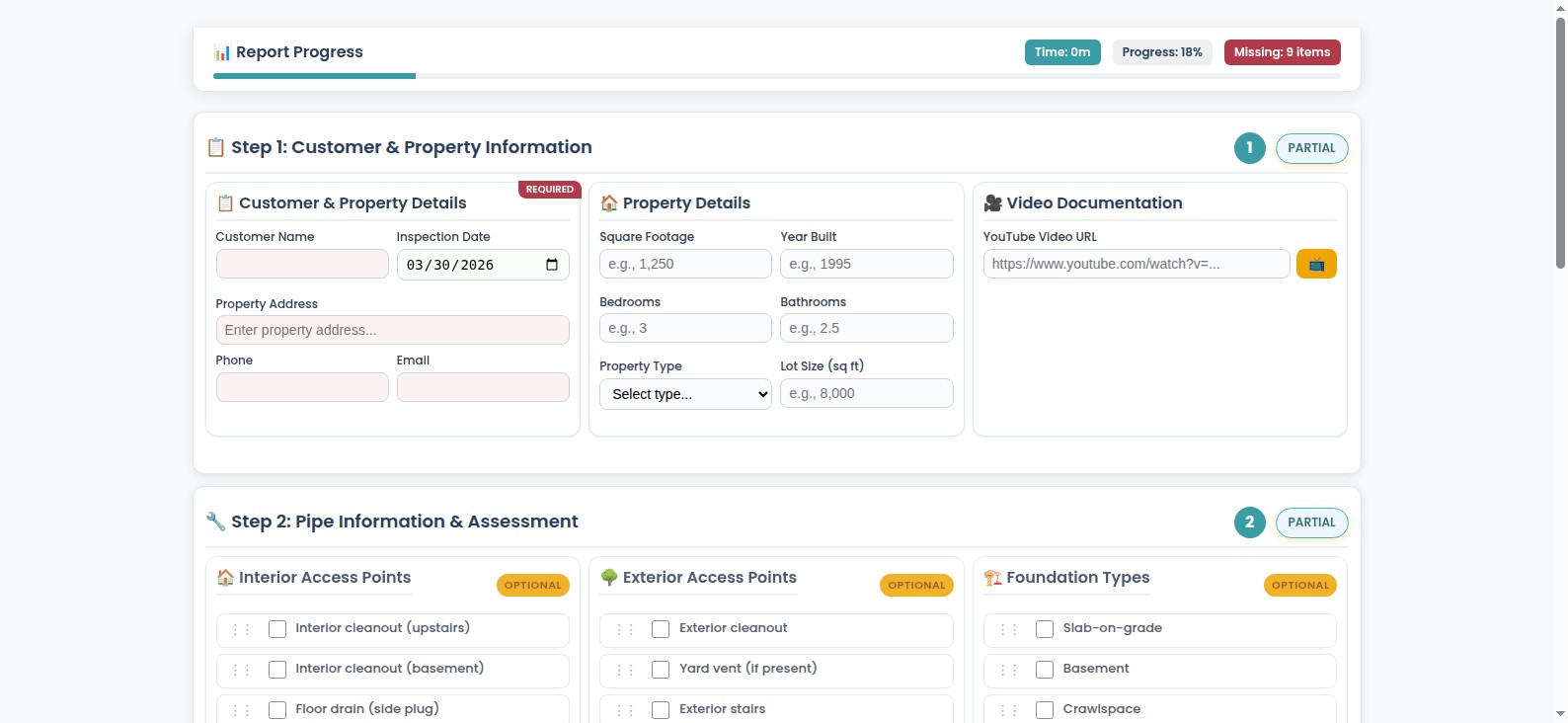
Start by entering the property address and basic pipe information: material type, approximate age, pipe diameter, and access point location. The form includes pre-populated options for all common residential pipe materials with helpful context about each one. You can also enter the distance to the municipal connection and note any cleanout locations.
Step 2: Upload Photos and Let AI Analyze
Upload still captures from your sewer camera. The AI engine analyzes each image and generates a professional defect description -- identifying the type of issue, its apparent severity, and a recommended course of action. You review each AI-generated comment and edit as needed before it goes into the report. The AI handles the heavy lifting of writing; you handle the professional judgment of accuracy.
Step 3: Generate and Deliver the Report
With one click, the software generates a branded PDF report that includes your company logo, the property details, all documented findings with photos and descriptions, a summary of conditions, and your overall recommendation. You can email it directly to the client and their agent from within the platform, or download the PDF to deliver however you prefer.
Professional Sewer Reports in Minutes
AI-powered pipe analysis, photo annotations, video embedding, and branded PDF generation. Built by an inspector who has scoped thousands of sewer lines.
Explore Sewer Scope FeaturesWhy AI-Powered Reports Save Time
The difference between writing sewer scope inspection reports manually versus using AI-powered software is not incremental -- it is transformational. Here is a side-by-side comparison based on real-world workflows:
| Task | Manual Process | AI-Powered Software |
|---|---|---|
| Entering pipe details | 5-10 min (typing from scratch) | 1-2 min (pre-populated fields) |
| Writing defect descriptions | 15-25 min (per finding) | 1-2 min (AI generates, you review) |
| Photo documentation | 10-15 min (screenshot, crop, insert) | 2-3 min (upload, auto-placed) |
| Formatting the report | 10-20 min (Word/PDF layout) | 0 min (auto-generated PDF) |
| Delivering to client | 5 min (compose email, attach) | 1 min (send from platform) |
| Total time per report | 45-75 minutes | 5-10 minutes |
That time difference compounds quickly. If you perform three sewer scope inspections per week, AI-powered software saves you roughly 2 to 3 hours every week -- time you can spend performing additional inspections or simply getting home earlier.
Common Pipe Materials and What They Mean
Understanding pipe materials is fundamental to writing accurate sewer scope inspection reports. Each material has a different expected lifespan, common failure patterns, and replacement cost implications. Here is what you need to know about the materials you will encounter most frequently:
Clay Tile (Vitrified Clay Pipe)
Clay tile is one of the oldest and most common sewer pipe materials in residential construction, especially in homes built before 1960. Individual clay segments are typically 2 to 3 feet long, joined together at bell-and-spigot connections. The material itself is extremely durable and resistant to chemical degradation -- pipes over 100 years old can still be in functional condition.
The weakness of clay tile is at the joints. Tree roots exploit the gaps between segments, and ground settling can cause offsets where one segment shifts relative to the next. When you scope a clay line, pay close attention to every joint. Root intrusion and offset joints are the most common findings. Replacement cost for a full clay line typically runs $5,000 to $15,000 depending on depth and length.
PVC (Polyvinyl Chloride)
PVC became the standard for residential sewer lines starting in the 1970s and remains the most commonly installed material today. PVC pipes are lightweight, chemically resistant, smooth on the interior (which reduces buildup), and connected with solvent-welded joints that create a nearly seamless run.
PVC lines in good condition are among the easiest to scope because the smooth interior and tight joints mean fewer findings. Common issues include belly sections (sagging caused by poor bedding or soil settlement), physical damage from construction activity near the line, and improper connections where the line meets the municipal main. Expected lifespan is 50 to 100+ years.
Cast Iron
Cast iron sewer pipes were commonly installed from the 1920s through the 1970s. The material is strong and was considered premium in its era. However, cast iron is susceptible to interior scaling (buildup of rust and corite deposits that reduce flow capacity) and channeling (erosion along the bottom of the pipe from decades of water flow).
When scoping cast iron, look for heavy scale buildup that narrows the effective diameter, channeling along the pipe bottom, and rust-through holes that appear as bright spots on camera. Cast iron replacement typically costs $6,000 to $20,000. Many plumbers recommend proactive replacement of cast iron lines older than 50 years, even when current camera footage looks acceptable.
Orangeburg (Bituminized Fiber Pipe)
Orangeburg pipe was manufactured from compressed wood fibers impregnated with coal tar pitch. It was widely installed from the 1940s through the early 1970s as an inexpensive alternative to clay and cast iron. The material has a severely limited lifespan -- most Orangeburg lines have already exceeded their useful life.
Orangeburg deteriorates by softening, deforming (collapsing into an oval shape), and eventually collapsing entirely. When you encounter Orangeburg during a sewer scope, the recommendation is almost always full replacement regardless of current condition. This should be clearly communicated in the report. Replacement cost is similar to other materials: $5,000 to $15,000.
How to Price Sewer Scope Inspections
Pricing sewer scope inspections correctly is essential for building a profitable add-on service. Price too low and you devalue the service; price too high and buyers skip it entirely. Here is how experienced inspectors approach sewer scope pricing in 2026:
Typical Price Ranges
- $125 - $175: Entry-level pricing, common in markets with heavy competition or when bundled with a full home inspection at a discount. This range covers your time and equipment costs but leaves thin margins.
- $175 - $250: The sweet spot for most markets. This price reflects the specialized equipment, training, and liability involved. Most inspectors who have established their sewer scope service land in this range.
- $250 - $350: Premium pricing justified by faster turnaround, more detailed reporting (video embedding, AI analysis, annotated photos), and established reputation. Markets in Colorado, Pacific Northwest, and major metro areas commonly support this range.
Upsell Strategies That Work
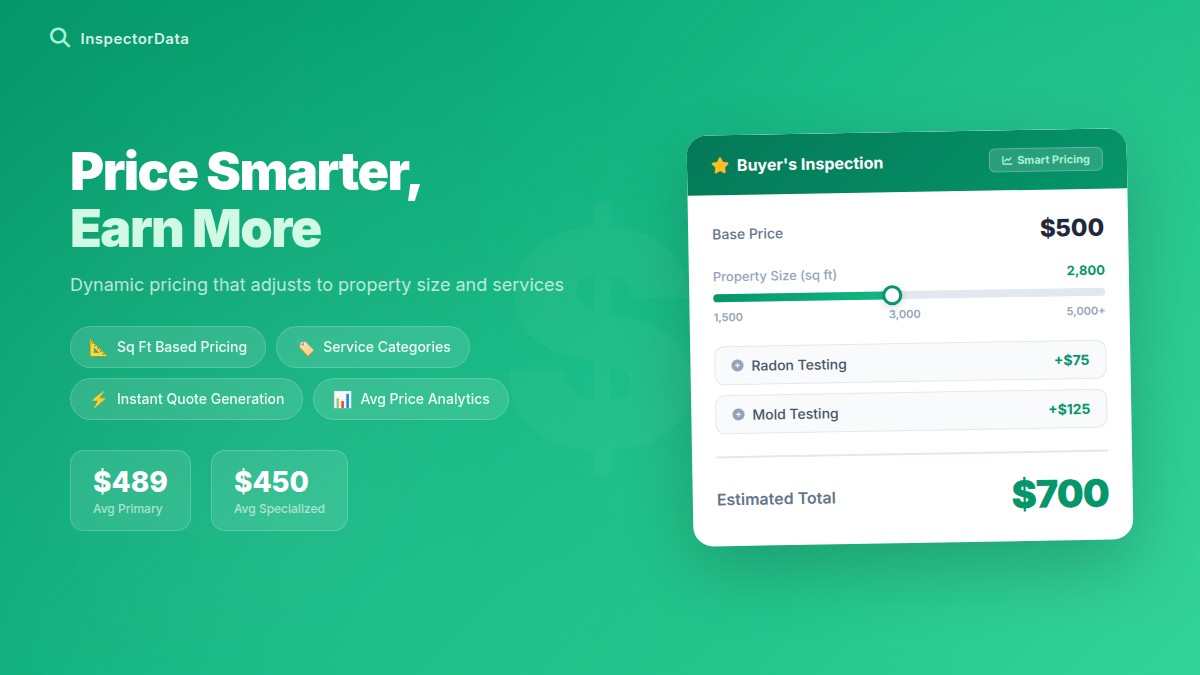
The most effective approach is offering sewer scope as a checkbox add-on during the booking process. When a buyer is already scheduling a $400 to $600 home inspection, adding a $200 sewer scope feels like a reasonable upgrade -- not a separate purchasing decision.
InspectorData's quote calculator supports this workflow natively. You configure your sewer scope service as an add-on in your pricing settings, and it automatically appears as an option when customers request quotes. The price is included in the total, and the buyer sees one combined estimate rather than two separate invoices.
Other strategies that drive sewer scope revenue:
- Agent education -- Send a one-page handout to your agent partners explaining why sewer scopes matter on homes with clay, cast iron, or Orangeburg pipes. Agents who understand the risk will recommend the service to their buyers.
- Age-based recommendations -- For any home older than 25 years, include a note in your standard home inspection report recommending a sewer scope. This creates demand even from buyers who did not initially consider it.
- Bundle discounts -- Offer $25 to $50 off the sewer scope when booked alongside a full home inspection. The bundled revenue is still higher than the home inspection alone, and the perceived discount drives conversion.
Choosing the Right Software
When evaluating sewer scope report software for your business, use this checklist to compare your options objectively:
| Feature | Must Have | Questions to Ask |
|---|---|---|
| Pipe material presets | Does it include all common residential materials? | |
| AI defect analysis | Does the AI analyze pipe photos specifically, or just generic images? | |
| Photo annotations | Can you draw arrows and add text overlays on camera captures? | |
| Video embedding | Can clients watch camera footage directly in the report? | |
| Branded PDF output | Does the PDF include your logo, colors, and contact info? | |
| Mobile-friendly workflow | Can you complete the full report on a phone or tablet? | |
| Distance-based tracking | Can you tag findings by footage distance from the access point? | |
| Integration with home inspection reports | Can the sewer report be linked to or bundled with the full inspection? | |
| No per-report fees | Is the sewer scope module included, or is it an extra charge? |
= Essential = Highly recommended
The most important thing to avoid is cobbling together a workflow from multiple tools. Using one app for your camera, another for photo editing, a word processor for the report, and email for delivery creates unnecessary friction. Every handoff between tools is a place where time is lost and errors creep in. A single integrated platform eliminates all of that.
Getting Started
If you are already performing sewer scope inspections -- or considering adding the service -- the right software makes the difference between a profitable, efficient workflow and a time-consuming administrative burden.
InspectorData includes the sewer scope report writer as part of its all-in-one platform at $79 per month. There are no additional charges for the sewer scope module, no per-report fees, and no premium tier required. Every feature described in this guide -- AI photo analysis, pipe material presets, video embedding, branded PDF generation, and email delivery -- is included from day one.
The 30-day free trial is available. You can test the full sewer scope workflow with real camera footage from your next inspection and see the results before committing.
Full access to all features including sewer scope reports.