- 1 Licensed vs. Non-Licensed States: The Big Picture
- 2 What State Licensing Typically Involves
- 3 License Requirements by State (All 50)
- 4 States With No Statewide License
- 5 The Most Heavily Regulated States
- 6 Working in Multiple States & Reciprocity
- 7 License Tiers: How States Structure Credentials
- 8 Common Licensing Mistakes to Avoid
- 9 How to Verify Your State's Current Rules
- 10 Frequently Asked Questions
Home inspector licensing is set by each state, not the federal government — so the answer to "what do I need to become a home inspector?" depends entirely on where you live. As of 2026, roughly 34 states license home inspectors at the state level, while the rest have no statewide requirement. This guide gives you the big-picture map, a state-by-state requirements table, and the practical steps to confirm exactly what applies to you before you spend money on training.
Quick Answer
About 34 states require a home inspector license; the rest have no statewide requirement. In licensed states, you typically need approved training (40-200 hours), a passing exam (often the NHIE), insurance, and an application fee. Texas, North Carolina, and a handful of others are the most heavily regulated. Always confirm current rules with your state's licensing board, since requirements change.
Licensed vs. Non-Licensed States: The Big Picture
There is no national home inspector license in the United States. Each state decides whether to regulate the profession, and the result is a patchwork. Broadly, states fall into three groups:
- Fully licensed states (~34): You must hold a state license to legally perform home inspections. These states define training hours, exams, insurance minimums, and continuing-education requirements.
- No statewide license (~16): The state imposes no licensing requirement. You can legally inspect, but professional certification carries the credibility that a license would otherwise provide.
- Limited or local regulation: A few states have voluntary registration, narrow rules, or leave regulation to local jurisdictions rather than a statewide license.
This is the single most important thing to get right before you start. A training program that satisfies one state's requirements may not satisfy another's, and inspecting without a required license can carry penalties. The table below maps where each state lands. For the deeper dive on the unlicensed states specifically, see our companion guide on states with no home inspection license required.
What State Licensing Typically Involves
In licensed states, the path to a license usually combines the same core ingredients, with the specifics dialed up or down by each state:
| Requirement | Typical Range | Notes |
|---|---|---|
| Approved education | 40-200 hours | Must be a state-approved provider |
| Exam | NHIE or state exam | ~$225; some states require both |
| Field inspections | 0-100+ supervised | Required in heavily regulated states |
| Insurance | E&O and/or liability | Minimum coverage often mandated |
| Application & fees | $50-$400+ | Plus possible background check |
| Continuing education | 8-20 hrs/year | To renew the license |
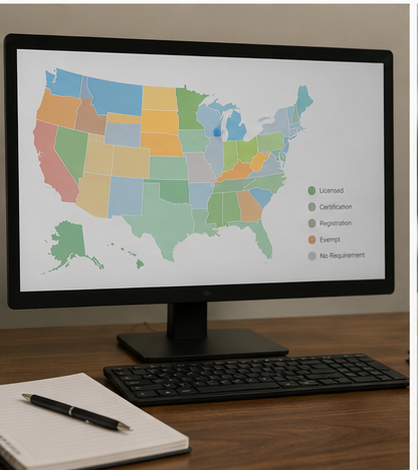
Home Inspector License Requirements by State (All 50)
The table below summarizes whether each state requires a license and the general flavor of its requirements. Treat it as a starting map, not legal advice — state boards update rules regularly, so verify the specifics with the official source before you enroll or apply. States marked "No state license" are covered in detail in our no-license states guide.
| State | License Required? | General Requirement Level |
|---|---|---|
| Alabama | Yes | Education + exam + insurance |
| Alaska | Yes | Education + exam + field experience |
| Arizona | Yes | Education + exam + field inspections |
| Arkansas | Yes | Education + exam + insurance |
| California | No state license | Certification recommended |
| Colorado | No state license | Certification recommended |
| Connecticut | Yes | Education + exam + field inspections |
| Delaware | Yes | Education + exam + insurance |
| Florida | Yes | Education + exam + insurance |
| Georgia | No state license | Certification recommended |
| Hawaii | No state license | Certification recommended |
| Idaho | No state license | Certification recommended |
| Illinois | Yes | Education + exam + insurance |
| Indiana | Yes | Education + exam + insurance |
| Iowa | No state license | Certification recommended |
| Kansas | No state license | Certification recommended |
| Kentucky | Yes | Education + exam + insurance |
| Louisiana | Yes | Education + exam + insurance |
| Maine | No state license | Certification recommended |
| Maryland | Yes | Education + exam + field inspections |
| Massachusetts | Yes | Education + exam + field inspections |
| Michigan | No state license | Certification recommended |
| Minnesota | No state license | Certification recommended |
| Mississippi | Yes | Education + exam + insurance |
| Missouri | No state license | Certification recommended |
| Montana | No state license | Certification recommended |
| Nebraska | No state license | Certification recommended |
| Nevada | Yes | Education + exam + field inspections |
| New Hampshire | Yes | Education + exam |
| New Jersey | Yes | Education + exam + field inspections |
| New Mexico | Yes | Education + exam + insurance |
| New York | Yes | Education + exam + field inspections |
| North Carolina | Yes | Heavy: education + exam + field inspections |
| North Dakota | No state license | Certification recommended |
| Ohio | Yes | Education + exam + field inspections |
| Oklahoma | Yes | Education + exam + insurance |
| Oregon | Yes | Education + exam + field experience |
| Pennsylvania | No state license | Association membership + experience expected |
| Rhode Island | Yes | Education + exam + field inspections |
| South Carolina | Yes | Education + exam + insurance |
| South Dakota | Yes | Registration + exam |
| Tennessee | Yes | Education + exam + insurance |
| Texas | Yes | Heavy: tiered license + education + field inspections |
| Utah | No state license | Certification recommended |
| Vermont | No state license | Certification recommended |
| Virginia | Yes | Education + exam + field inspections |
| Washington | Yes | Education + exam + field inspections |
| West Virginia | Yes | Education + exam + insurance |
| Wisconsin | Yes | Education + exam + insurance |
| Wyoming | No state license | Certification recommended |
States With No Statewide License
In states without a licensing requirement, you can legally inspect homes without a state credential — but that doesn't mean credentials don't matter. In fact, they matter more. When the state isn't vouching for your competence, your voluntary professional certifications (InterNACHI CPI, ASHI ACI, or the InterNACHI Master Inspector designation) become the trust signal that wins clients and agent referrals.
States generally without a statewide home inspector license as of 2026 include Colorado, Georgia, Idaho, Kansas, Maine, Michigan, Minnesota, Missouri, Montana, Nebraska, Utah, Vermont, Wyoming, and several others. If you're in one of these states, the smart move is to train and certify anyway — both to do the work well and to compete. Our full breakdown of the opportunity is in states with no home inspection license required, and the credentials worth pursuing are detailed in the certification guide.
The Most Heavily Regulated States
A handful of states stand out for demanding the most before you can work. If you live in one of these, budget more time and money for the licensing process:
- Texas: Among the most regulated. The Texas Real Estate Commission (TREC) uses a tiered system — Apprentice Inspector, Real Estate Inspector, and Professional Inspector — with substantial education hours, a state exam, supervised field inspections, and required insurance to reach the top tier. This is the path most people mean when they search "how to become a home inspector in Texas."
- North Carolina: Requires approved education, a licensing exam, and supervised field inspections, with distinct license levels.
- New York, New Jersey, Ohio, Virginia, Washington: All require a combination of approved education, an exam, and supervised field inspections before licensure.
The upside of high regulation is fewer competitors and a clearer professional standard. The downside is a longer, costlier on-ramp. Either way, plan the full timeline before you start — our step-by-step guide to becoming a home inspector walks through each phase.
Working in Multiple States & Reciprocity
Because there's no national license, working across state lines means holding each licensed state's credential. Some states offer reciprocity — recognizing a license from another state with similar standards — or have requirements close enough that adding a second license is straightforward. Others make you repeat training or exams.
If your market sits near a state border, or you plan to expand, check both states' boards for reciprocity agreements before you assume your license travels. A common scenario: an inspector licensed in one heavily regulated state can often add a neighboring less-regulated state quickly, while the reverse may require additional education. Plan your coverage area around the licensing reality, not just the geography.
License Tiers: How States Structure Inspector Credentials
Not every license is a single, one-and-done credential. Several states use a tiered structure that takes you from supervised trainee to fully independent inspector. Understanding the tiers helps you plan the timeline and avoid surprises.
Apprentice / Trainee Level
In tiered states like Texas, you typically start as an Apprentice or Trainee Inspector. At this level you can perform inspections only under the direct supervision of a licensed professional inspector. It's an on-ramp designed to build supervised field experience before you can work independently — and it's one of the best ways to learn the craft with a safety net.
Associate / Real Estate Inspector Level
The middle tier (called Real Estate Inspector in Texas, or an Associate level elsewhere) grants more independence but may still require sponsorship by, or affiliation with, a fully licensed inspector. You can do more on your own, but you haven't yet reached the top credential.
Professional / Licensed Inspector Level
The top tier — Professional Inspector in Texas, or simply "Licensed Home Inspector" in single-tier states — lets you inspect fully independently, sponsor others, and operate your own business without supervision. Reaching it usually requires the most education hours, a passed exam, the most field inspections, and the required insurance. This is the credential most aspiring inspectors are ultimately working toward.
Common Licensing Mistakes to Avoid
The licensing process is where new inspectors most often waste time and money. These are the avoidable mistakes that cost people months:
- Buying training before checking state approval. A course that satisfies one state may not be approved in yours. Confirm approval with your state board first, then enroll.
- Assuming a license transfers across state lines. There's no national license. If you work near a border or plan to expand, verify reciprocity before assuming your credential travels.
- Underestimating insurance requirements. Many states won't license you without proof of E&O or liability coverage at a minimum amount. Line up insurance quotes early so you're not stuck waiting on a policy at the application stage.
- Forgetting continuing education. Most licensed states require ongoing CE hours to renew. Letting your license lapse can mean re-testing or re-applying.
- Skipping the field-inspection requirement. In heavily regulated states, you must complete a number of supervised inspections. Arrange a mentor or sponsoring inspector before you finish your coursework so you're not stalled.
Getting these right the first time is the difference between inspecting in three months and inspecting in nine. When you're ready to compare the credentials worth pursuing beyond the basic license, our certification guide breaks down which ones actually raise your income.
How to Verify Your State's Current Rules
Licensing rules change, and an out-of-date course or assumption can cost you months. Before you enroll in training or submit an application, confirm requirements directly from the authoritative source:
- Your state's licensing board or real estate commission. This is the definitive source for current education hours, exams, insurance minimums, and fees.
- InterNACHI's state requirements pages. The association maintains state-by-state summaries that are a useful cross-check.
- An approved local training provider. Reputable providers build their curricula around current state mandates and can confirm what their program covers.
Frequently Asked Questions
How many states require a home inspector license?
As of 2026, roughly 34 states regulate and license home inspectors at the state level. The remaining states have no statewide licensing requirement, though a few have voluntary registration or leave regulation to local jurisdictions. Because rules change, always confirm current requirements with your state's licensing board or real estate commission before training.
Which states do not require a home inspector license?
States with no statewide home inspector license requirement include Colorado, Georgia, Idaho, Kansas, Michigan, Minnesota, Missouri, Montana, Nebraska, Utah, Wyoming, and several others. In these states you can legally inspect homes without a state license, but earning a professional certification such as InterNACHI CPI or ASHI ACI is strongly recommended for credibility and agent referrals.
How do I become a licensed home inspector in Texas?
Texas is one of the most regulated states. To become a licensed home inspector in Texas you generally progress through tiers — Apprentice, Real Estate Inspector, then Professional Inspector — administered by the Texas Real Estate Commission (TREC). The Professional Inspector level requires substantial approved education (well over 100 hours), passing the state exam, completing supervised inspections, and carrying the required insurance. Always verify current TREC requirements directly.
Can I inspect homes in multiple states?
Yes, but each licensed state requires you to hold that state's license. There is no national home inspector license. Some states offer reciprocity or have similar enough requirements that adding a second license is straightforward, while others require you to repeat training or exams. If you plan to work across state lines, check both states' boards for reciprocity agreements before assuming your existing license transfers.
How long does it take to get a home inspector license?
In most states, getting licensed takes 3 to 6 months from start to finish. Training programs range from about 40 to 200 hours depending on the state, then you schedule and pass an exam, submit your application with proof of insurance, and wait for the board to process it. Heavily regulated states with field-inspection requirements, such as Texas, can take longer.
Do home inspectors need insurance to be licensed?
Many licensing states require home inspectors to carry insurance to obtain or maintain a license — typically errors-and-omissions (E&O) coverage, general liability, or both, at a minimum coverage amount set by the state. Even where it is not legally required, carrying E&O and general liability is considered essential because it protects you from claims that a defect was missed or that damage occurred during an inspection.
Get Licensed, Then Get Booked
Once you've met your state's requirements, InspectorData gives you AI-powered reports, online scheduling, instant quoting, and digital agreements — everything you need to run a professional inspection business. $79/month with a 90-day free trial, no credit card required.
Start Your 90-Day Free Trial