- 1 Are Home Inspectors in High Demand?
- 2 The 2026 Job Outlook & Growth Projection
- 3 What Drives Demand for Inspections
- 4 Where the Jobs Are: States & Markets
- 5 How to Find Home Inspection Jobs Near You
- 6 Employee Jobs vs. Self-Employed Work
- 7 Is Home Inspection a Good Career?
- 8 Will AI Affect Inspector Jobs?
- 9 Frequently Asked Questions
Home inspector demand is steady and growing. Employment of construction and building inspectors — the category that includes home inspectors — is projected to grow roughly 5-7% through 2030, faster than the average occupation, driven by the millions of home sales that happen every year. This guide breaks down the 2026 job outlook, what's fueling demand, where the opportunities are, and exactly how to find home inspection work near you, whether you want a salaried job or to build your own business.
Quick Answer
Yes, home inspectors are in demand. The field is projected to grow about 5-7% through 2030, fueled by roughly 5.5 million annual existing-home sales plus new construction and investor inspections. The work is relatively recession-resistant. To find jobs, search company listings and job boards for employee roles, or build agent referrals and online booking for self-employed work — which is where most inspection volume comes from.
Are Home Inspectors in High Demand?
Short answer: yes. Home inspection demand is tied directly to real estate activity, and real estate is one of the largest, most consistent markets in the economy. In 2025, approximately 5.5 million existing homes were sold in the United States, and the large majority of those purchase transactions included a home inspection. Each of those sales is a potential job. Layer on new construction inspections, pre-listing inspections, and investor due-diligence work, and the opportunity runs into the millions of inspections per year.

The home inspection industry generates an estimated $5 billion in annual revenue, and consumer awareness of the value of inspections continues to grow. That combination — high transaction volume plus rising awareness — is why demand has stayed strong even as the broader economy cycles up and down.
The 2026 Job Outlook & Growth Projection
The U.S. Bureau of Labor Statistics classifies home inspectors within "construction and building inspectors." Employment in that category is projected to grow approximately 5-7% through 2030 — outpacing the average across all occupations. The BLS reports a median annual salary of roughly $67,700 for the category, though that blends lower-paid government building inspectors with private home inspectors, who can earn considerably more when self-employed.
| Metric | 2026 Snapshot | What It Means for You |
|---|---|---|
| Projected job growth | ~5-7% through 2030 | Faster than average; steady opportunity |
| Median salary (category) | ~$67,700 | Private/self-employed inspectors often earn more |
| Existing homes sold / yr | ~5.5 million | Millions of potential inspection jobs |
| Industry revenue | ~$5 billion / yr | Large, established market |
| Recession sensitivity | Relatively low | Homes still sell and need inspections in downturns |
Two nuances are worth understanding. First, inspection volume does rise and fall with the housing market — a hot market with bidding wars (where some buyers waive inspections) and a slow market both affect volume, just in different ways. Second, because the field skews self-employed, the "job outlook" for a motivated person is less about whether jobs exist and more about whether you can build the referral relationships that generate work. They exist; the question is execution.
What Drives Demand for Inspections
Understanding what creates inspection work helps you position yourself where the volume is. Demand comes from several distinct sources, and the smartest inspectors tap more than one:
- Buyer's inspections: The bread and butter. A buyer under contract hires an inspector to evaluate the home before closing. This is the single largest source of work and is overwhelmingly driven by real estate agent referrals.
- Pre-listing (seller's) inspections: Sellers increasingly inspect before listing to avoid surprises during negotiation. A growing category, especially in competitive markets.
- New construction inspections: Even brand-new homes have defects. Phase inspections and final walkthrough inspections on new builds add steady volume.
- Investor & rental due-diligence: Real estate investors inspect properties before buying and between tenants. Repeat clients who can become a reliable revenue base.
- Specialty & ancillary work: Radon, mold, sewer scope, wind mitigation, and four-point inspections add demand on top of the standard inspection — and raise revenue per job.
The takeaway: demand isn't one faucet, it's several. Inspectors who cultivate agent referrals and add ancillary services and court investor clients build the most resilient, year-round workload.
Where the Jobs Are: States & Markets
Inspection demand follows population, home sales, and real estate turnover. The highest-volume opportunities tend to cluster in fast-growing, high-transaction states — think Florida, Texas, the Carolinas, Arizona, Georgia, and Tennessee — where steady in-migration and new construction keep transaction counts high. Large metro areas in any state also concentrate demand simply because more homes change hands.
That said, where you'll earn the most isn't always where there's the most volume — pricing power, competition, and cost of living all factor in. A mid-size market with less competition can be more lucrative than a saturated big city. To match opportunity to earnings, cross-reference local demand with our home inspector income by state guide, which breaks down typical pay in all 50 states.
How to Find Home Inspection Jobs Near You
"Home inspection jobs near me" means two different things depending on your goal. Here's how to find work either way.
If You Want an Employee or Apprentice Job
- Search local inspection companies directly. Many established firms hire and train apprentices or associate inspectors. A direct email or call often beats waiting for a posting.
- Check job boards. Indeed, ZipRecruiter, and LinkedIn list inspector and apprentice roles, especially at multi-inspector firms and franchises.
- Look at franchise career pages. National inspection franchises regularly recruit and train new inspectors in local markets.
- Network through associations. InterNACHI and ASHI chapters connect new inspectors with firms that are hiring.
If You Want Self-Employed Work (Where the Money Is)
- Build real estate agent relationships. Agents drive most inspection referrals. Becoming the inspector agents trust is the highest-leverage thing you can do — our guide on how to become the go-to home inspector for realtors covers exactly how.
- Set up a Google Business Profile and collect genuine reviews so you show up when buyers search locally.
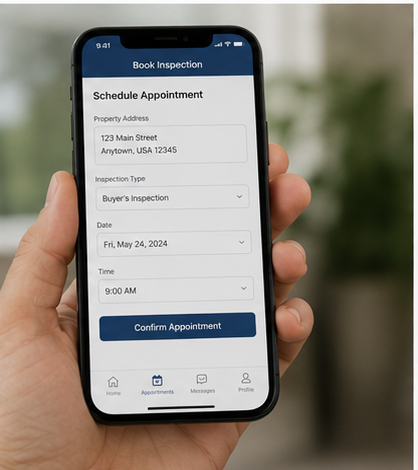
- Make booking effortless. Online scheduling and instant quotes let agents and buyers book you in seconds instead of playing phone tag with a competitor.
- Deliver fast, clear reports. A same-day or next-day, photo-rich report is the best marketing there is — it's what gets you re-referred.
For self-employed inspectors, the "job search" never really ends — it becomes a referral engine. The good news is that once it's running, it compounds. For the full picture of building this from scratch, see how to become a home inspector and your first year in home inspection.
Employee Jobs vs. Self-Employed Work
Both models are viable, and many inspectors do both at different career stages. Here's the honest comparison:
| Factor | Employee / Apprentice | Self-Employed |
|---|---|---|
| Income potential | Steadier, lower ceiling | Higher ceiling ($100K-$200K+) |
| Startup cost | Minimal | Training, license, insurance, tools |
| Learning curve | Mentored, lower risk | On your own (mentorship helps) |
| Schedule control | Set by employer | You set it |
| Who finds the work | Employer | You (via agent referrals) |
A common and smart path: start as an employee or apprentice to learn the trade with less risk, then transition to self-employment once you have the skills, confidence, and a few agent relationships. The highest earnings are on the self-employed side, but so is the responsibility for finding work. Our salary and income guide details how the two models compare on pay.
Is Home Inspection a Good Career?
For the right person, home inspection is one of the most attractive trades-adjacent careers available in 2026. The case for it:

- Low barrier to entry. No college degree; you can qualify in 3-6 months for a modest investment.
- Strong, recession-resistant demand. Homes sell in every market, and most sales involve an inspection.
- Flexible schedule and independence. Self-employed inspectors set their own hours and territory.
- High income ceiling. Solo inspectors regularly earn $100,000+, and business owners more.
- Meaningful work. You protect people from buying a home with serious hidden problems.
The honest trade-offs: first-year income is usually modest while you build referrals; the work is physically demanding (crawlspaces, attics, roofs, all weather); and there's real liability, which is why insurance and solid reports matter. If you're comfortable with those, the upside is substantial. For a deeper look at whether the technology side is a threat, read will AI replace home inspectors.
Will AI Affect Inspector Jobs?
AI is reshaping how inspectors work, not eliminating the role. The physical job — accessing the property, evaluating systems, exercising professional judgment, and standing behind the findings — requires a licensed human on-site. What AI changes is the back end: AI home inspection software that assists with photo analysis and report writing makes inspectors faster, which lets them complete more inspections per week and deliver clearer reports.
In practical terms, that's good news for inspector demand, not bad. The inspectors who adopt modern tools gain a productivity edge: more jobs per week, faster turnaround, and reports that win re-referrals. Rather than competing against AI, the winning move is to use it — which is exactly what an inspection platform with AI-assisted reporting delivers.
Frequently Asked Questions
Are home inspectors in high demand?
Yes, demand for home inspectors is steady and growing. Employment of construction and building inspectors, the category that includes home inspectors, is projected to grow about 5-7% through 2030, faster than the average occupation. Demand is driven by the roughly 5.5 million existing homes sold each year, plus new construction, pre-listing inspections, and investor due-diligence work. Because homes sell in any market, demand is also relatively recession-resistant.
How do I find home inspection jobs near me?
There are two paths. To find a job as an employed inspector, search local inspection companies, job boards like Indeed and ZipRecruiter, and franchise career pages, and reach out to established firms directly — many hire and train apprentices. To find inspection work as a self-employed inspector, the 'jobs' are referrals: build relationships with real estate agents, set up a Google Business Profile, and make it easy for buyers and agents to book you online. Most inspection volume comes from agent referrals, not job postings.
Is home inspection a good career in 2026?
For many people, yes. Home inspection offers a low barrier to entry, no college degree requirement, a flexible schedule, and the potential to earn $50,000 to $150,000 or more as you build a client base. The work is relatively recession-resistant because homes still sell and still need inspections in slower markets. The main trade-offs are modest first-year income while you build referrals and the physical demands of crawlspaces, attics, and roofs.
Will AI replace home inspectors?
No. AI is changing how inspectors work rather than replacing them. Tools that assist with photo analysis and report writing make inspectors faster and let them handle more inspections per week, but the core job — physically accessing and evaluating a property, exercising professional judgment, and standing behind the findings — requires a licensed human on-site. The realistic outlook is that AI raises productivity and report quality, not that it eliminates the role.
How many home inspections happen each year?
There is no single official count of inspections, but the volume is large. With roughly 5.5 million existing homes sold annually in the United States and the majority of purchase transactions including an inspection, the residential inspection market runs into the millions of inspections per year. Add new construction, pre-listing, and investor inspections and the total opportunity is even larger — the home inspection industry generates an estimated $5 billion in annual revenue.
Do home inspectors work for themselves or for a company?
Both models are common. Many inspectors start as employees or apprentices at an established inspection company to learn the trade and earn a salary or per-inspection commission. Over time, a large share become self-employed, running their own inspection business where income depends on volume, pricing, and add-on services. Self-employment is where the highest earnings are, but it also requires building your own client base and handling the business side.
Build a Business That Captures Steady Demand
InspectorData gives you AI-powered reports, online scheduling, instant quoting, digital agreements, and payment processing — everything you need to turn inspection demand into a full, profitable schedule. $79/month with a 30-day free trial.
Start Your 30-Day Free Trial