
- 01 Why Subcontractors Are Essential for Growing Inspection Businesses
- 02 Types of Subcontractors Home Inspectors Need
- 03 How to Find and Vet Subcontractors
- 04 Setting Up Rates and Service Areas
- 05 Tracking Jobs, Payables, and Performance
- 06 How InspectorData's Partner Network Works
- 07 Common Mistakes to Avoid
- 08 Getting Started
Every home inspector hits the same ceiling: a buyer needs a radon test, sewer scope, or mold assessment, and you either offer it through a subcontractor or lose that revenue to someone else. The inspectors who build reliable subcontractor networks don't just capture ancillary revenue -- they become the single point of contact for every service a real estate transaction needs. This guide covers how to find, vet, compensate, and manage subcontractors so you can scale your service offerings without adding full-time overhead.
Why Subcontractors Are Essential for Growing Inspection Businesses
The math on subcontractors is straightforward. A standard home inspection generates $400-$550 in revenue. Add radon testing, sewer scope, WDI, and mold -- coordinated through your subcontractor network -- and the same transaction generates $900-$1,400. You've doubled your revenue per job without doubling your time on-site.
But revenue is only part of the story. Subcontractor relationships create three structural advantages that solo inspectors without networks don't have:
- Single-call convenience: Real estate agents prefer working with one inspector who coordinates everything. When you can say "I'll handle the radon, sewer scope, and WDI -- all scheduled around the home inspection," you become the default recommendation for that agent's office.
- Revenue without overhead: Unlike hiring W-2 employees, subcontractors carry their own insurance, maintain their own equipment, and handle their own licensing. Your cost is a percentage of the job fee, paid only when work is performed.
- Competitive moat: A well-managed network of trusted subcontractors is difficult for competitors to replicate quickly. It takes months to vet providers, establish rates, and build mutual reliability. Once you have it, you have a real advantage.
Types of Subcontractors Home Inspectors Need
Not every market requires every specialty, but most successful inspection companies maintain relationships with at least three to four of the following subcontractor types:
Subcontractor Types and Revenue Potential
| Specialty | Typical Fee | Your Markup | Demand Level | Licensing Required |
|---|---|---|---|---|
| Radon Testing | $125-$175 | 15-25% | High (required in many states) | State-specific certification |
| Sewer Scope | $200-$350 | 10-20% | High (growing rapidly) | Varies by municipality |
| WDI / Termite | $75-$125 | 15-25% | High (lender-required in many areas) | Pest control license |
| Mold Testing | $250-$500 | 15-30% | Moderate | State certification where applicable |
| Structural Engineer | $400-$800 | 5-15% | Low (issue-triggered) | PE license |
| Chimney Inspection | $150-$300 | 10-20% | Moderate (seasonal) | CSIA certification preferred |
| Pool/Spa Inspection | $125-$250 | 15-25% | Market-dependent | Varies |
Building Your Core Network
Start with the services most commonly requested in your market. In the upper Midwest, radon testing and sewer scopes are nearly universal add-ons. In the Southeast, WDI inspections are lender-required on most transactions. In the West, pool inspections and seismic evaluations may be more relevant. Let your market demand guide your first three subcontractor relationships.
The goal is not to build the largest network possible -- it's to build a reliable one. Two vetted radon testers who respond within an hour and deliver results on time are worth more than ten names in a spreadsheet.
How to Find and Vet Subcontractors
Finding subcontractors is easy. Finding reliable ones who won't damage your reputation is the challenge. Here is a repeatable process for vetting new subcontractors before you send them to a client's property:
Where to Find Candidates
- InterNACHI and ASHI networks: Both organizations maintain directories of specialty inspectors and related service providers. Members are already invested in the inspection industry.
- Real estate agent recommendations: Ask the agents who refer you. They know which radon testers and sewer scope operators show up on time and deliver clean reports.
- Local trade associations: Plumbing contractors associations (for sewer scope), pest management associations (for WDI), and CSIA chapters (for chimney) all maintain member directories.
- Other home inspectors: Non-competing inspectors in adjacent territories often share subcontractor recommendations freely.
- Online directories: Google Business profiles with high ratings in your service area. Look for consistency in reviews, not just high scores.
The Vetting Checklist
Before adding any subcontractor to your network, verify all of the following:
- Current licensing and certification -- request copies, verify with the issuing authority, note expiration dates
- General liability insurance -- minimum $1M per occurrence, with your company listed as additional insured
- Workers' compensation -- if they have employees, this is non-negotiable
- E&O / professional liability -- especially for structural engineers and mold assessors
- References from 3+ inspection companies -- not personal references, professional ones from companies like yours
- Sample reports -- review 2-3 actual reports for thoroughness, professionalism, and clarity
- Response time test -- call or text at a normal business hour and measure how long they take to respond. If it takes 24+ hours during vetting, it will take longer once they're comfortable.
- Service area confirmation -- map their coverage against your inspection territory to identify gaps
Setting Up Rates and Service Areas
The rate structure you negotiate with subcontractors directly impacts your margins, your competitiveness, and the subcontractor's willingness to prioritize your jobs. Get this wrong and you'll either price yourself out of the market or attract subcontractors who treat your jobs as low priority.
Common Rate Structures
Subcontractor Payment Models
| Model | How It Works | Best For | Watch Out For |
|---|---|---|---|
| Flat referral fee | You pay sub full rate, charge client your rate, keep the spread | High-volume, standardized services (radon, WDI) | Margin can be thin if sub rates increase |
| Percentage split | Sub receives 70-85% of invoiced amount | Variable-price services (mold, structural) | Sub may feel undercompensated on high-value jobs |
| Wholesale rate | Sub offers you a discounted rate in exchange for volume | Established relationships with consistent volume | Requires volume commitment to maintain discount |
| Direct billing | Sub bills client directly, pays you a referral fee per job | High-liability services (structural engineering) | Less control over client experience and pricing |
Recommended starting approach: Negotiate a wholesale rate that gives you 15-20% margin on radon and WDI (high volume, low complexity) and 10-15% on sewer scope and mold (higher complexity, higher base fees). Put the rates in writing with a simple one-page agreement that covers pricing, payment terms, insurance requirements, and a 30-day termination clause for either party.
Service Area Mapping
Map your subcontractors' coverage areas against your own inspection territory. Identify:
- Areas where you have full coverage across all services
- Gaps where you lack a specific subcontractor type
- Overlap zones where multiple subs compete (use this as leverage for better rates)
- Edge territories where drive time may require a travel surcharge
Tracking Jobs, Payables, and Performance
The difference between an inspection company that profits from subcontractors and one that simply coordinates them is tracking. Without a system to monitor jobs dispatched, payments owed, and performance over time, you are running a charity for your subcontractors -- not a business.
What to Track for Every Subcontractor Job
- Job dispatch date and time -- when did you assign the job?
- Subcontractor response time -- how quickly did they confirm availability?
- Service completion date -- did they meet the agreed timeline?
- Report delivery time -- how long between service and report delivery?
- Client satisfaction -- any complaints, compliments, or issues?
- Amount owed -- what do you owe the subcontractor for this job?
- Amount invoiced -- what did you charge the client for this service?
- Payment status -- has the subcontractor been paid? When?
Performance Metrics That Matter
Review these metrics monthly for each subcontractor:
- On-time completion rate -- target 95%+. Below 90% means they are hurting your reputation.
- Report turnaround time -- average hours from service to delivered report. Faster is better for your client experience.
- Client complaint rate -- any subcontractor generating complaints on more than 5% of jobs needs a conversation or replacement.
- Revenue generated -- total revenue per subcontractor, total margin earned. Know who your most valuable partners are.
How InspectorData's Partner Network Works
Managing subcontractors with spreadsheets and text messages works until it doesn't -- usually around the point where you're coordinating 20+ subcontractor jobs per month across multiple specialties. That's where dedicated subcontractor management software becomes essential.
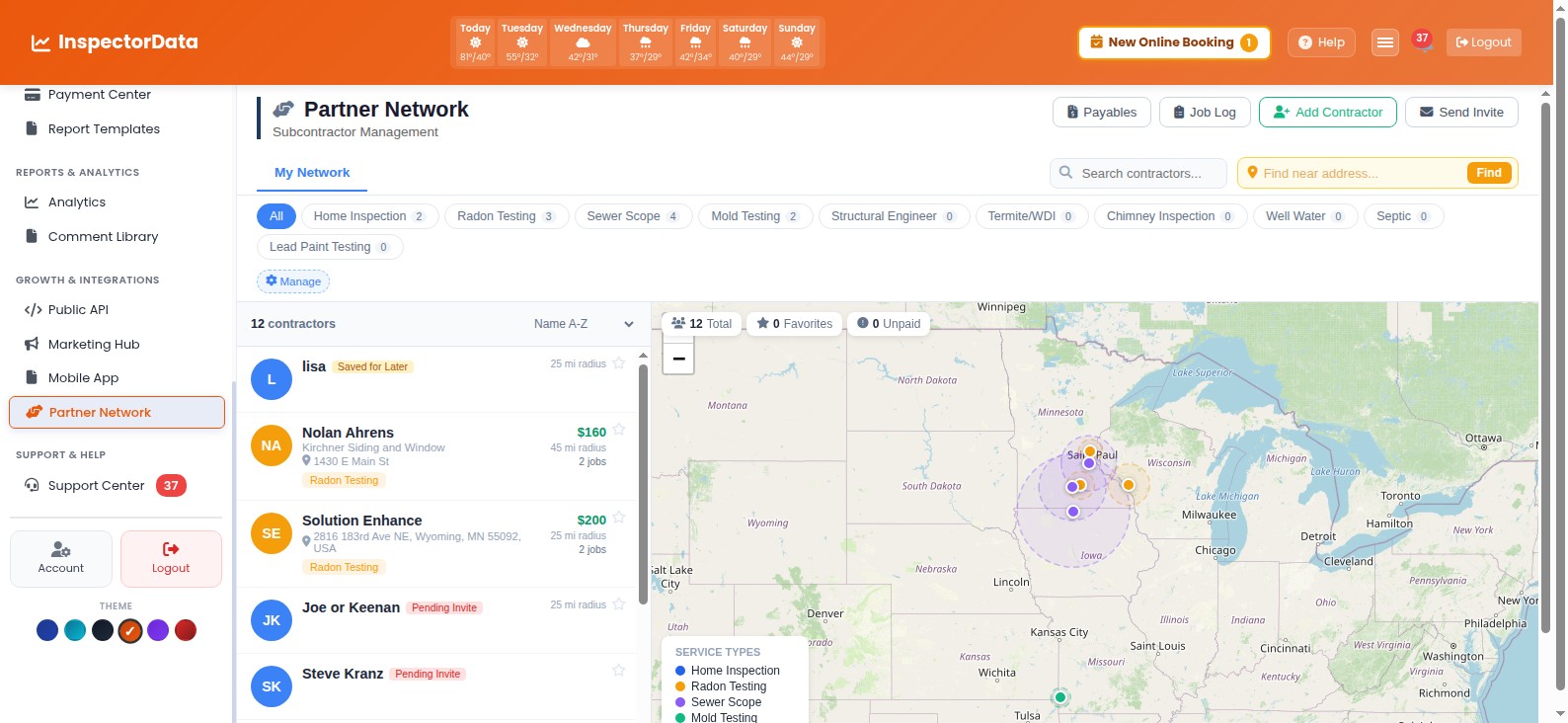
InspectorData's Partner Network feature was built specifically for this workflow. Here's what it handles:
- Subcontractor profiles: Store contact information, licensing details, insurance expiration dates, service specialties, and rate agreements in one place. Get automated alerts when licenses or insurance policies are approaching expiration.
- Rate configuration: Set per-service rates for each subcontractor. The system calculates your margin automatically when you add ancillary services to a client's inspection order.
- Service area mapping: Define each subcontractor's coverage area by zip code or radius. When you book an inspection, the system shows which subcontractors are available for that location.
- Job dispatch and tracking: Assign subcontractor jobs directly from the inspection calendar. Track confirmation, completion, and report delivery without manual follow-up.
- Payables management: Track what you owe each subcontractor across all jobs. Generate payment summaries by date range, subcontractor, or service type.
- Performance dashboard: Monitor on-time rates, turnaround times, and client feedback scores per subcontractor. Identify your top performers and address issues early.
The system integrates with InspectorData's inspection calendar and client management, so when you schedule an inspection with add-on services, the subcontractor assignments flow automatically into the workflow.
Common Mistakes to Avoid
After working with hundreds of inspection companies, these are the subcontractor management mistakes we see most often:
1. No Written Agreement
A handshake and a text thread is not a subcontractor agreement. At minimum, you need a one-page document covering: rate structure, payment terms, insurance requirements, non-solicitation clause (they don't market directly to your clients), report delivery expectations, and termination terms. This protects both parties and prevents misunderstandings that destroy relationships.
2. Single Points of Failure
If you have one radon tester and they get sick, take a vacation, or quit, you have zero radon testing capability. Always maintain at least two vetted subcontractors for every high-demand service. Redundancy is not waste -- it's reliability.
3. Not Verifying Insurance Annually
Insurance policies expire. A subcontractor who was insured when you onboarded them 18 months ago may not be insured today. Request updated certificates of insurance at least annually. If they can't produce one within 48 hours of your request, stop sending them jobs until they can.
4. Ignoring Client Feedback
When a client complains about a subcontractor, that complaint is really about you. You coordinated the service. You recommended the provider. Every piece of client feedback about a subcontractor should be logged and reviewed. Two complaints about the same issue from the same subcontractor is a pattern, not a coincidence.
5. Competing on Price Alone
Choosing subcontractors based solely on who offers the lowest rate is a recipe for quality problems. The subcontractor who charges $100 for a sewer scope and the one who charges $275 are not offering the same service. Interview, vet, and review reports before making rate the deciding factor.
6. Paying Late or Inconsistently
Subcontractors talk to each other. If you develop a reputation for slow payment, the best providers will stop accepting your jobs. The ones who remain will be the ones who can't afford to say no -- and that's rarely the quality tier you want representing your brand.
Subcontractor Management: DIY vs. Dedicated Software
| Capability | Spreadsheets + Texts | Dedicated Software |
|---|---|---|
| Contact management | Manual, scattered | Centralized profiles |
| Insurance tracking | Manual calendar reminders | Automated expiration alerts |
| Job dispatch | Phone call or text | One-click from calendar |
| Rate calculation | Manual math per job | Automatic margin calculation |
| Payables tracking | Spreadsheet prone to errors | Running totals with payment history |
| Performance metrics | Gut feeling | Data-driven dashboards |
| Service area coverage | Memory-based | Zip code and radius mapping |
| Scalability | Breaks at 15-20 jobs/month | Handles hundreds of jobs |
Getting Started
You don't need to build a massive subcontractor network overnight. Start with the service most requested by your clients that you don't currently offer. For most inspectors, that's radon testing or sewer scoping.
Your First 30 Days
- Week 1: Identify the top 2-3 ancillary services your market demands. Ask your top referring agents what services they wish you offered.
- Week 2: Find 3-4 candidates for each service using the sourcing methods above. Begin the vetting process -- collect licenses, insurance certificates, and sample reports.
- Week 3: Negotiate rates and draft simple subcontractor agreements. Set up tracking in your inspection management software or a dedicated spreadsheet if you're not on a platform yet.
- Week 4: Begin offering the new services. Send 3-5 trial jobs to your primary subcontractor. Track everything. Collect client feedback after each job.
Within 60-30 days, you should have a reliable primary subcontractor for each service and a backup for your highest-volume specialties. At that point, the revenue impact will be visible in your monthly numbers -- and the agent feedback will confirm that your full-service approach is generating more referrals.
Build and Manage Your Subcontractor Network
InspectorData's Partner Network gives you subcontractor profiles, rate management, job tracking, payables, and performance dashboards -- all integrated with your inspection calendar and client management.
Start Your Free 30-Day TrialFull access for 30 days.