
The difference between a $150,000 inspection business sale and a $600,000 sale isn't just revenue — it's how that revenue is structured. Two inspection businesses with identical revenue can have a 4x difference in sale price based on factors that have nothing to do with how good the inspector is. Understanding what buyers pay multiples for — and systematically building those characteristics into your business — is the highest-leverage exit strategy you have.
How Inspection Businesses Are Valued
Most small inspection businesses sell for 1–2.5x Seller's Discretionary Earnings (SDE). SDE is your net income plus any owner-specific expenses (your salary, personal vehicle, phone, etc.) added back.
The Basic Valuation Formula
Gross Revenue: $250,000
Business Expenses: -$80,000
Net Profit: $170,000
+ Owner's Salary/Draw: Already included in SDE
+ Add-backs (personal phone, auto, etc.): +$15,000
SDE: $185,000
At 1.5x multiple: Sale price = $277,500
At 2.5x multiple: Sale price = $462,500
The difference between 1.5x and 2.5x on $185K SDE = $185,000 in value — from the SAME business.
What Determines the Multiple?
| Factor | Impact on Multiple | Direction |
|---|---|---|
| Recurring/predictable revenue | Very High | +0.3–0.8x |
| Revenue not dependent on owner | Very High | +0.3–0.7x |
| Documented systems and SOPs | High | +0.2–0.5x |
| Diversified client base (no agent >20%) | High | +0.1–0.3x |
| Established team (2+ inspectors) | High | +0.2–0.4x |
| Revenue growth (3-year trend) | Medium-High | +0.1–0.3x |
| Strong online reputation (100+ reviews) | Medium | +0.1–0.2x |
| Clean 3-year financial records | High (risk reducer) | +0.1–0.3x |
| Commercial inspection revenue | Medium-High | +0.1–0.3x |
| Single-owner dependency | High (negative) | -0.3–0.7x |
Recurring Revenue: The #1 Valuation Driver
Buyers pay premium multiples for revenue they can count on continuing after you leave. Unpredictable, transaction-based revenue (individual inspection bookings that could stop tomorrow) gets discounted. Recurring or predictable revenue gets rewarded.
How to Build Recurring Revenue
- Annual maintenance inspection plans — clients who pay $199–399/year for recurring visits. A maintenance plan base of 50 clients = $10,000–20,000 in predictable annual revenue that transfers with the business
- Home warranty referral arrangements — ongoing referral income from warranty companies
- Contractor preferred vendor relationships — formalized referral agreements that continue under new ownership
- Agent retainer relationships — some teams pay inspectors a monthly retainer for priority scheduling
Systems and Documentation
A business that runs on the owner's head is not a business — it's a job. Buyers pay for systems they can operate without you. Every documented process makes your business more valuable.
Documentation That Increases Value
| Document | What It Shows Buyers |
|---|---|
| Inspection protocols and checklists | Quality is systematic, not personality-dependent |
| Client communication templates | Processes can be handed off without quality loss |
| Agent relationship database with notes | Relationships are documented and transferable |
| Marketing playbook | Lead generation continues without your network |
| Employee training manual | Team can be managed without founder knowledge |
| Vendor/contractor contact list | Business relationships survive the transition |
| Financial tracking templates | Metrics are tracked and understood |
| QC process documentation | Quality control is systematic, not ad hoc |
Revenue Diversification
A business that depends on one agent for 40% of its revenue is terrifying to buyers. If that agent retires or switches referral inspectors post-acquisition, the business loses nearly half its revenue immediately. Diversification is a risk-reduction story that buyers pay more for.
Valuation-Friendly Revenue Distribution
| Revenue Source | Maximum Safe % for High Valuation |
|---|---|
| Single agent referral | Under 15% |
| Agent referrals total | Under 65% |
| Online/SEO organic | 15–30% (good for value) |
| Add-on services | 20–30% (great for value) |
| Commercial inspections | 10–25% (premium for value) |
| Recurring revenue | Higher = better (no maximum) |
Clean Financials and Records
Buyers do due diligence. If your financials are a mess — commingled personal and business expenses, cash income not recorded, inconsistent bookkeeping — buyers discount their offer or walk away. Clean financials = higher multiples + more buyer interest.
Financial Hygiene for Valuation
- 3 years of clean tax returns — your P&L must match your tax returns
- Separate business and personal finances — no personal purchases on business cards
- Documented add-backs — owner salary, personal vehicle, phone clearly documented and justifiable
- Consistent revenue recording — all income runs through business accounts
- Monthly bookkeeping — not a year-end scramble
- Accountant-prepared financials — buyer trust increases significantly with CPA-prepared statements
Team and Owner Independence
The most critical valuation factor for service businesses: does the business survive without you? A solo operator business typically gets 1–1.5x SDE. A business with a team that runs independently gets 2–3x or higher.
Reducing Owner Dependency
- Have at least 1 trained inspector who handles inspections independently
- Don't be the only person who knows key agent relationships
- Ensure your booking and scheduling system works without you
- Train your team to handle client questions and concerns
- Stay out of the business for 2+ weeks before listing — prove the business runs without you
Growth Trajectory and Market Position
Buyers pay for the future, not the past. A business growing 15% year-over-year with a dominant local market position is worth more than a stagnant business with the same current revenue.
| Growth Scenario | Multiple Impact |
|---|---|
| Revenue declining year-over-year | 1x or less; buyers see risk |
| Revenue flat for 3 years | 1–1.5x; stable but not exciting |
| Revenue growing 5–10%/year | 1.5–2x; healthy business |
| Revenue growing 15–25%/year | 2–2.5x; strong growth premium |
| Revenue growing 25%+ with recurring revenue | 2.5–3.5x; premium acquisition target |
A 2-Year Valuation Increase Plan
If you're planning to sell in 2–3 years, here's a systematic action plan to maximize your sale price:
| Timeline | Action | Valuation Impact |
|---|---|---|
| Month 1–3 | Start clean monthly bookkeeping; separate all personal expenses | Reduces buyer risk discount |
| Month 1–3 | Document core inspection processes (checklists, templates, protocols) | +0.2–0.3x multiple |
| Month 3–6 | Launch maintenance plan subscriptions; target 25+ clients in year 1 | +0.2–0.4x multiple |
| Month 3–6 | Systematically expand agent base; reduce any single-agent concentration below 20% | +0.1–0.2x multiple |
| Month 6–12 | Launch or strengthen add-on services (radon, sewer); target 25%+ of revenue from add-ons | +0.1–0.2x multiple |
| Month 6–12 | Build or train a team — at least 1 inspector who operates independently | +0.3–0.5x multiple |
| Year 2 | Demonstrate 15%+ revenue growth; hit 100+ Google reviews at 4.8+ | +0.1–0.3x multiple |
| 6 months pre-sale | Engage a business broker; get a formal valuation | Optimizes sale price |
Build a Business Worth Buying
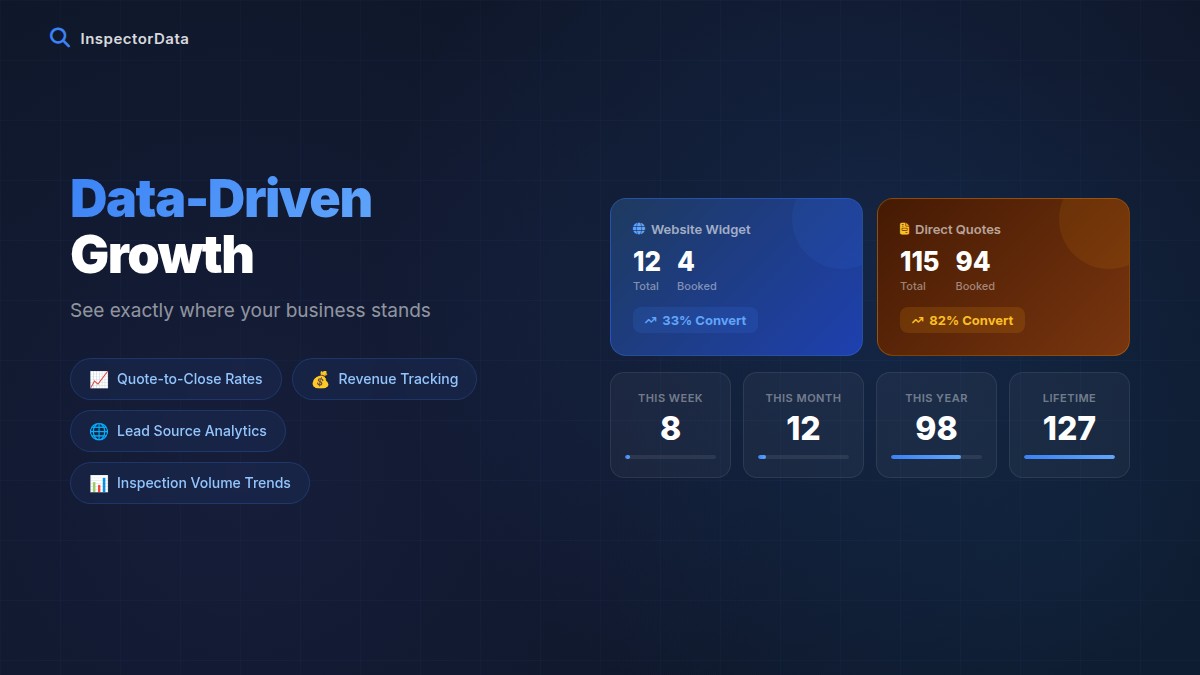
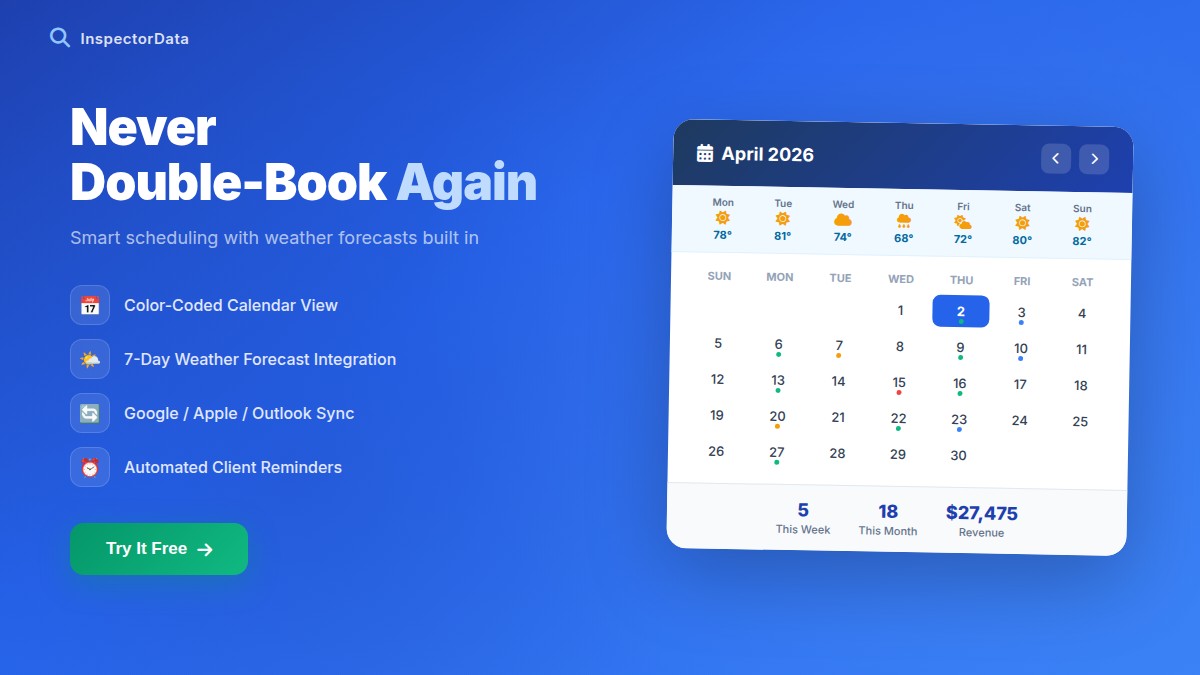
InspectorData's professional systems — automated scheduling, branded reports, client communication, and business analytics — are exactly the kind of documented, transferable infrastructure that increases business valuation. Buyers pay more for businesses with real systems.
Try InspectorData Free for 30 DaysSet up in 10 minutes.