

Building an inspection business that generates income beyond your own capacity requires systems that work without you. The franchise and licensing model is how some of the most successful inspectors have expanded their brand across cities and states — generating royalty income and ongoing revenue without doing a single additional inspection themselves.
Franchise vs. License: Key Differences
Before pursuing either path, understand what you're actually creating. These are legally and operationally distinct models:
| Factor | Franchise | License |
|---|---|---|
| Legal structure | Highly regulated — FTC governs in the US | Simple contract between parties |
| FDD (Franchise Disclosure Document) | Required — significant legal cost | Not required |
| Ongoing royalties | Typically 5–12% of gross revenue | Fixed monthly fee or per-use |
| Brand control | High — franchisee must follow your system | Lower — more flexibility for licensee |
| Initial investment | $50,000–500,000+ to set up properly | $5,000–50,000 |
| Scale potential | Unlimited with proper support infrastructure | Moderate — harder to enforce standards |
Most solo inspection business owners who want to scale beyond their local market should start with a licensing or operational model first — not a full franchise. Full franchising requires substantial legal and operational investment that only makes sense at certain revenue levels.
When Is Your Business Ready to Franchise?
Franchising a broken or inconsistent business just replicates the problems at scale. Before pursuing any expansion model, your home operation must meet these benchmarks:
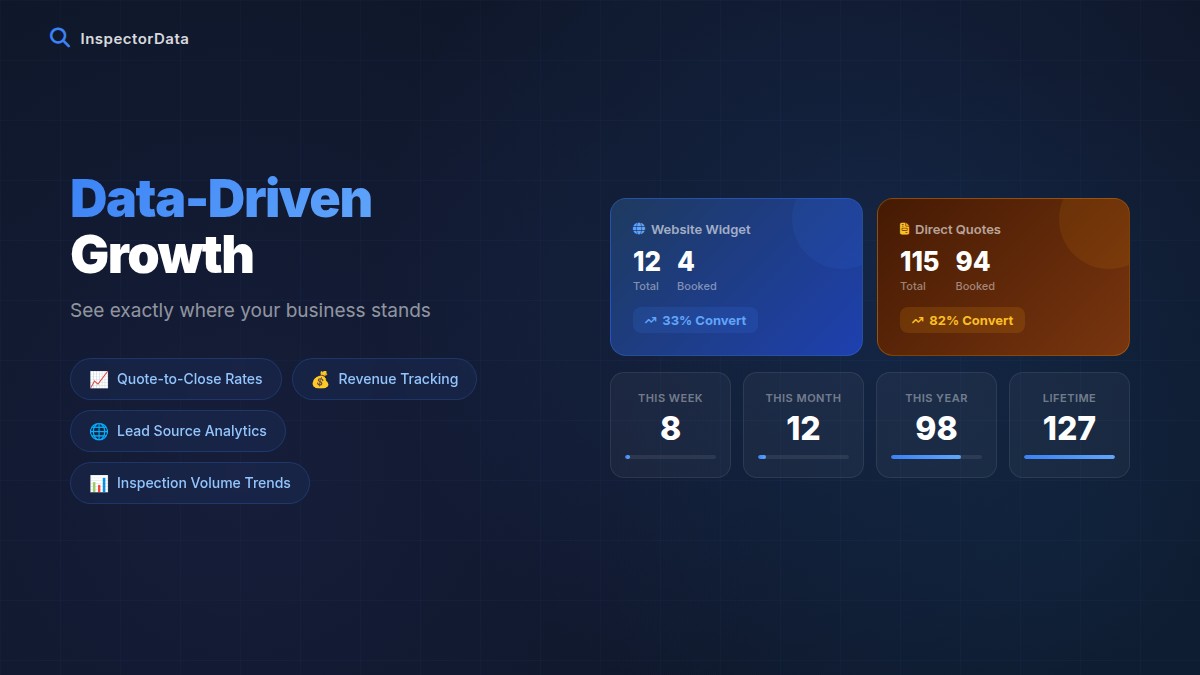
- Documented, repeatable systems: Everything you do must be written in operations manuals that someone else can follow
- Proven profitability: Your business should be generating 25%+ net profit margins consistently
- Strong brand recognition: At minimum, dominant in your local market with measurable reputation metrics
- Revenue level: Most franchise consultants recommend $1M+ in revenue before franchising makes economic sense
- Training infrastructure: You must be able to train someone else to replicate your service quality
- Technology platform: Software, booking systems, and reporting tools that can be handed to a franchisee
Building the Systems That Make Franchising Possible
A franchisable inspection business runs on documented systems that produce consistent results regardless of who's doing the work. Here's what must be documented before you can hand it to someone else:
Operations Manual
Your operations manual is the bible of how you do business. It should cover:
- Inspection methodology and standards (your specific approach, not just ASHI/InterNACHI)
- Client communication scripts and templates
- Report writing standards and formatting requirements
- Equipment requirements and maintenance
- Scheduling and booking procedures
- Quality control and callback handling
- Marketing and lead generation systems
- Financial management and reporting requirements
Training Program
How do you turn someone with inspection certification into someone who delivers your brand's quality? Your training program must cover technical skills, customer service standards, report writing, and business operations. Plan for 2–4 weeks of initial training and ongoing support in year one.
Technology Stack
Franchisees need the same technology platform you use — or one you've built specifically for your franchise. A unified CRM, reporting software, booking system, and financial tracking tool ensures brand consistency and gives you visibility into franchisee performance.
The Economics of Franchising an Inspection Company
| Revenue Stream | Typical Range | When Received |
|---|---|---|
| Initial franchise fee | $25,000–75,000 | On signing |
| Ongoing royalties | 5–10% of gross revenue | Monthly |
| Technology/software fee | $100–500/month | Monthly |
| Marketing fund contribution | 1–3% of gross revenue | Monthly |
| Training fees (additional) | $2,000–10,000 | Per training event |
Example franchise revenue: If you have 10 franchisees each generating $400,000/year, with a 7% royalty, that's $280,000/year in royalty income alone — before initial franchise fees or technology revenue. At 20 franchisees, that becomes $560,000/year in largely passive royalty income.
What you provide in return: Marketing support, operational guidance, technology platform, brand use rights, lead generation support, ongoing training, and quality control. Franchising is not passive — it requires building a support organization. But the leverage is extraordinary compared to growing a single location.
Legal Requirements for Franchising
In the United States, franchising is regulated by the Federal Trade Commission. Before selling your first franchise, you must:
- Register your trademarks: File with the USPTO to protect your brand name and logo
- Create a Franchise Disclosure Document (FDD): A 200–300 page legal document disclosing all material facts about your franchise. Must be prepared by a franchise attorney. Cost: $15,000–50,000.
- Register in registration states: About 15 states require franchise registration before you can sell franchises there. California, New York, Illinois are the major ones.
- Draft a franchise agreement: The legal contract with each franchisee. Must be state-specific and reviewed annually.
- Establish audit rights and quality control mechanisms: You need legal mechanisms to enforce your standards.
Budget $30,000–80,000 in legal fees to set up a franchise properly. This is non-negotiable — franchising without proper legal structure exposes you to significant liability.
Finding and Vetting Franchisees
Your franchisee is either your biggest asset or your biggest liability. Vet carefully.
Ideal Franchisee Profile
- Existing inspector with 3+ years experience who wants to run a business, not just do inspections
- Someone in your local market who trained under you (lowest training risk)
- Business-minded buyer who understands their role is operations and marketing, not just field work
- Financial capacity to survive the ramp-up period (typically 12–18 months to profitability)
- Strong local market knowledge and network
Where to Find Franchisee Candidates
- Your own inspector employees looking to own their market
- InterNACHI and ASHI member networks
- Franchise broker networks (they earn a commission but provide vetted candidates)
- Franchise portals like FranchiseGator, Entrepreneur's franchise listings
- Your local market reputation and word-of-mouth
Alternative Scaling Models (If Not Ready to Franchise)
Franchising is the most complex model. Here are lower-barrier alternatives that give you many of the same benefits:
| Model | Complexity | Revenue Potential | Best For |
|---|---|---|---|
| Multi-inspector company | Low–medium | $500K–2M | Dominate your local market |
| Licensing your brand | Medium | $50K–300K/year | Scale regionally without FDD |
| Training/certification business | Medium | $100K–500K/year | Monetize your expertise |
| Full franchise model | Very high | $500K–5M+/year | National brand building |
| Private equity partnership | High | Significant capital event | Exit-oriented growth |
For most inspectors, the highest-value path before franchising is building a multi-inspector company that dominates their local market (see our guide on scaling from solo to multi-inspector) and then exploring licensing or franchise expansion from a position of proven, documented success.
The franchise dream is real — it's how national inspection brands were built. But it requires building a business worth franchising first. Focus there, and the expansion options will follow naturally.
Build the Foundation for an Expandable Business
InspectorData gives you the professional systems, client management, and operational structure to build a business worth licensing or franchising. Start with your free trial today.
Try InspectorData Free for 30 Days