
The right tool stack separates the inspector who finishes reports by 7pm from the one who's up until midnight. Beyond efficiency, the right tools improve thoroughness — thermal cameras find moisture and energy issues invisible to the naked eye; sewer cameras reveal problems that cost buyers tens of thousands. This guide covers every tool category, with specific recommendations and ROI analysis for each major investment.
Business Software Stack
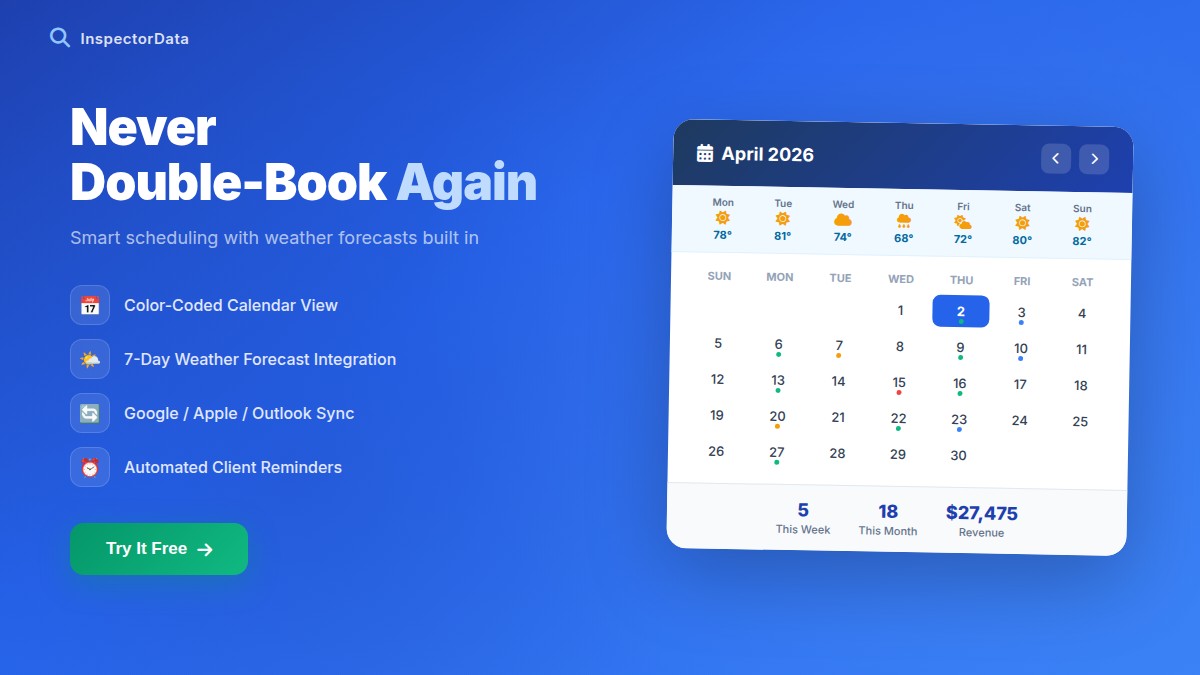
Before equipment, build your software stack. Business software creates leverage: it automates tasks, tracks revenue, manages clients, and reduces administrative overhead that would otherwise consume hours you should spend on inspections.
Core Business Software Categories
| Category | Purpose | Options | Monthly Cost |
|---|---|---|---|
| Business management | Booking, scheduling, client management, reports | InspectorData, ISN, Spectora | $50-$150 |
| Bookkeeping | Revenue tracking, expense management, tax prep | QuickBooks, Wave, FreshBooks | $0-$90 |
| CRM/email | Client follow-up, agent relationships, campaigns | HubSpot, Mailchimp, ActiveCampaign | $0-$75 |
| Scheduling | Online booking calendar, availability management | Built into inspection software | Included |
| Payment processing | Collect deposits and payments | Stripe, Square, PayPal | 3.35% + $0.40/transaction |
| Communication | Business phone, text, email | Google Voice, RingCentral, Dialpad | $10-$45 |
Total monthly software cost for a lean but effective stack: $120-$250/month. At 150 inspections per year, that's less than $20/inspection — easily offset by a single additional inspection per month that automation enables.
Inspection Report Software
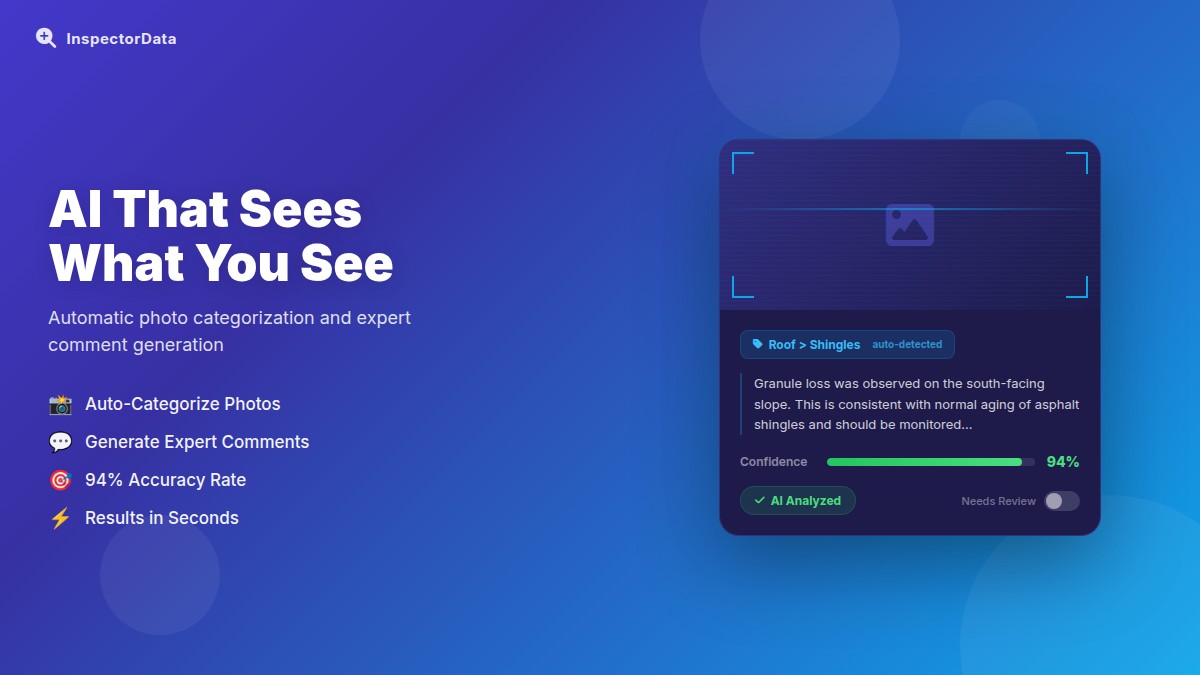
Your report is your product. Report software determines how quickly you write reports, how professional they look, and how easily clients and agents can read them.
What to Look For in Report Software
- Template library: Pre-written comment templates for common findings save 30-60 minutes per report
- Mobile-first: Fill in findings on-site using an inspection mobile app, not later — on-site reporting produces more accurate, detailed reports
- Photo integration: Photos attached directly to findings, not emailed separately or manually uploaded
- Customizable: Your branding, your terminology, your finding classifications
- Client-friendly output: Reports easy for non-technical clients to read, with clear priority indicators
- Fast delivery: Secure link delivery, notification when client opens the report
Core Inspection Tools
These are the non-negotiables — every inspector needs them regardless of budget or market:
Essential Inspection Equipment
| Tool | Purpose | Budget Option | Quality Option |
|---|---|---|---|
| Flashlight (2-3) | Attic, crawlspace, cabinet illumination | $20-$40 (Streamlight) | $80-$150 (Olight, Fenix) |
| Headlamp | Hands-free lighting in confined spaces | $25-$40 | $60-$100 (Petzl, Black Diamond) |
| Electrical tester | Outlet polarity, GFCI testing, voltage presence | $15-$30 (simple 3-prong) | $60-$200 (GFCI tester + circuit analyzer) |
| Moisture meter | Detect moisture in walls, floors, ceilings | $30-$60 | $150-$350 (Tramex, Protimeter) |
| Probe thermometer | HVAC supply/return temperature differentials | $20-$40 | $80-$150 (non-contact + probe combo) |
| Gas leak detector | Detect natural gas and propane leaks | $30-$60 | $100-$200 (Fieldpiece, UEi) |
| Carbon monoxide detector | CO testing near appliances | $40-$80 | $150-$250 (professional sensor) |
| Ladder (extension) | Roof access, attic access, tall ceilings | $150-$250 | $350-$600 (fiberglass, rated) |
| Binoculars or monocular | Roof inspection without climbing | $30-$60 | $100-$200 (high magnification) |
| Telescoping mirror/magnet | Under appliances, tight spaces | $10-$25 | $40-$80 (magnetic tip) |
Thermal Imaging Cameras
Thermal imaging is the single highest-ROI equipment investment for experienced inspectors. IR cameras reveal moisture intrusion, insulation defects, electrical overloads, and HVAC issues that are completely invisible to the naked eye.
Business Case for Thermal Imaging
A thermal camera add-on service priced at $75-$150 per inspection: if you add thermal to 60% of inspections at $100 each, and you do 150 inspections per year, that's $9,000 in additional revenue annually. A quality entry-level thermal camera costs $600-$2,000 — paying for itself in 1-3 months.
Thermal Camera Options for Inspectors
| Option | Price Range | Resolution | Best For |
|---|---|---|---|
| FLIR One Pro (phone attachment) | $400-$600 | 160×120 | Budget entry, basic moisture detection |
| Seek Thermal CompactPRO | $500-$700 | 320×240 | Good entry, higher resolution |
| FLIR E5-XT / E6-XT | $1,200-$2,000 | 160×120 / 240×180 | Professional quality, standalone unit |
| FLIR E8-XT | $2,800-$4,000 | 320×240 | High-end professional, luxury homes |
| Seek ShotPRO | $500-$700 | 320×240 | Good value standalone |
Minimum recommended resolution for professional inspection use: 160×120 pixels. The FLIR One Pro is acceptable for getting started; the FLIR E5-XT or E6-XT is the sweet spot for professional use. InterNACHI's Level 1 infrared certification is recommended before marketing thermal services.
Specialty Test Equipment
Radon Testing Equipment
Radon testing equipment opens one of the most profitable add-on service categories. Options:
- Short-term charcoal canisters: Send to lab, $15-$25 cost, charge $150-$200. Low investment, high margin.
- Continuous electronic monitors: $150-$350 purchase, reusable. Charges same rate with faster results.
- Professional monitors (Sun Nuclear, Femto-Tech): $800-$2,000, lab-certified, required for NRPP certification.
Sewer Scope Camera
Sewer cameras are one of the best equipment investments for revenue generation. A sewer scope service typically prices at $150-$300 per inspection. Equipment cost: $2,000-$8,000 for a quality push camera system.
- RIDGID SeeSnake Compact series: $2,500-$4,000. Workhorse for residential sewer lines.
- General Pipe Cleaners mini-cam: $1,500-$3,000. Lighter, good for solo operation.
- CUES Mini-CCTV: $4,000-$8,000. Professional-grade, NASSCO certification compatible.
Water Quality Testing
Basic water test kits for pH, hardness, and common contaminants: $10-$30 per test at cost, charge $75-$150. For certified lab testing (lead, bacteria, nitrates): send samples to certified lab, charge accordingly.
Photo & Video Equipment
Photography quality directly affects client confidence in your reports. Blurry, dark, or poorly composed photos undermine even excellent written findings.
Camera Recommendations
- Smartphone with quality camera: iPhone 14+ or Samsung S23+ produce excellent inspection photos. Free if you already own one.
- 360° camera (Ricoh Theta or Insta360): $300-$600. Captures every surface of a room in one shot. Excellent for documenting crawlspaces and attics — one shot shows everything with no repositioning.
- Drone (Part 107 certified): For inspectors who obtain FAA Part 107 certification, roof drone inspections offer premium add-on revenue. DJI Mini 4 Pro: $760. Roof inspection add-on: $75-$150.
Safety Equipment
Safety isn't optional. These items protect you physically and legally:
- Knee pads: Crawlspaces punish unprotected knees. $30-$80 for quality pair.
- Respirator (N95 minimum): Mold, asbestos, rodent droppings in attics and crawlspaces. $25-$50 for reusable mask + filters.
- Tyvek coveralls: Protect clothing in dirty crawlspaces. $10-$20 per pack of disposables.
- Chemical-resistant gloves: Crawlspaces and attics with unknown substances. $10-$20.
- Safety glasses: Eye protection when using tools. $10-$25.
- First aid kit: Compact kit for your vehicle. $25-$50.
- Lockout kit: For inspecting electrical panels safely.
Equipment Budget by Career Stage
Inspector Equipment Budget by Stage
| Stage | Priority Investments | Budget Range |
|---|---|---|
| Just starting (Year 1) | Core tools + safety + basic report software + radon canisters | $2,000-$4,000 |
| Growing (Year 2-3) | Add thermal camera + continuous radon monitor + quality moisture meter | $2,000-$4,000 more |
| Established (Year 3-4) | Sewer camera + 360° camera + upgraded electrical testing | $3,000-$8,000 more |
| Scaling (Year 4+) | Duplicate core kit for additional inspector + drone | $5,000-$15,000 more |
Equipment investment is one of the best returns in an inspection business. Every $1,000 in quality equipment typically enables $3,000-$10,000 in additional annual revenue through improved service quality, new add-on services, or faster throughput. Buy quality where it matters (thermal camera, moisture meter, electrical testing) and be practical where quality differences are minimal (basic hand tools).
The Software That Ties Your Tools Together
InspectorData integrates your scheduling, client management, report delivery, and revenue tracking in one platform designed specifically for home inspectors. Start your free trial and see the difference the right software makes.
Start Your Free 30-Day TrialFull access for 30 days.