
The average home inspection fee hasn't kept pace with inflation. But the average revenue per inspection can grow dramatically — through ancillary services that buyers genuinely want and need. An inspector doing 150 inspections per year at $400 generates $60,000. The same inspector with a full ancillary service menu and 45% add-on attachment rate generates $90,000+. That $30,000 difference doesn't require one additional client — just more services per client.
The Revenue Math of Ancillary Services
Ancillary services increase revenue per inspection without proportional increases in marketing cost. You already have the client, the relationship, and the appointment. Adding ancillary services captures incremental revenue from that existing relationship.
Revenue Impact of Ancillary Services
| Service | Fee Range | Attach Rate (Realistic) | Annual Revenue at 150 Inspections |
|---|---|---|---|
| Radon testing | $150-$200 | 35% | $7,875-$10,500 |
| Sewer scope | $175-$300 | 25% | $6,562-$11,250 |
| Mold testing | $200-$400 | 10% | $3,000-$6,000 |
| Thermal imaging | $75-$150 | 40% | $4,500-$9,000 |
| Pool/spa inspection | $150-$250 | 15% (of applicable homes) | $1,500-$3,750 (if 40% of homes have pools) |
| Water quality test | $75-$150 | 15% | $1,687-$3,375 |
| Total add-on potential | $25,124-$43,875/year |
Even capturing half of this add-on potential adds $12,000-$22,000 per year in revenue from the same client base. Every ancillary service is a revenue multiplier on your core inspection work.
Radon Testing
Radon testing is the easiest ancillary service to add. Every home in the country has some radon level, and the EPA recommends testing all homes. In high-risk regions (Midwest, Mid-Atlantic, mountain states), most buyers should test.
How to Add Radon Testing
- Get certified: National Radon Proficiency Program (NRPP) certification establishes your credibility and may be required by state law. Typically requires a course, exam, and ongoing CE.
- Choose your method: Charcoal canisters (cheapest, slowest) or continuous electronic monitors (higher cost, faster results, better positioning).
- Price it right: $150-$200 for standard testing. In high-radon areas, don't price too low — low prices signal low quality and you'll get low attachment rates.
- Present it at booking: "I'll test while I'm there — it only takes a few minutes to set up and the results come back before closing. Would you like to add that?"
State Radon Risk by Region
EPA Zone 1 (highest radon potential) includes most of Iowa, North Dakota, South Dakota, Minnesota, Pennsylvania, Ohio, and parts of many other states. If you're in a Zone 1 market, radon testing should attach to 50%+ of your inspections. Know your market's radon risk and adjust your pitch accordingly.
Sewer Scope Inspections
Sewer scope inspections are the highest-dollar ancillary service for most inspectors. A camera inserted into the sewer lateral from the cleanout reveals root intrusion, pipe offsets, cracks, and deterioration that can cost $5,000-$50,000 to repair.
When to Recommend Sewer Scopes
Recommend sewer scopes for:
- Homes over 30-35 years old (clay or cast iron pipes more likely)
- Homes with mature trees near the sewer line
- Homes with slow drains or prior sewer history
- Homes in established neighborhoods with older infrastructure
A simple script: "This home is 45 years old and has mature oak trees in the backyard right along where the sewer line likely runs. Tree roots are the number one cause of sewer line damage in older homes, and repairs can run $8,000-$25,000. A $200 sewer scope today could save you that. Would you like to add it?"
Mold and Air Quality Testing
Mold testing is a higher-margin service with lower attachment rates than radon or sewer — but it's high-value when appropriate and commands premium pricing.
Types of Mold Services
- Air quality sampling: Air samples sent to lab for spore count and species identification. $150-$300 including lab fees, charge $200-$400.
- Swab/tape sampling: Surface sampling of visible mold growth for species identification. $75-$150/sample, charge $150-$250.
- Moisture mapping: Using thermal camera and moisture meter to identify moisture sources. Add-on to mold testing or standalone.
Mold certifications (MICRO, CMR through IAC2) add credibility and in some markets are required for mold testing services. Check your state's regulations — some states restrict who can perform mold testing or remediation assessment.
Thermal Imaging
Adding thermal imaging as an explicit add-on (vs. using it on every inspection) creates a separate revenue line item while improving your thoroughness for clients who opt in.
What Thermal Imaging Finds
- Moisture intrusion: Active leaks and water damage behind walls and ceilings, invisible to naked eye
- Insulation defects: Missing, damaged, or improperly installed insulation
- Electrical issues: Overheating connections, overloaded circuits, failing equipment
- HVAC efficiency: Duct leaks, inefficient distribution, system performance issues
Pricing Thermal Imaging
Two approaches: bundle it into a premium inspection tier (e.g., "Complete Inspection $550 includes thermal imaging") or offer it as a separate add-on ($75-$150). The bundle approach typically achieves higher attachment; the add-on approach creates a clearer value demonstration.
Pool and Spa Inspections
Pool inspections are specialized, high-margin, and relatively low-competition. In markets where 20-30% of homes have pools, this is a significant revenue opportunity.
Pool Inspection Components
- Pool shell condition (cracks, plaster, structural)
- Pump and filtration system operation
- Electrical safety (GFCI protection, bonding)
- Heater operation (gas or heat pump)
- Safety features (fencing, gates, alarms, drain covers)
- Automated systems and controls
Pool inspection certifications from the Pool and Spa Inspection Association (PPSA) or through InterNACHI's pool inspection courses add credibility. Charge $150-$250 as an add-on; full pool inspection without general inspection: $200-$350.
Other High-Value Ancillary Services
Additional Ancillary Service Options
| Service | Fee Range | Certification Required | Best Markets |
|---|---|---|---|
| Lead paint testing | $100-$250 | EPA RRP certification | Markets with pre-1978 homes |
| Water quality testing | $75-$200 | No (lab partnership) | Well water, rural markets |
| Asbestos testing | $150-$350 | State specific | Older homes (pre-1980) |
| 4-point inspection | $100-$175 | No | Insurance markets, Florida especially |
| Wind mitigation report | $100-$175 | State specific (FL) | Coastal markets |
| Pre-listing inspection | Same as buyer inspection | No | All markets — seller-paid |
| 11-month warranty inspection | $250-$400 | No | New construction markets |
| Consultation (post-report) | $75-$150/hr | No | All markets |
Rolling Out New Services
Adding services successfully requires a deliberate rollout — not just buying equipment and hoping clients ask about it.
5-Step Service Rollout
- Get trained and certified first: Never market a service you're not qualified to perform. Certification protects you legally and builds confidence in your offering.
- Add it to your website and booking system: Before you start pitching, it needs to be bookable and visible on your website with clear description and pricing.
- Train your scripts: Practice explaining the service and its value clearly and confidently. Clients accept recommendations from experts who sound certain, not uncertain.
- Announce to your network: Email past clients and agent contacts: "We've just added [service]. Here's why it matters for the homes we inspect." This creates immediate referral awareness.
- Track attachment rates: Monthly, review: how many times did you offer the service, and how many accepted? If acceptance is below 20%, your pitch needs work. If above 40%, scale the offering.
Start with one ancillary service. Master it. Add the next. Within 2-3 years, a complete ancillary service menu can add 30-50% to your revenue without adding a single new client. That's the compounding power of diversification.
Track Your Add-On Revenue and Grow It
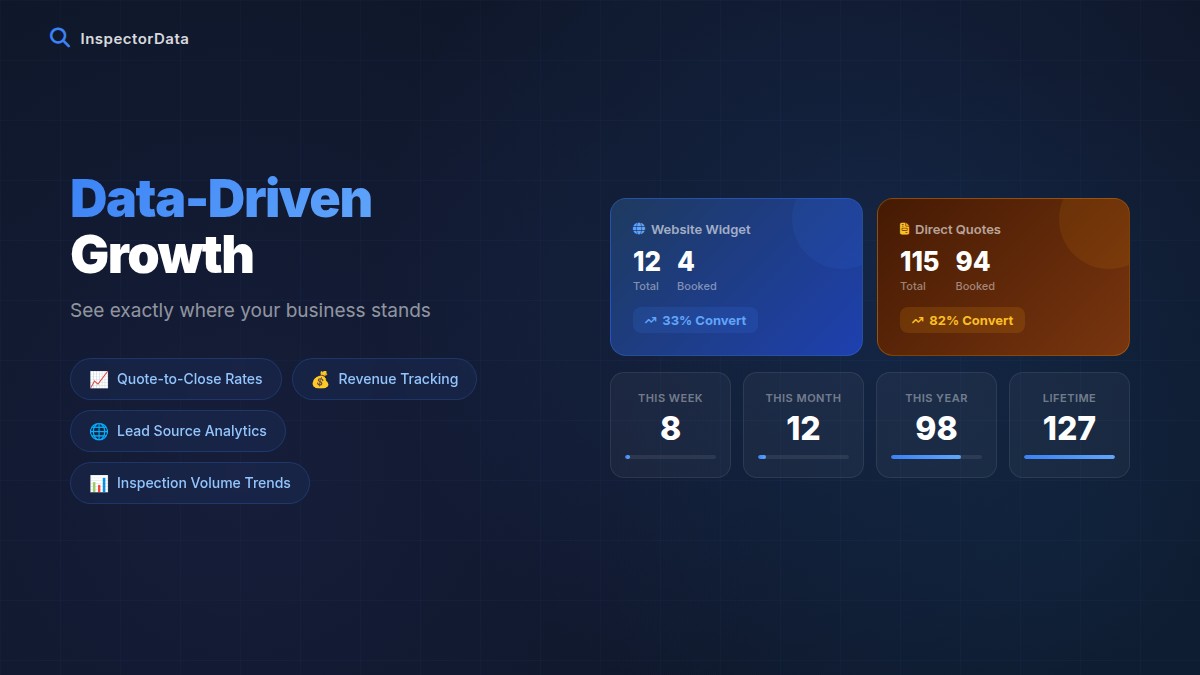
InspectorData tracks revenue by service type, shows you add-on attachment rates, and helps you identify which ancillary services are most profitable for your business.
Start Your Free 30-Day TrialFull access for 30 days.