
The biggest content challenge for home inspectors isn't execution — it's knowing what to create. Most inspectors post generic updates or stop posting altogether because they can't think of anything. This guide gives you a full year of content ideas, organized by type and audience. Save this page. Bookmark it. Use it every week when you sit down to create content for your inspection business.
Finding Reveals (10 Ideas)
Finding reveals — showing a specific defect with context about what it means and what it costs — are consistently the highest-performing content type for inspectors. Use anonymized photos (remove or blur identifiable information) and explain clearly.
- The Double-Tapped Breaker: Photo of a double-tapped breaker panel. "What this is, why it's a code violation, and what it costs to fix."
- Knob-and-Tube Wiring: Photo in attic. "Found in a 1930s home today. What buyers need to know about insurance and costs."
- Negative Grading: Photo showing ground sloping toward foundation. "The $3,000-$30,000 problem hiding in plain sight."
- Improper Bathroom Vent: "Your bathroom fan isn't venting outside — it's pumping humidity into the attic. Here's what that does over time."
- Poly-B Plumbing: If in your market, photo of grey plastic pipes. "This type of plumbing fails without warning. Here's how to tell if a house has it."
- GFCI Missing in Kitchen/Bathroom: Outlet without GFCI protection near water. "An easy $15 fix that prevents electrocution. Still missing in millions of older homes."
- Efflorescence on Foundation: White mineral deposits. "This white powder on the basement wall isn't just ugly — here's what it tells you."
- Missing Drip Edge: Roof photo. "A $300 fix your seller skipped. Here's why it matters for your home."
- Improperly Installed Insulation: Vapor barrier on wrong side. "Installed backward. This is trapping moisture that will eventually cause mold."
- Flue Liner Damage: Camera view of damaged chimney flue. "We used a camera to inspect the inside of this chimney. What we found could have been deadly."
Buyer Education (10 Ideas)
Buyer education content positions you as the trusted expert buyers seek before they need an inspector. These perform well on Facebook, Instagram carousels, and YouTube.
- What to Expect at Your Inspection: Step-by-step walkthrough of the inspection day. Reduces anxiety; first-timers love this.
- How to Read Your Inspection Report: "Red flag" vs. "maintenance item" — many buyers don't know the difference.
- 10 Questions to Ask Your Inspector: Empowers buyers; positions you as the inspector who welcomes questions.
- Should You Attend Your Inspection? "Yes — and here's how to get the most out of it." A strong opinion that drives engagement.
- What Inspectors Can't Inspect: Set expectations around limitations — underground pipes, behind walls, hidden systems.
- How Age Affects Home Inspection Findings: Different issues by decade (1950s, 1970s, 1990s, 2000s homes).
- The 5 Most Expensive Problems Found in Home Inspections: Foundation, roof, electrical, HVAC, water damage. Cost ranges for each.
- New Construction Myth: "New homes don't have inspection issues." Myth. Here's what we found in new builds this month.
- DIY vs. Inspector: What homebuyers try to DIY-inspect before an offer — and what they miss.
- How Inspectors Protect Buyers: Case study format. "This buyer almost lost $40,000. Here's what we found."
Myth Busting (8 Ideas)
Myth-busting content gets strong engagement because it's surprising and slightly controversial. People comment, share, and tag others who believe the myth.
- "If it's permitted, it's safe": Permits don't guarantee quality or code compliance. What you actually need to verify.
- "Home warranty covers everything": What home warranties actually cover (and what they conveniently don't).
- "The inspector said it was fine": What "passed inspection" actually means vs. what buyers think it means.
- "My agent's inspector is the best": Why the inspector your agent recommends may not be the one you want.
- "I can skip the inspection in a hot market": What buyers who waived inspections in 2021 are dealing with now.
- "Mold = must buy elsewhere": When mold is a dealbreaker vs. when it's just a remediation project.
- "Sewer scopes are optional": What $250 preventively vs. $10,000+ reactively looks like.
- "The city inspection cleared it": What city/county inspectors check vs. what a professional home inspection covers.
Seasonal & Timely (8 Ideas)
Seasonal content feels relevant and gets higher engagement because it's timed to what people are already thinking about:
- Spring: "5 things every homeowner should check after winter." Targets current homeowners who become future sellers/referral sources.
- Spring: "Spring inspection season is here. How to book before the calendar fills up." Direct conversion content.
- Summer: "Is your AC ready for the heat?" HVAC content relevant to summer buyers and current homeowners.
- Summer: "Attic heat in summer: why it matters for your home's energy cost and roof life."
- Fall: "Your fall home maintenance checklist: 10 things to do before winter." Shareable, saves-worthy content.
- Fall: "What we find in furnaces when we turn them on for the first time in October."
- Winter: "Pipe protection checklist: what to do before temps drop below 20°F."
- Year-Round: Local market content — "I inspected 47 homes in [City] this quarter. Here's what I found most often."
Behind the Scenes (8 Ideas)
Behind-the-scenes content builds trust and makes you human. People hire people they like and trust — this content builds both:

- Your inspection kit: Lay out all your tools. "Here's what I bring to every inspection."
- Day in the life: Short video following your full inspection day — drive, inspection, client walkthrough, report.
- Attic crawl: Short video of crawling through a cramped attic. "This is why we do it."
- Your inspection checklist: Simplified visual of what systems you check. Builds confidence in thoroughness.
- Proudest find this month: Share the finding you're most proud of catching — the one that saved your client significantly.
- Training day: If you're training a new inspector, document the process. Shows professionalism and systems.
- Your first inspection: Personal story about your first home inspection — relatable, humanizing.
- Why I became an inspector: Your origin story. People connect with "why," not just "what."
Agent-Targeted Content (8 Ideas)
Content that directly helps agents performs well on LinkedIn and in email to your agent network. Share this type of content directly with agents, not just on public platforms:
- What to tell buyers before the inspection: Prep article agents can forward. "Here's how I prep my clients."
- How to use the inspection report in negotiations: Practical guide for agents on using findings strategically.
- Common issues in [Local Neighborhood]: "In homes built in [Year Range] in [Area], here's what I almost always find."
- Your inspection turnaround guarantee: "Reports delivered within X hours, every time. Here's why that matters for your transactions."
- What happens when a deal falls apart at inspection: Prevention-focused — how early conversation prevents blown deals.
- Market insight report: "Q1 inspection data: what I found in 45 inspections across [City] this quarter."
- Pre-listing inspection benefits: Why your sellers should get an inspection before listing. Forward-thinking agents love this.
- What agents should know about radon: Education for agents on how to discuss radon with buyers — positions you as the expert.
How to Make It All Work
Having 52 ideas is only useful if you execute consistently. The system that makes consistency possible:
The Monday Content Batch
Every Monday morning, spend 30-45 minutes creating content for the week. Don't post daily in real-time — batch create and schedule. Tools like Buffer, Later, or Hootsuite allow you to schedule a week's posts in one sitting.
Content Repurposing
Each idea generates multiple pieces of content:
- One blog post (800-1,500 words)
- One Instagram carousel (3-5 slides)
- One short video (60-90 seconds)
- One email to your agent list (or client list)
- One LinkedIn post
That's five pieces of content from one idea — 52 ideas × 5 = 260 pieces of content per year. Distribute across platforms and you have a consistent, visible content presence without creating from scratch every day.
Track What Works
After 30 days, review which content types got the most engagement and generated the most bookings. Double down on what works. Let what doesn't work fade away. Your audience tells you what they want — listen to the data.
Manage Your Business While Your Content Works for You
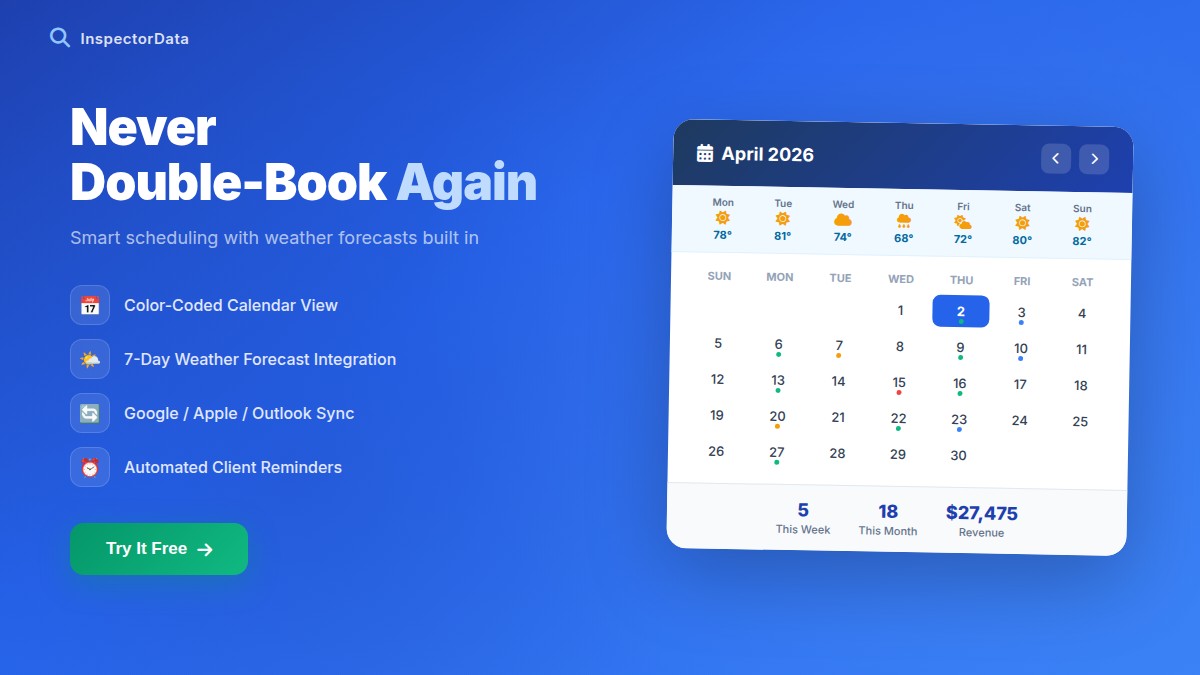
InspectorData handles your booking, scheduling, and client management so you have more time to create the content that grows your inspection business. Automate the admin; focus on marketing.
Start Your Free 30-Day TrialFull access for 30 days.